01 — At a Glance
The Housing Finance Company That’s Deliberately Shrinking Its Market
- 52-Week High / Low₹365 / ₹218
- Dec 2025 Revenue₹554 Cr
- Dec 2025 PAT₹236 Cr
- Q3 EPS (Dec 2025)₹4.72
- Annualised EPS (Q3×4)₹18.88
- Book Value₹93.0
- Price to Book2.41x
- Dividend Yield1.99%
- Debt / Equity1.57x
- Current Promoter Hold23.9%
Auditor’s Opening Note: Aptus finished Q3 FY26 with ₹554 crore quarterly revenue (+23% YoY), ₹236 crore PAT (+24% YoY), and annualised EPS of ₹18.88 (vs full-year EPS guidance territory around ₹15–17). But here’s the plot twist: they deliberately stopped lending to loans below ₹7 lakh, a segment that made up ~₹283 crore of disbursement “base” that simply vanished. The stock? Down 31.5% in six months. Sometimes growth + prudence = punishment.
02 — Introduction
The Housing Finance Company That Fired Its Worst Customers
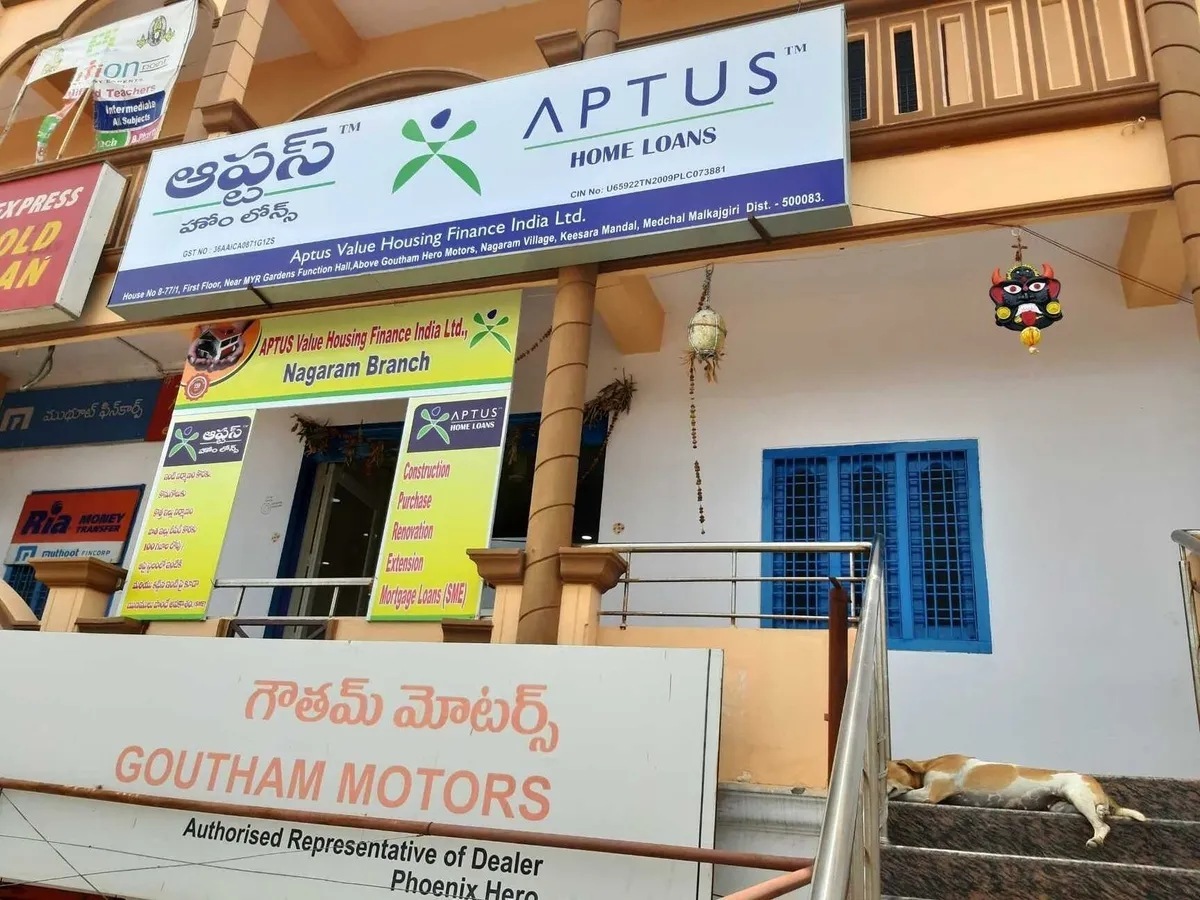
Aptus Value Housing Finance is what happens when a housing finance company decides that not all customers are worth the trouble. They serve self-employed, low and middle-income families in semi-urban and rural India — territory where collateral is a self-occupied property and customer verification requires actual detective work.
The business is straightforward: originate home loans, collect reliably through a network of 335 branches, maintain pristine asset quality through paranoid underwriting, and grow AUM at ~25% CAGR. For five years, they’ve done exactly that. Then in late 2025, management looked at loans below ₹7 lakh, calculated the headaches, and made the nuclear decision: they stopped lending to that segment entirely.
Why? Not because Aptus had bad asset quality in that bucket. No. Because the entire sub-₹7L micro-housing segment was showing stress across Indian MFIs and small finance banks. Management’s calculation: “We’d rather miss ₹280+ crore of annual disbursement in a problematic segment than risk blowing up our pristine asset quality metrics.”
That’s a bold strategic call. That’s also why the stock tanked 31.5% in six months, despite ₹554 crore quarterly revenue and 26% profit growth. Because investors hate it when companies admit to optionality scarcity and deliberately shrink TAM.
Concall Clarity (Feb 2026): Management stated: “Not because of asset quality within Aptus, but a proactive response to stress in the MFI and small LAP segment.” Translation: We’re clean, but the whole neighbourhood is smelly, so we’re moving house.
03 — Business Model: The Low-Income Housing Grind
Home Loans for People Banks Won’t Touch. And It Works.
Aptus makes one fundamental bet: self-employed individuals and low-income families need housing credit, banks find them too labour-intensive to service, and someone needs to fill that gap. That someone is Aptus. They don’t lend to builders. They don’t do commercial real estate. They do: home loans (54% of AUM as of Mar 2025), quasi-home loans (refinancing of construction/purchase; 21% of AUM), business loans secured by property (20%), and insurance-linked products (5%).
The customer profile tells the story: 77.8% self-employed (drivers, shopkeepers, artisans, small traders). 79% in the LIG (low income group) bracket. Average loan size: ~₹10–10.5 lakh, climbing modestly. Collateral: self-occupied residential property, with Aptus maintaining paranoid LTV discipline — 81% of the portfolio at LTV ≤50% as of Mar 2025.
The cost of serving this customer base is high. Collections require local knowledge. Underwriting demands site visits and character assessment. Compliance is manual-heavy. But the flip side: interest margins of 12.96% NIM (as of FY25) and an AUM that’s grown 28% CAGR over five years to ₹12,330 crore. All-in-house origination, underwriting, valuation, legal, and collections mean they own the entire value chain.
Self-Employed77.8%Portfolio Mix
LIG Customers79%Portfolio Mix
Branch Network335As of Q3 FY26
AUM CAGR (5yr)28%FY21–FY25
Geography Reality Check: Andhra Pradesh = 42% of AUM. Tamil Nadu = 33%. Telangana = 16%. Karnataka = 8%. Maharashtra & Odisha = 0.5% (new). This is a South India company masquerading as a pan-India play. Expansion to non-South states is real, but still nascent.
💬 Have you ever wondered why housing finance companies have such different risk appetites? Drop a thought on why Aptus chose self-employed over salaried!
04 — Financials Overview
Q3 FY26 (Dec 2025): The Numbers
Continue reading with a premium membership.