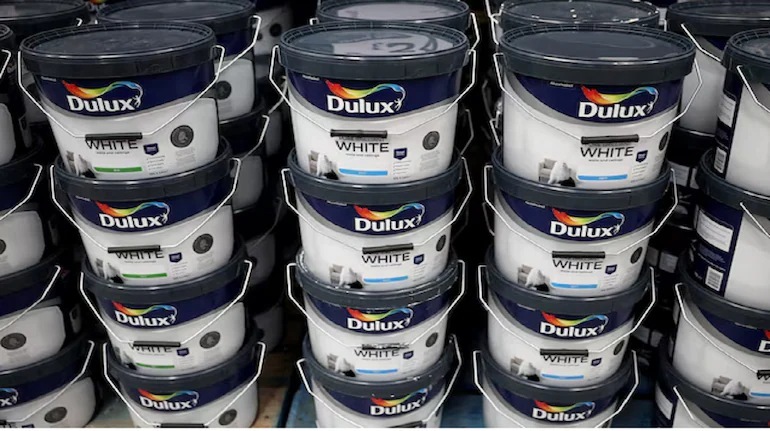
JSW Dulux:
35.2x P/E. Revenue Down 14%.
But Wait, There’s a Takeover.
Akzo Nobel just got bought. The name is changing. The CEO is new. The strategy is flipped. And somehow the stock is still trading at the second-highest P/E in the paint sector. Welcome to organized chaos.
The Paint Can That Exploded
- 52-Week High / Low₹3,916 / ₹2,649
- CMP (12 Mar 2026)₹2,917
- Q3 FY26 Revenue₹908 Cr (-13.6% QoQ)
- Q3 FY26 PAT₹74.6 Cr
- Q3 FY26 EPS₹16.27
- Book Value₹495
- Price to Book5.89x
- Dividend Yield3.43%
- Debt / Equity0.03x
- JSW Holding (Dec 2025)61.2%
The Paint Company That Didn’t Want to Be Paint Anymore
Akzo Nobel India was born in 1954 as the Indian arm of the Dutch global coating giant. For 70 years, it did what global coating MNCs do: sold decorative paints under the Dulux brand, provided industrial coatings, kept margins tight, and paid dividends that would put most Indian pharma companies to shame. P/E was always in the 25–30x range because global brand + scale + moat = premium pricing.
But then something funny happened. In Q3 FY25 (Sep 2025), something shifted. A large “Other Income” entry of ₹1,882 crore appeared in the profit statement. That’s not earnings. That’s capital gains. On 10 December 2025, JSW Paints announced it was acquiring 61.2% of Akzo Nobel India. Imperial Chemical Industries (the original promoter, 50.46% holding) exited. Akzo Nobel Coatings International B.V. (24.30% holding) exited. The company’s global parent companies are out. JSW, a paint company from southern India, is in.
Management’s concall in February 2026 revealed the strategy: forget MNC discipline. Go aggressive. Compete on price in the mid-market. Build volume. Beat Asian Paints and Berger Paints by sheer scale and distribution muscle. The company is being renamed JSW Dulux. Parth Jindal (JSW Group’s boss) is the new Chairman. Rajiv Rajgopal is Joint MD & CEO. The old guard is mostly gone.
Here’s the thing: the numbers look terrible on the surface (revenue down, profit down, exceptional items masking the true earnings), but the story is interesting. A 70-year-old global brand is being handed to an aggressive Indian promoter with deep pockets and no patience for slow growth. This is not an investment thesis. This is a restructuring we’re watching in real time. Let’s break it down, laugh at some of it, and see if the math works.
Dulux. That’s It. That’s the Brand.
Akzo Nobel’s (soon-to-be JSW Dulux’s) business is split three ways: (1) Decorative paints for home interiors and exteriors — sold via 153 distributors, 82% of whom have been with the company for over 10 years, and 6,000 town-level reach; (2) Industrial coatings — automotive OEM coatings, protective coatings for ships and oil rigs, powder coatings, specialty coatings for appliances; (3) Specialty products like waterproofing solutions (Aquatech), wood finishes (Solitaire), and protective coatings under the Interpon and Sikkens brands.
The Dulux brand is iconic in India. In the premium decorative paints segment, it’s the go-to for people who can afford ₹200+ per litre paint. The issue: Dulux’s pricing was structurally 5–9% higher than competitors, which “led to volume erosion,” per management. Asian Paints is ₹213,095 crore in market cap. Berger Paints is ₹49,325 crore. Akzo Nobel is ₹13,245 crore. The market leader has a 16x moat just from sheer distribution. Akzo’s 153 distributors? Asian Paints has 30,000+ dealers. Game over before it started — unless the new PE/promoter remixes the playbook entirely.
And that’s exactly what JSW is doing. Concall revealed: (1) price cuts coming — “5–9% structurally overpriced” is being corrected; (2) mid-market segment entry — historically absent, now seen as “huge opportunity”; (3) royalty savings being redeployed into growth — the Dulux IP was acquired in June 2025, so the decorative royalty to global parent (~₹60–65 crore annually) stops. That cash goes into distribution, media, and schemes. This is not gradual margin expansion. This is aggressive repositioning with a 3–4 year timeline to become #2 in Indian coatings. Wild? Maybe. Funded? Absolutely.
Q3 FY26: The Train Wreck & The Hope
Result type: Quarterly Results | Q3 FY26 Revenue: ₹908 Cr | Q3 FY26 EPS: ₹16.27 | Annualised EPS (Q3×4): ₹65.08
Source table
| Metric (₹ Cr) | Q3 FY26 Dec 2025 |
Q3 FY25 Dec 2024 |
Q2 FY26 Sep 2025 |
YoY % | QoQ % |
|---|---|---|---|---|---|
| Revenue | 908 | 974 | 1,050 | -6.8% | -13.5% |
| Operating Profit | 136 | 167 | 167 | -18.6% | -18.6% |
| OPM % | 15% | 17% | 16% | -200 bps | -100 bps |
| PAT (Before Exceptionals) | 74.6 | 94 | 103 | -20.6% | -27.6% |
| EPS (₹) | 16.27 | 20.9 | 22.6 | -22.2% | -28.0% |
What’s This Restructuring Actually Worth?
Method 1: P/E Based
Latest trailing EPS (FY25 full year): ₹94.11. Current P/E: 35.2x. Peer median P/E (ex-exceptional outliers): ~26–28x. For a company in restructuring with aggressive growth mantra, justified premium: 0.9x–1.1x peer median. Fair P/E band: 23x–31x.
Range: ₹2,165 – ₹2,917
Method 2: EV/EBITDA Based
FY25 EBITDA = ₹1,955 Cr (based on TTM PAT ₹1,955 Cr adjusted for interest, tax, D&A). Current EV = ₹13,042 Cr (market cap – net cash ~₹200 Cr). EV/EBITDA = 6.7x. Quality paint peers trade at 12–16x. Restructuring discount justified: 9x–13x fair range.
EBITDA range (9x–13x): ₹17,595 Cr – ₹25,415 Cr → Per share:
Range: ₹2,051 – ₹2,869
Method 3: DCF Based
Base FCF (normalized): ₹400–500 Cr annually (conservative given restructuring). Growth: 8–12% for next 3 years (back to normalization), then 6% terminal. WACC: 10% (low cost of capital due to JSW backing).
→ Terminal Value (6% growth / 4% cap rate): ~₹12,600 Cr
→ Total EV: ~₹14,700 Cr (near-zero net debt)
Range: ₹2,150 – ₹2,850
A Dutch Company. Bought by an Indian Billionaire. Plot Twist Incoming.
🔴 The JSW Acquisition: A 70-Year-Old Brand Gets a New Boss
On 10 December 2025, JSW Paints announced it had acquired 61.2% of Akzo Nobel India for an undisclosed amount (market cap is ₹13,245 crore, so rough valuation around ₹8,000+ crore of equity). Imperial Chemical Industries (ICI), the original British promoter holding 50.46%, sold its stake. Akzo Nobel Coatings International B.V. (24.30%) also exited. JSW, a southern Indian paint company with strong distribution in states like Karnataka, Tamil Nadu, and parts of Maharashtra, is now calling the shots. By postal ballot (Mar 2, 2026), shareholders approved the name change to “JSW Dulux” effective 11 Mar 2026. The ambition: “number two in 3–4 years.” Sounds wild until you realize JSW has ₹2,000+ crore capex firepower and zero patience for “global brand discipline.”
⚠️ Management Musical Chairs
- • Parth Jindal (JSW Group Chairman) appointed Board Chairman
- • Rajiv Rajgopal re-designated Joint MD & CEO (9 Jan 2026)
- • Shantanu Khosla added as Independent Director
- • HR Director Neelima Kataria resigned (Feb 17, 2026)
- Translation: complete ownership change = complete management change.
✅ Strategic Overhauls Already Underway
- • Dulux brand IP acquired by listed entity (June 2025) — ₹60–65 Cr annual royalty saved
- • Price cuts announced: structurally overpriced 5–9%, being corrected
- • Mid-market segment entry: “huge opportunity,” rolling out this quarter
- • Royalty savings: ₹200–225 Cr free cash being redeployed to growth
- • Volume target: blended 6% growth across decorative + industrial confirmed
Is the Fort Still Standing?
Source table
| Item (₹ Cr) | Mar 2023 | Mar 2024 | Mar 2025 | Sep 2025 (Q2) |
|---|---|---|---|---|
| Total Assets | 2,739 | 2,903 | 2,902 | 3,640 |
| Net Worth (Equity + Reserves) | 1,316 | 1,330 | 1,329 | 2,254 |
| Borrowings | 70 | 60 | 62 | 71 |
| Other Liabilities | 1,354 | 1,513 | 1,511 | 1,315 |
| Total Liabilities | 2,739 | 2,903 | 2,902 | 3,640 |
Net worth exploded from ₹1,329 Cr (Mar 2025) to ₹2,254 Cr (Sep 2025) because JSW’s capital infusion and that ₹18,463 million exceptional income (capital gain from sale of assets/brands) hit the books. The balance sheet got a steroid injection.
Borrowings: ₹71 Cr. Interest coverage: 48.2x. Debt-to-equity: 0.03x. This company can borrow ₹5,000 crore tomorrow if it wanted to fund a distribution blitz. The lenders would sleep easy.
Other liabilities ₹1,315 Cr — mostly trade payables. Days payable: 151 days. Customer collection: 52 days. Classic distributor model with positive float — they collect fast, pay slow.
Sab Number Game Hai
Source table
| Cash Flow (₹ Cr) | Mar 2023 | Mar 2024 | Mar 2025 |
|---|---|---|---|
| Operating CF | +486 | +486 | +311 |
| Investing CF | -15 | -87 | +123 |
| Financing CF (Dividends) | -302 | -439 | -460 |
| Net Cash Flow | +170 | -41 | -26 |
High ROCE. High P/E. Falling Revenue. Make It Make Sense.
Revenue CAGR (10Y): 5% 💀
Source table
| Metric (₹ Cr) | Mar 2022 | Mar 2023 | Mar 2024 | Mar 2025 |
|---|---|---|---|---|
| Revenue | 3,149 | 3,802 | 3,962 | 4,091 |
| Operating Profit | 434 | 526 | 633 | 642 |
| OPM % | 14% | 14% | 16% | 16% |
| PAT | 290 | 335 | 427 | 429 |
| EPS (₹) | 63.68 | 73.58 | 93.70 | 94.11 |
The Story: Akzo Nobel was a textbook MNC cash cow. Revenue growing 5–9% annually, margins stable at 14–16%, EPS expanding 11–13% due to operational leverage and cost control. Classic “slow, profitable, boring, exiting.” Then Q3 FY25 happened. “Other Income” became ₹1,882 crore (asset sales and accounting adjustments). Q3 FY26 revenue tanked. The company is in between identities: too large to be a scrappy startup, too small to be Asian Paints, too new-managed to be MNC-predictable. That’s either a value trap or a once-in-a-decade asymmetric bet. Your call.
JSW Dulux vs The Paint Oligopoly
Source table
| Company | CMP (₹) | P/E | Market Cap (Cr) | ROCE % | ROE % | Recent Sales Qtr |
|---|---|---|---|---|---|---|
| JSW Dulux (Akzo) | 2,917 | 35.2x | 13,245 | 41.7% | 32.2% | 908 |
| Asian Paints | 2,221 | 52.2x | 2,13,095 | 25.7% | 20.6% | 8,867 |
| Berger Paints | 422.70 | 44.0x | 49,325 | 24.9% | 20.3% | 2,984 |
| Kansai Nerolac | 188.06 | 24.7x | 15,276 | 13.0% | 10.4% | 1,982 |
| Indigo Paints | 818.05 | 26.2x | 3,899 | 19.5% | 14.7% | 339 |
The Roast: Asian Paints has 16x the market cap. Berger Paints has 4x. Kansai Nerolac is the same size but trades at P/E 24.7x because it’s being murdered by the big two. JSW Dulux’s P/E 35.2x implies investors believe the new owner can either (a) triple revenue in 3–4 years, or (b) be acquired at a 40–50% premium. Anything in between = bag holders. The ROCE vs P/E disconnect is the tell: 41.7% ROCE but P/E 35.2x? The market is pricing in either significant ROCE compression OR significant growth. Probably both.
Imperial Exits. JSW Enters. Parth Jindal Is Now Holding Your Paint Brush.
Pre-Acquisition (Mar 2025)
- Promoters (ICI Ltd)74.76%
- FIIs3.68%
- DIIs8.49%
- Public13.08%
Post-Acquisition (Dec 2025)
- Promoters (JSW Paints)61.20%
- FIIs8.66%
- DIIs20.58%
- Public9.56%
Angels or Devils? Auditors, Boards, and Exceptional Items That Mask Everything
✅ The Clean Slate
- ✓ Clean audit history — no material qualifications
- ✓ Board meeting held Feb 2, 2026 — Q3/9M results approved
- ✓ Postal ballot (Mar 2, 2026) — name change approved by shareholders
- ✓ 48th AGM to be held soon — business as usual continuing
- ✓ New independent director added (Shantanu Khosla) — board refresh ongoing
- ✓ Zero promoter pledges — no financial distress signals
⚠️ Governance Red Flags
- ⚠ Exceptional items hide true earnings — ₹18,463 Mn capital gains in Q2 FY26
- ⚠ Draft GST assessment order (₹3.94 Cr dropped by Maharashtra, but Telangana/Karnataka still pending)
- ⚠ Complete management overhaul in 3 months — integration risks high
- ⚠ Royalty rate to Akzo Nobel (industrial): still continuing; decorative rate ceased post-IP acquisition
- ⚠ Dividend payout ratio 107% — unsustainable long-term; watch if JSW changes this
Governance Summary: The company is in a “friendly restructuring” mode. No red flags about fraud, board quality, or audit independence. The GST assessments are typical MNC pain points (different state interpretations). The real governance question is: will JSW honor minority shareholder rights during aggressive capex expansion, or will it prioritize group synergies? History suggests aggressive growth sometimes compromises minority protect — stay vigilant.
The Paint Sector: Where Everyone Is Terrible, But Some Are Less Terrible
India’s decorative paints market is ₹45,000+ crores, growing at 10–12% annually. Industrial paints add another ₹30,000+ crores. The category is dominated by two: Asian Paints (50%+ share) and Berger Paints (15%+). The remaining 35% is split among 50+ players. Margins are 14–18% at the top, 8–12% for mid-tier, and 2–5% for bottom-tier. The value pool is at the top. JSW Dulux’s strategy is explicitly mid-market: enter at lower prices (5–9% cheaper than Dulux), build volume, achieve scale, then expand upmarket. This is the classic Maruti playbook that created ₹3+ trillion in automotive wealth.
💄 The Pricing War: Can a Brand Survive Price Cuts?
Dulux was premium. Now it’s “premium-ish.” Management is taking “5–9% price cuts” to be competitive. The risk: brand equity erosion. People pay premium for Dulux because it’s “trusted, lasts long, premium color range.” Once you’re 5–9% cheaper than competitors, you’re no longer premium — you’re just “good value.” The real test: will the brand still attract premium customers while also winning in value segments? Historically, that requires two brands (Dulux for premium, something else for value). JSW hasn’t clarified if they’ll sub-brand or mono-brand. This matters. A lot.
🔴 The Distribution Nightmare: 153 Distributors vs 30,000 Competitors
Asian Paints has 30,000+ dealers. JSW Paints (standalone) had 5,000+ before the merger. JSW Dulux now has 153 Akzo distributors (82% >10 years tenure) + JSW’s own network. Management is “studying” a hybrid model (distributor + direct). That study period is 6–12 months. Meanwhile, Berger has 12,000 dealers. The gap is structural. To close it requires ₹500+ crore capex, 3–4 years, and flawless execution. JSW has the money but not the time — the market moves fast.
💎 The Brand Opportunity: Can You Own Two?
JSW Paints (standalone) has strong southern India presence. Dulux is pan-India but underpenetrated in south. Post-merger, the entity could be: (a) unified as “JSW Dulux” (CEO’s current stance); (b) dual-branded (JSW Paints for value/mid, Dulux for premium); (c) portfolio (JSW, Dulux, something else). The brand architecture study is “just about to commence.” This is the most important strategic decision and it’s still in “study” phase. Slow. For a company claiming “number two in 3–4 years,” that’s not the pace.
✅ The Industrial Opportunity: Specialization Pays
Industrial coatings (automotive OEM, protective, specialty) is more fragmented and less price-sensitive than decoratives. Akzo’s Interpon and Sikkens brands are respected in industrial. JSW is weaker in industrial. Merger creates adjacency play: sell Akzo’s tech to JSW’s industrial distribution, and vice versa. Management acknowledged this but hasn’t quantified upside. Likely 2–3 year play, not immediate.
Macro Tailwinds: Indian urbanization, affordable housing push (Government is building 10+ million homes by 2030), real estate recovery, industrial capex uptick (manufacturing PLI schemes). All decorative paint demand drivers. Macro Headwinds: already high category penetration in metros, new-entrant commoditization (Kansai, Valspar, others fighting on price), and the eternal EV threat (fewer moving parts = less need for paint finishes). Fair offsetting. The paint sector will be fine. The question is which player takes share.
The Final Coat
JSW Dulux is not a paint company anymore. It’s a restructuring bet. A 70-year-old MNC asset (Akzo Nobel India) just got handed to an aggressive Indian billionaire (Parth Jindal, JSW Group) with a mandate: “become number two in 3–4 years.” The company is taking price cuts, entering mid-market segments it historically avoided, redeploying royalty savings into growth capex, and managing a complete board/management overhaul simultaneously.
The Current State (Q3 FY26): Revenue is down 13.6% QoQ (₹1,050 Cr → ₹908 Cr). Operating profit is down 18.6% YoY. OPM compressed from 17% to 15%. But management has clarified: (a) this includes portfolio adjustments (powder coatings sold, export lines discontinued, ~₹25 cr/quarter drag); (b) like-to-like growth is ~2–6% depending on segment; (c) competitive intensity is elevated but “will ease in 2–3 quarters once our pricing resets stabilize.” The underlying business isn’t collapsing. The transition is messy.
The Strategic Bet: JSW’s playbook is volume growth + market share expansion. Management is explicit: “volume growth and revenue growth is the first mantra… Typically, it’s not the same in an MNC business.” Translation: they’re willing to accept margin compression in Years 1–2 (15% EBITDA instead of 17%+) to gain distribution footprint and customer base. By Year 3–4, they aim to leverage that scale into margin expansion and become the #2 player. This worked for Maruti in auto. It can work in paints. But execution is 95% of the game.
The Valuation Disconnect: Stock is trading at ₹2,917, valuing the company at ₹13,245 crore (P/E 35.2x). Our fair value range is ₹2,050–₹2,917. The upper bound prices in successful execution of the 3–4 year plan. Any slip — missed volume targets, margin compression beyond expectations, competitive intensity that doesn’t ease, brand dilution from aggressive pricing — and the stock could correct 15–25% to ₹2,200–₹2,450. The upside if they nail it? Limited from here. The downside if they flop? Substantial.
Past Performance: Over 5 years, Akzo Noble stock delivered 4.89% CAGR (₹1,850 → ₹2,917). Over 10 years, 9% CAGR. Classic boring compounder. Under JSW, the next 3–4 years are either a +50% re-rating (if they become #2) or a -30% correction (if execution slips). That’s a binary bet, not a boring compounder anymore.
✓ Strengths
- Dulux brand: iconic in India, trusted, premium perception (still)
- ROCE 41.7%: best-in-class capital efficiency, rare for paint sector
- Debt-free: can borrow ₹5000+ crore if needed, zero financial stress
- Royalty savings: ₹60–65 Cr annually now available for reinvestment
- Industrial capabilities: Interpon/Sikkens respected, can grow
- Promoter backing: JSW has deep pockets, proven execution in other sectors
✗ Weaknesses
- Distribution: 153 distributors vs Asian’s 30,000 — structural disadvantage
- Revenue decline: Q3 down 13.6% QoQ, headwinds real even if temporary
- Margin pressure: OPM down from 17% to 15% — pricing cuts taking toll
- Integration risk: brand architecture undefined, distribution model in “study”
- Brand dilution: 5–9% price cuts risk eroding Dulux’s premium perception
- Management churn: HR director resigned, multiple key departures post-takeover
→ Opportunities
- Mid-market entry: Dulux at “competitive” pricing can capture volume
- Industrial expansion: Akzo + JSW tech stack can win in B2B segments
- Geographic fill: JSW’s south + Akzo’s pan-India = better coverage
- Affordable housing surge: Government push creates decor paint demand
- Synergy value: if brand architecture optimized, could unlock 15–20% synergies
⚡ Threats
- Asian Paints adaptation: #1 can easily match pricing, flooding distribution
- EV impact: fewer moving parts = less automotive paint demand (long-term)
- Execution complexity: simultaneous brand, distribution, margin, and growth push
- Competitive intensity: Kansai, new entrants, price wars could persist 3+ quarters
- Margin trap: if cost base doesn’t decline fast enough, margins stay compressed 3+ years
- Shareholder dilution: aggressive capex may squeeze dividend, altering shareholder mix
JSW Dulux is a restructuring in progress, not a “buy the dip” stock.
The 70-year-old Dutch brand just got a 3–4 year Indian growth mandate. That’s either the smartest capital allocation or the most aggressive gamble. Revenue is down 13.6% QoQ. Margins are compressing. Management has just been swapped. But the strategic direction is clearer than it’s been in years: fight for volume, build distribution, sacrifice short-term margin for long-term share. If they nail it, the stock could re-rate 50%+. If they flop, it corrects 30%. That’s a binary outcome, not a boring compounder.
Current valuation (₹2,917) prices in success. Our fair value range of ₹2,050–₹2,917 reflects balanced upside/downside. For existing shareholders, stay for the outcome. For new buyers, wait for execution clarity in H1 FY27 (volumes stabilizing, margins finding support). This isn’t a stock for the patient. It’s a stock for the optimistic. And right now, the market is pricing in exactly that.