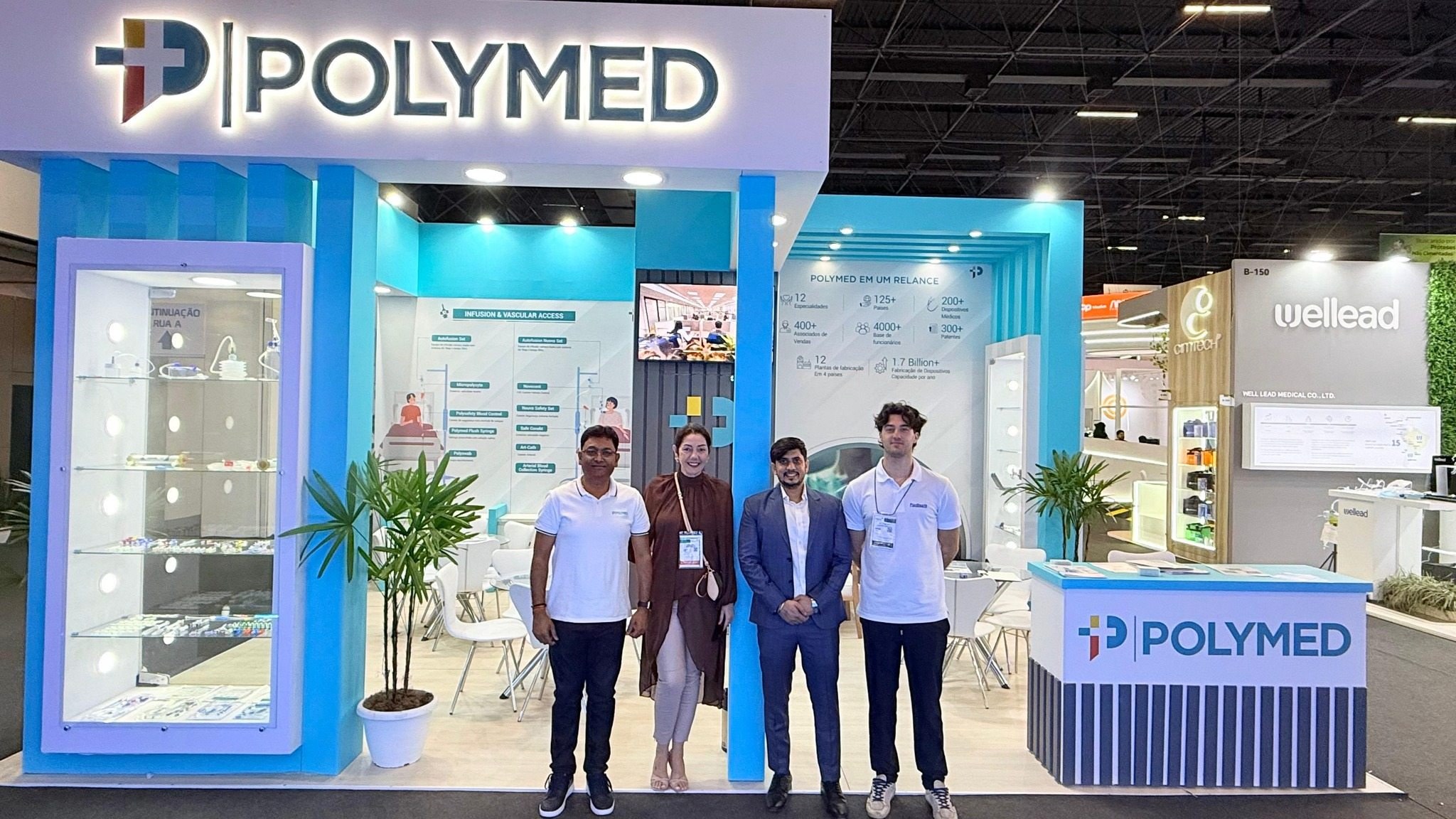
Poly Medicure:
₹494 Cr Quarterly Revenue.
P/E of 37.5x. But the Story? Priceless.
India’s largest medical device exporter. Plastic tubes going places. Wall Street envy. One crushing 40% stock decline, because apparently, even exporting catheters to 100+ countries isn’t enough excitement for the market.
Exporting Plastic Tubes to Billionaires. Literally.
- 52-Week High / Low₹2,938 / ₹1,210
- FY25 Revenue₹1,669 Cr
- FY25 PAT₹339 Cr
- Full-Year FY25 EPS₹33.41
- Q3 FY26 EPS (Latest)₹7.00
- Book Value₹288
- Price to Book4.52x
- Dividend Yield0.27%
- Debt / Equity0.08x
- 1-Year Stock Return-40.9%
The Company That Sells Tubes You’ll Never See But Your Doctor Will
Poly Medicure Limited is India’s largest exporter of plastic medical disposables and surgical devices. Think infusion therapy sets, central venous catheters, blood collection systems, urology devices, and gastroenterology equipment. Unglamorous. Essential. Profitable. Global.
The company ships 200+ different product SKUs across 12 medical specialties to 100+ countries, including Europe (32% of revenue), Rest of World (38%), and India (30%). They’ve been doing this since the late 1980s. They’ve never really stopped. And yet, the stock is down 40% in one year.
Why? Because in 2024, every medical device company got hammered by concerns over margins, competition, and a supposed “slowdown” in developed markets. Most of those concerns are either overblown or outdated. Poly Medicure, meanwhile, just quietly acquired a European company (Medistream) for ₹184 crore in February 2026, commissioned new plants in Palwal, Jaipur, and Haridwar, grew profits 33% over 3 years, and continues to grab market share in a fragmented global medical device space.
Welcome to the most boring company that’s also quietly printing money while everyone else is panicking.
Plastic Tubes That Save Lives. For Cheap.
Here’s what Poly Medicure does: they buy raw materials (plastic resins, catheters, tubing), manufacture medical-grade disposable devices in 12 different specialties, get EU MDR certification (the strictest), and ship them to hospitals, clinics, and distribution networks across the world. No recurring revenue. No SaaS. No AI. Just pure manufacturing excellence and global logistics.
Revenue mix in Q3 FY26: Infusion Therapy dominates at ~68%, Blood Transfusion at 10%, and everything else (respirators, drainage kits, urology gear) at 22%. Geography: Europe 32%, Rest of World 38%, India 30%. They serve 100+ countries through 475 internal sales associates, 600+ distributors in India, and 240 distributors globally. Distribution depth is the moat.
They’ve got 334 patents granted globally. Twelve manufacturing plants operational. Three more plants under construction (Palwal, Jaipur, Haridwar). R&D team of 100+ based in Faridabad. They spend ~1.5% of turnover on R&D annually. In 9M FY25, they received EU MDR certification for 54 products. That’s not noise. That’s industrial-grade execution.
Q3 FY26: The Numbers Game
Result type: Quarterly Results | Q3 FY26 EPS: ₹7.00 | Annualised EPS (Q3×4): ₹28.00 | Full-year FY25 EPS: ₹33.41
Source table
| Metric (₹ Cr) | Q3 FY26 Dec 2025 |
Q3 FY25 Dec 2024 |
Q2 FY26 Sep 2025 |
YoY % | QoQ % |
|---|---|---|---|---|---|
| Revenue | 494 | 425 | 444 | +16.4% | +11.3% |
| Operating Profit | 111 | 115 | 115 | -3.5% | -3.5% |
| OPM % | 23% | 27% | 26% | -400 bps | -300 bps |
| PAT | 71 | 85 | 92 | -11.0% | -22.8% |
| EPS (₹) | 7.00 | 8.41 | 9.06 | -16.8% | -22.7% |
What’s This Export Tube Company Actually Worth?
Method 1: P/E Based
FY25 full-year EPS = ₹33.41. Estimate FY26E EPS at ₹35–36 (mid-point: ₹35.50) assuming normalized margin recovery post-capex. Medical device peer median P/E = 34.2x. Poly’s historical P/E range: 30x–45x (FY22–FY24). Fair P/E band for quality exports + 33% profit CAGR: 32x–40x.
Range: ₹1,136 – ₹1,420
Method 2: EV/EBITDA Based
FY25 EBITDA = ₹422 crore (Operating Profit + D&A). Current EV = ₹13,448 crore (Market Cap + Net Debt). EV/EBITDA = 31.9x. Global medical device makers trade at 20x–28x EBITDA. Poly’s multiple is premium due to export growth + capex. Conservative: 22x–28x range = ₹9,284–₹11,816 crore EV.
Net Debt: ₹240 crore (negligible). Fair EV ÷ 10.1 cr shares:
Range: ₹920 – ₹1,170
Method 3: DCF Based
Base FCF: ₹210 crore (operating CF from FY25). Growth: 16% for 3 years (capex ramp), then 8% for 2 years. Terminal: 4%. WACC: 10.5%.
→ Terminal Value (8% FCF / 6.5% cap rate): ~₹11,800 Cr
→ Total EV: ~₹13,200 Cr (current market cap level)
Range: ₹1,050 – ₹1,350
They’re Buying Europe. Building India. Executing Madly.
🟢 Medistream & Citieffe Acquisitions (Feb-Sept 2025)
Poly Medicure acquired Medistream SA (infusion therapy, blood transfusion) in February 2026 for ₹184 crore (~EUR23m), and Citieffe Group (Italy-based medical devices, ₹324 crore / EUR31m) in September 2025. Both close to 100% done. Why? European revenue diversification. Citieffe alone did EUR17.3 crore (₹183 crore) in CY24 revenue. These aren’t token acquisitions — they’re strategic marches into premium geographies.
✅ Capex Offensive
- • ₹400–500 Cr investment in 3 new plants
- • Palwal (Haryana) — largest, 2026 commissioning
- • Jaipur (Rajasthan) — mid-2026
- • Haridwar (Uttarakhand) — late 2026/early 2027
- • Target: 1.7B units/year capacity by 2027
- • Will reduce per-unit cost, boost margins
⚠️ Short-Term Margin Pressure
- • D&A ramping up (₹29 Cr in Q3 vs ₹21 Cr prior year)
- • Depreciation will add ₹15–20 Cr annually
- • Interest expense likely ₹4–5 Cr more by FY27
- • OPM compression expected through FY26–FY27
- • Normalization likely by FY28 (post-ramp)
Is The Fort Getting Stronger?
Source table
| Item (₹ Cr) | Mar 2024 | Mar 2025 | Sep 2025 | Latest (Sep 2025) |
|---|---|---|---|---|
| Total Assets | 1,859 | 3,192 | 3,587 | |
| Net Worth (Eq + Reserves) | 1,472 | 2,766 | 2,919 | |
| Borrowings | 174 | 180 | 240 | |
| Other Liabilities | 215 | 246 | 429 | |
| Total Liabilities | 1,859 | 3,192 | 3,587 |
Total assets jumped from ₹1,859 Cr (Mar 2024) to ₹3,587 Cr (Sep 2025). Why? New plants under construction (CWIP: ₹83 Cr). Fixed assets now ₹1,439 Cr. Investments jumped to ₹930 Cr (includes Medistream/Citieffe stake). This is capex, not bloat.
Debt raised from ₹180 Cr to ₹240 Cr (only 33% increase despite massive capex). Debt/Equity: 0.08x. Interest coverage: 34.6x. Company could borrow another ₹500 Cr easily. Financing headroom is abundant.
Current ratio: 3.89x (very healthy). But inventory days jumped to 233 from 205 (raw material stockpiling for new plants?). Cash conversion cycle: 239 days. Needs watching, but not alarming.
Printing Cash, Then Reinvesting It Into Growth
Source table
| Cash Flow (₹ Cr) | FY23 | FY24 | FY25 |
|---|---|---|---|
| Operating CF | +191 | +266 | +240 |
| Investing CF | -179 | -241 | -1,194 |
| Financing CF | -13 | -20 | +951 |
| Net Cash Flow | -1 | +5 | -3 |
Sexy Growth. Moderate Returns. Fair Price.
Four Years of Compounding
Source table
| Metric (₹ Cr) | FY22 | FY23 | FY24 | FY25 |
|---|---|---|---|---|
| Revenue | 922 | 1,115 | 1,375 | 1,669 |
| Operating Profit | 215 | 267 | 361 | 455 |
| OPM % | 23% | 24% | 26% | 27% |
| PAT | 147 | 179 | 258 | 339 |
| EPS (₹) | 15.28 | 18.69 | 26.91 | 33.41 |
This is NOT hypergrowth. This is strong, sustainable compound growth with expanding margins. The story is about operating leverage, export market penetration, and manufacturing scale. Boring? Maybe. Profitable? Absolutely.
Poly Medicure vs The Rest of Medical Device Land
Source table
| Company | Qtr Revenue (₹ Cr) | Qtr PAT (₹ Cr) | P/E | ROCE % | ROE % |
|---|---|---|---|---|---|
| Poly Medicure | 494 | 71.9 | 37.5x | 20.1% | 15.8% |
| Fischer Medical | 101 | 19.2 | 57.8x | 1.1% | 0.7% |
| Tarsons Products | 108 | 5.9 | 48.8x | 6.9% | 4.8% |
| Laxmi Dental | 66 | 5.9 | 37.6x | 19.2% | 21.9% |
| OSEL Devices | 147 | 15.2 | 31.7x | 31.1% | 30.1% |
Poly Medicure’s P/E (37.5x) is moderate within the med-device peer group. But the ROCE (20.1%) is middle-of-pack — OSEL Devices (31.1%) and Laxmi Dental (19.2%) are comparable. Poly’s strength: scale (₹1,669 Cr annual revenue vs peers at ₹250–400 Cr). Weakness: ROCE not exceptional for the valuation multiple.
The Baid Family Runs This Show. Institutional Money is Cautious.
Promoter Holding: 62.42% The Baid family (Rishi, Himanshu, Smt. Mukulika, and extended clan) own 62.42% of Poly Medicure. Key players: Rishi Baid (9.59%), Himanshu Baid (7.80%), Himanshu Baid (HUF) (3.79%), Smt. Mukulika Baid (3.02%), and assorted LLPs (Ezekiel Global 12.20%, Zetta Matrix 8.21%, VCB Trading 3.49%, Jai Polypan 3.26%). Zero pledges. Clean hands.
DII Holding: 13.84% Mutual funds, insurance companies, and other domestic institutions own 13.84%. Key players: Quant Mutual Fund (various schemes across small cap, large cap, healthcare), Axis Max Life Insurance, and Max Life Insurance. Rising domestic interest, but still underweight for a ₹13,000 crore cap company.
FII Holding: 9.41% International institutional investors own just 9.41%. This is the short-squeeze powder keg. Limited foreign interest despite strong export credentials and USD revenues. If momentum shifts, FIIs will return. Until then, the stock remains Baid-family-controlled and underowned globally.
Public Holding: 14.34% Retail investors own 14.34% (67,750 shareholders as of Dec 2025, up from 35,400 in Mar 2023). Retail is slowly accumulating, but in dribs and drabs.
Clean Hands. Strong Oversight. Family-Driven Execution.
✅ Clean & Transparent
- ✓ CRISIL AA-/Stable rating on facility (March 2025)
- ✓ Zero promoter pledges — skin in the game
- ✓ Debt facility raised from 12 banks (SBI, HDFC, HSBC, Citi)
- ✓ 30th AGM held Sep 2025 — all resolutions passed cleanly
- ✓ ESOP program active (2,000 options granted Feb 2026)
- ✓ Borrowing limit raised from ₹400 Cr to ₹1,000 Cr (Sep 2025)
⚠️ Watch List
- ⚠ Family shareholding at 62% — limits independent board
- ⚠ Pankaj Gupta appointed as new director (Sep 2025) — credential changes afoot?
- ⚠ Major capex cycle ongoing — execution risk on Palwal plant
- ⚠ Medistream/Citieffe acquisition integration risk
- ⚠ Rupee depreciation exposure (50%+ USD revenues)
Medical Devices: A Boring Sector That Silently Prints Money
India’s medical device market is growing 10–12% annually. Global med-device market: 4–5%. India’s advantage: low-cost manufacturing, strong R&D, and EU regulatory certifications. Poly Medicure is one of the few Indian exporters at scale. The sector has no glamour (no D2C, no AI, no crypto), which is precisely why it’s so boring — and so profitable.
💉 The Export Goldmine
India manufactures 70% of the world’s surgical syringes by volume. That’s 3.5 billion units annually. Poly Medicure captures ~5–6% of the Indian market and serves 100+ countries globally. The TAM is enormous, fragmented, and underconsolidated. As Indian manufacturers scale, the export business will consolidate around players like Poly. It’s not about capturing market share in India; it’s about exporting to Europe, Americas, and ASEAN.
🌍 Geopolitical Tailwind
Supply chain diversification from China is real. Europe and US are actively seeking non-China sourcing for medical devices. India is the beneficiary. Poly’s EU MDR certifications (54 product lines) are the golden ticket. Once Palwal, Jaipur, and Haridwar are operational, cost-per-unit will drop, pricing power will expand, and customer stickiness will cement. This is a 3–5 year story, not a 3-month sprint.
⚡ The Margin Squeeze (Now)
Raw material costs spiked in 2024–25 (medical-grade plastics, catheters). Freight rates are elevated post-Red Sea crisis. Labor costs in India are climbing. Poly’s OPM fell from 27% (FY25) to 23% (Q3 FY26). Competitors like Veedol and Gulf Oil are also under pressure. The margin compression is real, not imaginary. It will persist until new plants come online and drive cost leadership.
🤖 Adjacent Opportunities
Data centre cooling, robotics-compatible medical devices, AI-enabled diagnostic tools — these are emerging. Poly’s R&D team of 100+ is positioned for adjacency plays. But realistically, these are 5+ year optionalities. For now, the business is: manufacture disposable medical devices, export at scale, slowly consolidate the fragmented market.
Competitive Dynamics: Majority of competition is unorganized (small manufacturers in Tamil Nadu, Gujarat) or internationally diversified (Baxter, Medtronic, Becton Dickinson). Poly’s niche: mid-market export player with strong pricing power in emerging markets and developing-world hospitals. In developed markets, brand-name competitors dominate. In emerging markets, cost is king — and Poly is the cost leader among organized players.
Macro tailwinds: India’s healthcare capex is growing. Hospital bed additions are accelerating (NaBH scheme). Surgical volumes are rising post-COVID recovery. Global med-device demand is resilient (aging populations, chronic disease prevalence). Export markets are actively de-risking from China. This is all structural, multi-year tailwinds.
The Plastic Tubes Story
Poly Medicure is not the sexiest stock in your portfolio. It will never be. It doesn’t have AI, blockchain, or a “moonshot” narrative. But it has 33% profit CAGR, 20% ROCE, ₹240 crore annual free cash flow, zero net debt, and a capex cycle that will drive cost leadership in a fragmented ₹1+ trillion global market. The stock is down 40% in one year. Fair or overcooked?
Q3 FY26 Execution: Revenue +16.4% YoY (₹494 crore). PAT -11% YoY (₹71.9 crore) — purely due to D&A impact from new plants. Operating cash flow steady. Medistream and Citieffe acquisitions locked in. Management is executing with capital discipline, not careless growth-at-all-costs.
The Capex Payoff: Three new plants (Palwal, Jaipur, Haridwar) will add 1.7 billion units of annual capacity by 2027. Cost-per-unit will drop 15–20%. OPM should recover to 28–30% range. EPS growth will re-accelerate post-FY27. This is not speculation — it’s basic manufacturing math.
Valuation Reality: P/E of 37.5x is fair-to-rich IF profits grow 15%+ annually (they have, historically). Fair value range of ₹920–₹1,420 suggests the stock at ₹1,301 is fairly priced. Not cheap. Not expensive. Fairly priced for a company with 33% profit CAGR and structural export tailwinds, but also pricing in the capex payoff flawlessly. Any stumble, any delays, any margin compression — the stock will re-rate lower. Any strong execution, any faster plant commissioning, any FII inflows — the stock will re-rate higher.
Sentiment vs. Fundamentals: The 40% stock decline in 12 months has created a sentiment washout. Retail investors have likely exited. Institutional interest (FIIs: 9.4%, DIIs: 13.8%) is underweight. If the narrative shifts from “capex is destroying margins” to “capex is about to deliver cost leadership,” the stock could re-rate 25–40% higher. That’s not price manipulation — that’s sentiment normalization.
✓ Strengths
- India’s largest medical device exporter (11-year reign)
- 33% profit CAGR (5yr) — exceptional execution
- 20% ROCE — capital is generating returns
- ₹240 Cr annual operating cash flow
- 334 patents; 54 EU MDR certifications
- Export diversification (32% Europe, 38% RoW)
✗ Weaknesses
- Margin compression from 27% (FY25) to 23% (Q3)
- Capex cycle creating D&A & interest drag (FY26–FY27)
- P/E of 37.5x leaves little room for surprises
- Family ownership at 62% — limited board independence
- Rupee depreciation exposure (50% USD revenues)
- Integration risk from Medistream/Citieffe deals
→ Opportunities
- Palwal/Jaipur/Haridwar capacity by 2027
- Cost-per-unit reduction (15–20% likely)
- OPM recovery to 28–30% range (FY28+)
- Global supply chain de-risking from China
- India healthcare capex spending up 12%+ annually
- M&A consolidation play (small-cap rollups)
⚡ Threats
- Capex execution delays (construction, commissioning)
- Raw material cost inflation (medical-grade plastics)
- Competitive price pressure from low-cost rivals
- Regulatory changes (MDR tightening, API regulations)
- INR appreciation vs. USD (export competitiveness)
- Customer concentration risk in Europe
Poly Medicure is a manufacturing story disguised as a medical-device story.
The company doesn’t care about quarterly sentiment shifts or analyst downgrades. It cares about building factories, certifying products in Europe, and exporting at scale. That is deeply unsexy. It is also deeply profitable — when the capex cycle normalizes.
The 40% stock decline has created an asymmetric opportunity for patient capital. The fair value range of ₹920–₹1,420 includes upside of 9–22% from ₹1,301, assuming proper execution. But the range also includes downside risk of 30% if execution stumbles or margins don’t recover post-2027.
This is not a “buy and forget” stock. This is a “buy, monitor, and reassess in 12–18 months when Palwal is operational” stock. For investors comfortable with a 2–3 year holding period and the discipline to rebalance on execution updates, the risk-reward is compelling.