01 — At a Glance
The Chemical Cousin Everyone’s Betting On (Even Though Returns Are Ugly)
- 52-Week High / Low₹495 / ₹338
- TTM Revenue₹8,042 Cr
- TTM PAT₹371 Cr
- TTM EPS₹10.4
- Dividend Yield0.23%
- Book Value₹158
- Price to Book2.74x
- Debt to Equity0.70x
- Net Leverage3.8x
- Interest Coverage2.14x
Auditor’s Observation: Aarti reported Q3 FY26 revenue of ₹2,318 crore (+25.8% YoY) and PAT of ₹148 crore (+222% YoY) — but here’s the catch: the YoY PAT comparison is distorted by an abnormal tax benefit in Q3 FY25. Strip that out, and it’s a respectable +25% profit increase. The 9-month TTM EPS is ₹10.4, the stock P/E is 42.1x, and ROCE of 6.3% screams “we’re still fixing this ship.” Fitch just downgraded to negative outlook. India Ratings smells blood. Yet capacity is scaling. Let’s dig.
02 — Introduction
Specialty Chemicals: Where Margin Dreams Go to Die (But Sometimes Come Back)
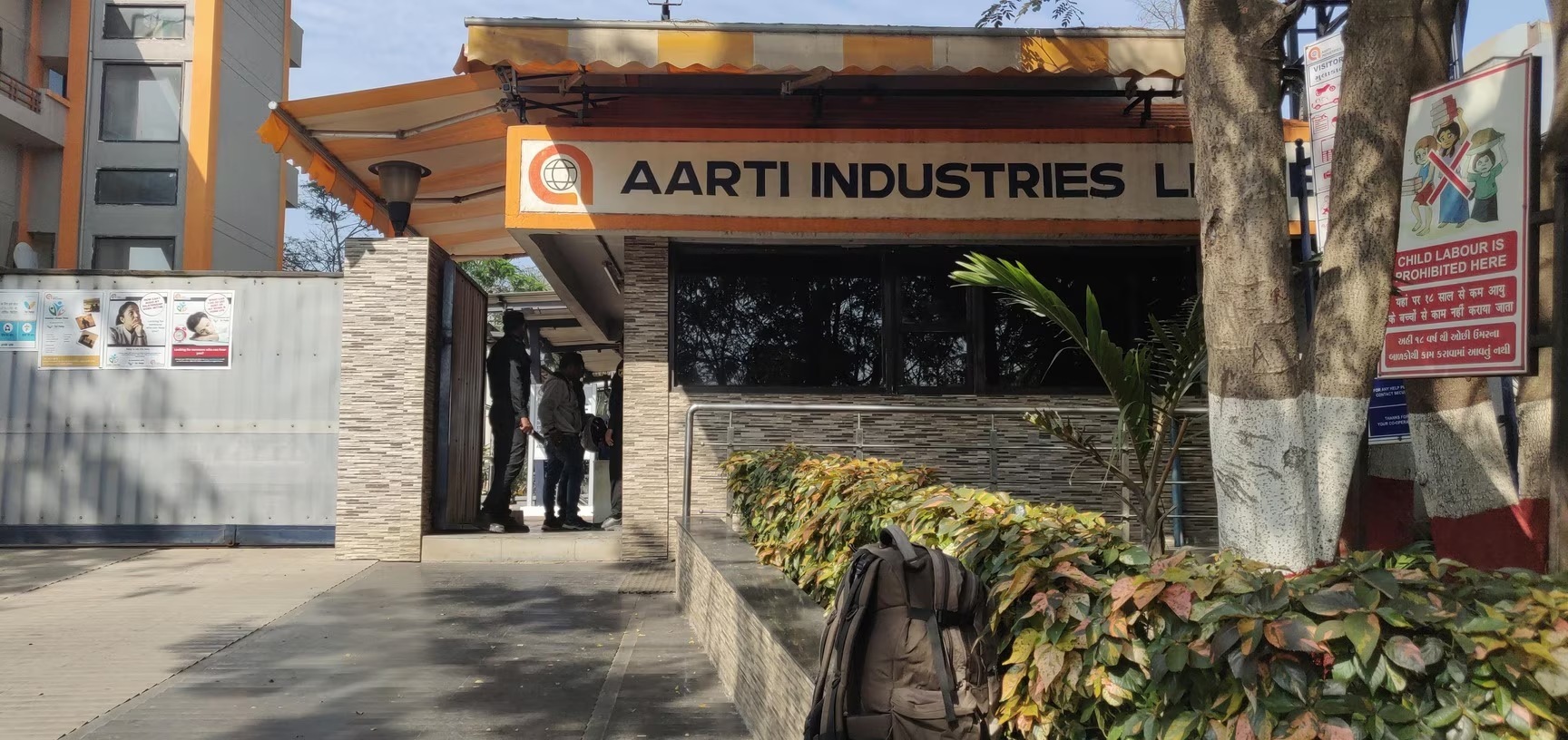
Aarti Industries is not a household name. No yoga mat startup nonsense here. No IPO hype. Just a 40-year-old family-controlled chemicals manufacturer from Gujarat that makes stuff your mechanic has never heard of — benzene derivatives, chlorinated compounds, amines, toluenes, methyl methacrylates. You know, sexy. Global market leader in di-chlorobenzene (DCB) and top-three in nitro-chlorobenzenes (NCB). Commands roughly 25–40% market share in 75% of its portfolio.
Here’s the problem: specialty chemicals is a brutally cyclical business. When global demand is strong and supply is tight, margins hit 20–23%. When China floods the market with dumping, margins collapse to 13–14%. Aarti has been living in the latter scenario for the past 18 months. Bad forex, US tariffs hammering PDA and PDCB exports, working capital bloat, and debt that doubled from ₹1.8 crore (FY20) to ₹3.9 crore (Sep 2025). ROCE collapsed from 22% (FY22) to 6.3%. ROE fell from 16% (10-year average) to 6%.
But in the last quarter, something shifted. MMA capacity is ramping. US tariffs got slashed. China announced “anti-involution” policies to curb dumping. US-India trade deal got signed. Management is guiding FY28 EBITDA to ₹1,800–₹2,200 crore. Zone 4 is coming online. Is this the inflection? Or just another quarterly mirage in the chemicals business?
Concall Insight (Feb 2026): “Energy business, led by MMA, continues to be a key growth driver.” Translation: they’re betting everything on one product capacity that scales from 290 KTPA to 360 KTPA by Q4 FY26. Do not miss this number when they report next quarter.
03 — Business Model: How Do You Make Money Selling Molecules?
Benzene Goes In. Margins Go Out. (Unless They Don’t.)
Aarti doesn’t mine anything. It sources benzene (partially imported, partially domestic from refineries), imports toluene, sources methanol, and then runs those feedstocks through sophisticated chemical processes — chlorination, nitration, hydrogenation, ethylation, fluorination — across 16 manufacturing facilities in Gujarat and Maharashtra. The result: 100+ end products sold to aggregates across polymers (PPS resins demand from EV makers), agrochemicals, pharmaceuticals, dyes, pigments, inks, and energy-sector additives.
Business model looks like: buy feedstocks at global prices, add processing margin, sell to global customers or exporters. Sounds straightforward. The volatility, however, is biblical. When crude/benzene prices drop 30%, you’re selling at old prices but buying at new prices. When your customers (mostly chemical conglomerates like BASF, Huntsman, Syngenta) get hit by their own margin compression, they pass it down to you. You then absorb tariffs, forex headwinds, and China’s dumping. Welcome to specialty chemicals.
Revenue split in 9M FY26: Agrochemicals 19%, Polymers 15%, Energy (MMA-led) 36%, Pharma 10%, Dyes/Pigments 12%, Other 9%. Geographical: exports 50%, domestic 50%. Export mix: US 18% of annual revenue, which got hammered when tariffs spiked.
Revenue CAGR (10yr)10%But margins fell
Current OPM %14%vs 19% decade avg
Capacity Additions₹1,100 CrFY26 capex spend
Global Market ShareLeader DCBTop 3 NCB
04 — Financials Overview
Q3 FY26: Volume Win, But Margins Still in the Doghouse
Result type: Quarterly Results (Q3 = Dec 2025) | Q3 FY26 EPS: ₹3.67 | Annualised EPS (Q3×4): ₹14.68 | TTM EPS: ₹10.4
| Metric (₹ Cr) |
Q3 FY26
Dec 2025 |
Q3 FY25
Dec 2024 |
Q2 FY26
Sep 2025 |
YoY % |
QoQ % |
| Revenue | 2,318 | 1,843 | 2,100 | +25.8% | +10.4% |
| Operating Profit | 321 | 231 | 291 | +39.0% | +10.3% |
| OPM % | 14% | 13% | 14% | +1 pp | Flat |
| PAT (Adjusted) | 133 | 46 | 106 | +189% | +25.5% |
| EPS (₹) | 3.67 | 1.27 | 2.92 | +189% | +25.7% |
The Asterisk on Profits: Q3 FY25 PAT was depressed due to abnormal tax treatment and labor code provisions. The organic profit comparison is more like +25–30%. More importantly, EBITDA in Q3 FY26 was ₹323 crore before a ₹15 crore one-time labor code expense — so the underlying operational EBITDA is solid at ₹338 crore. Revenue jumped 25.8% YoY on volume growth in MMA, NT (nitro-toluene), and DCB. OPM ticked up to 14%, a 100 bp improvement YoY. Operating leverage is beginning to show. The annualised EPS from Q3 (₹3.67 × 4 = ₹14.68) is higher than TTM EPS of ₹10.4, suggesting sequential profit trajectory is positive.
05 — Valuation: Fair Value Range
What Should You Pay for a Turnaround That Hasn’t Happened Yet?
Join 10,000+ investors who read this every week.