01 — At a Glance
The Gas Pipeline That Keeps The NCR Breathing
- 52-Week High / Low₹229 / ₹152
- Q3 FY26 Revenue (Standalone)₹4,068 Cr
- Q3 FY26 PAT (Consolidated)₹392 Cr
- Q3 FY26 EPS (₹)2.81
- Annualised EPS (Q3×4)₹11.24
- Book Value₹80.2
- Price to Book1.99x
- Dividend Yield2.62%
- Debt / Equity0.01x
- 12-Month Trailing EPS₹11.88
Auditor’s Opening Quip: IGL printed a magnificent 31% EBITDA growth in Q3 FY26 — driven almost entirely by regulatory favours that shouldn’t be counted as core business momentum. Strip out the transmission tariff reclassification (₹330 crore for the sector, IGL’s share yet to materialize fully) and Gujarat tax relief (₹0.35–₹0.40/SCM, only Dec impact captured so far), and you’re looking at a steady-as-she-goes gas distribution business. The stock is down 15.4% in a year. Markets apparently hate free cash flow and monopolistic regional positioning. Good news for patient investors.
02 — Introduction
The Unglamorous Business That Keeps 33 Lakh Homes Warm
Indraprastha Gas Limited: established 1998, still obscure in 2026. The business? Piped natural gas to households, compressed natural gas to taxis and buses, and industrial/commercial gas to factories nobody talks about at dinner parties. Revenue grew 6.98% over 10 years. That’s slower than population growth. Yet the stock delivered 20% ROE and maintains a cash balance of ₹3,988 crore with zero net debt. This is the anti-Tesla story.
IGL operates exclusively across the National Capital Territory of Delhi, Noida, Ghaziabad, Haryana pockets (Rewari, Karnal, Gurugram, Meerut), and newly awarded areas in Uttar Pradesh and Rajasthan. Marketing exclusivity in Delhi expired in 2012. Infrastructure exclusivity (the real moat) expired in May 2025. Yet IGL remains the dominant player — not through regulation anymore, but through first-mover advantage and capital-intensive infrastructure. Try building 30,000 km of pipeline networks in 3 years. Go on. Try.
The real story is Q3 FY26: regulatory tailwinds converged. Transmission tariff zoning changed. Gujarat imposed a 2% CST on domestic gas instead of 15% VAT. The GST on CNG vehicles dropped from 28% to 18%, sparking conversions from petrol/diesel to CNG. One-time Labour Code provisioning (₹28 crore) distorted profits. Strip all that, and you have a well-oiled, capital-light distribution business reaching maturity. The question isn’t if IGL grows. The question is: who cares?
Concall Insight (Feb 2026): Management confidently exited Q3 averaging 10.4 MMSCMD daily, up from 9.11 MMSCMD YoY. By month-end, draws crossed 10 MMSCMD on most days. “March will be >10,” they said. Volume growth is happening. It’s just unsexy to discuss at an earnings call for 45 minutes without mentioning AI.
03 — Business Model: Who Needs Oil When You Can Pipe Gas?
The Infrastructure Monopoly That Owns Your Neighbourhood
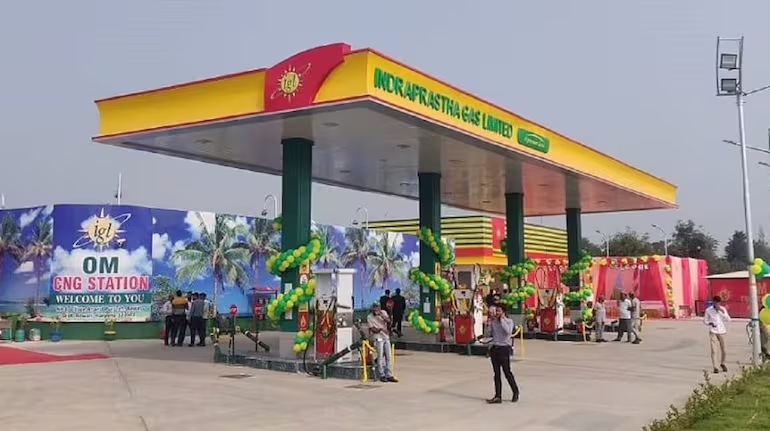
Here’s the machine: IGL buys natural gas from GAIL (government-allocated), RLNG importers, and spot markets. It pipes the gas through 26,364 km of medium-density polyethylene (MDPE) networks and 2,350 km of steel pipelines. It compresses some of that gas and dispenses it at 954 CNG stations to 17 lakh vehicles (mostly taxis, auto-rickshaws, and some honest citizens). It delivers the rest via pipelines to 30.7 lakh domestic households, 12,049 industrial/commercial customers, and 7,400 commercial establishments.
Revenue split: 75% CNG, 25% PNG. Within PNG: 30% domestic, 38% industrial, 10% commercial, 22% sales to other CGD companies. The beauty? Once the pipeline is built, it’s there for decades. New customers are almost pure margin. Capex is front-loaded. Operating leverage is immense.
Challenges: domestic natural gas allocation from the government is shrinking. Q3 FY26 saw domestic sourcing at 43% of total volume (down from 72% in FY24). The rest comes from costlier RLNG and HPHT gas. Every rupee of gas cost increase either compresses margins or forces a tariff hike that nobody wants. Management’s hedging strategy: pass costs to customers selectively, but keep CNG retail selling price (RSP) stable to avoid demand destruction. Walking a tightrope.
CNG Revenue74%Of Total Mix
PNG Domestic30%Of PNG Mix
Industrial PNG38%Of PNG Mix
Stations (Mar 2025)954Nationwide
Infrastructure Moat Note: Even though marketing and infrastructure exclusivity expired, IGL’s 26,364 km of MDPE network took 25 years to build. A new entrant would need 5–10 years and ₹5,000+ crore to build comparable capacity. That’s why IGL is the de-facto monopoly in Delhi, despite what the PNGRB rulebook says.
💬 Drop a comment: Do you use CNG or PNG? Ever wondered who runs the wires and pipes under your neighbourhood?
04 — Financials Overview
Q3 FY26: The Numbers Don’t Lie (But They’re Noisy)
Result type: Quarterly Results (Consolidated) | Q3 FY26 EPS: ₹2.81 | Annualised EPS (Q3×4): ₹11.24 | 12-Month Trailing EPS: ₹11.88
| Metric (₹ Cr) |
Q3 FY26
Dec 2025 |
Q3 FY25
Dec 2024 |
Q2 FY26
Sep 2025 |
YoY % |
QoQ % |
| Revenue | 4,068 | 3,759 | 4,023 | +8.2% | +1.1% |
| Operating Profit (EBITDA) | 471 | 362 | 441 | +30.1% | +6.8% |
| EBITDA Margin % | 11.6% | 9.6% | 11.0% | +200 bps | +60 bps |
| PAT (Consolidated) | 392 | 326 | 385 | +20.2% | +1.8% |
| EPS (₹) | 2.81 | 2.33 | 2.76 | +20.6% | +1.8% |
The Fine Print That Matters: Q3’s 31% EBITDA growth is a siren song. Exclude the ₹28 crore Labour Code provisioning and EBITDA would’ve been ₹500 crore — representing an effective margin of 12.3%. But transmission tariff benefits (₹330 crore sector-wide, IGL’s ₹260 crore pending customer pass-through) and Gujarat tax relief (₹0.35–₹0.40/SCM, only one month captured) inflate the headline growth. For Q4 and FY27, expect margin recovery as these benefits annualize. Full-year FY26 margins are tracking toward the 13% guided band — not explosive, but respectable for a regulated utility facing commodity cost volatility.
05 — Valuation: The Boring But Fair Range
What Is a Steady Gas Pipeline Actually Worth?
Join 10,000+ investors who read this every week.