01 — At a Glance
The Logistics Machine That Just Woke Up. And It’s Angry.
- 52-Week High / Low₹946 / ₹639
- Q3 FY26 Revenue₹1,725 Cr
- Q3 FY26 PAT₹233 Cr
- Q3 FY26 EPS₹5.04
- Annualised EPS (Q3×4)₹20.16
- Book Value₹169
- Price to Book3.86x
- Dividend Yield1.11%
- Debt / Equity0.41x
- 9M FY26 PAT₹652 Cr
The Auditor’s Tl;dr: Aegis posted 9-month PAT of ₹652 crore, up 39% YoY. Revenue at ₹5,739 crore (+13%). Normalized EBITDA at ₹929 crore (+26%). Q3 was the punchline: ₹1,725 crore revenue, ₹233 crore PAT (+45% YoY), all from record volumes in LPG distribution and the liquids terminals. The stock fell 12% in 3 months and 13.6% in 1 year, even as the company printed record numbers. This is the auditor’s favorite kind of market inefficiency: the one where fundamentals smile and the market frowns.
02 — Introduction
Oil, Gas, and Logistics Walk Into an Infrastructure Bar.
Aegis Logistics is the middle child that grew up to run the family business. Incorporated in 1956, it operates about one-third of India’s liquid bulk storage and LPG terminal capacity. That’s not a guess — the company literally said that in the latest concall, with the kind of confidence only market leaders can muster while everyone else is still fighting over crumbs.
Here’s the operating model: India imports oil, chemicals, and petrochemicals at ports. Someone needs to receive them, store them in massive tanks, handle the paperwork, manage the inventory, and distribute to refineries, factories, and retail distributors. That someone is Aegis (and a few friends). Two divisions: Liquids (port terminals for petroleum, chemicals, and vegetable oils) and Gas (LPG sourcing, terminal storage, distribution, and retailing).
Boring? Yes. Important? Absolutely yes. India’s energy infrastructure doesn’t run on ambition and venture capital — it runs on logistics companies that wake up every day and move millions of metric tonnes of explosive liquids without blowing anything up. Aegis has been doing that for 70 years, and Q3 FY26 was the quarter they decided to suddenly prove they’d been undervalued the entire time.
The concall was spicy. Management announced a capex plan that would make infrastructure investors weep. ₹10,000 crore gross capex by FY27 (up from ₹6,000 crore today). Port-by-port expansion. LPG pipelines coming online. VLGC-compliant terminals. A 15-year take-or-pay petroleum contract at Pipavav. And yes, they’re building an ammonia terminal because green hydrogen and green ammonia are the next boom, and Aegis wants in early. The company is essentially saying: “We’re not just storage. We’re infrastructure.”
Concall Essence (Feb 2026): “Record performance.” “All-time high revenue.” “All-time Q3 throughput volumes.” Management repeated “record” or “all-time” six times in 90 seconds. Then they dropped the capex bomb. Translation: we’ve been boring and profitable, now watch us get boring AND big.
03 — Business Model: WTF Do They Even Do?
We Store Explosive Liquids. Safely. That’s It.
Aegis operates in two buckets. First, the Liquids Division (~30% of FY24 EBITDA): They own or operate tank terminals at 6 Indian ports (Mumbai, Kandla, Pipavav, Mangalore, Haldia, Kochi) with a combined capacity of ~1.7 million KL today (expected to hit 2.5–3.0 million KL by FY27). They store petroleum products, chemicals, vegetable oils, and soon — ammonia. The company makes money in two ways: fixed monthly fees (capacity rental) and variable fees (handling, storage duration). Higher-realization products (complex chemicals, niche POL products) command premium pricing. Lower-realization products (bulk petroleum, vegetable oils) are bread-and-butter volume business.
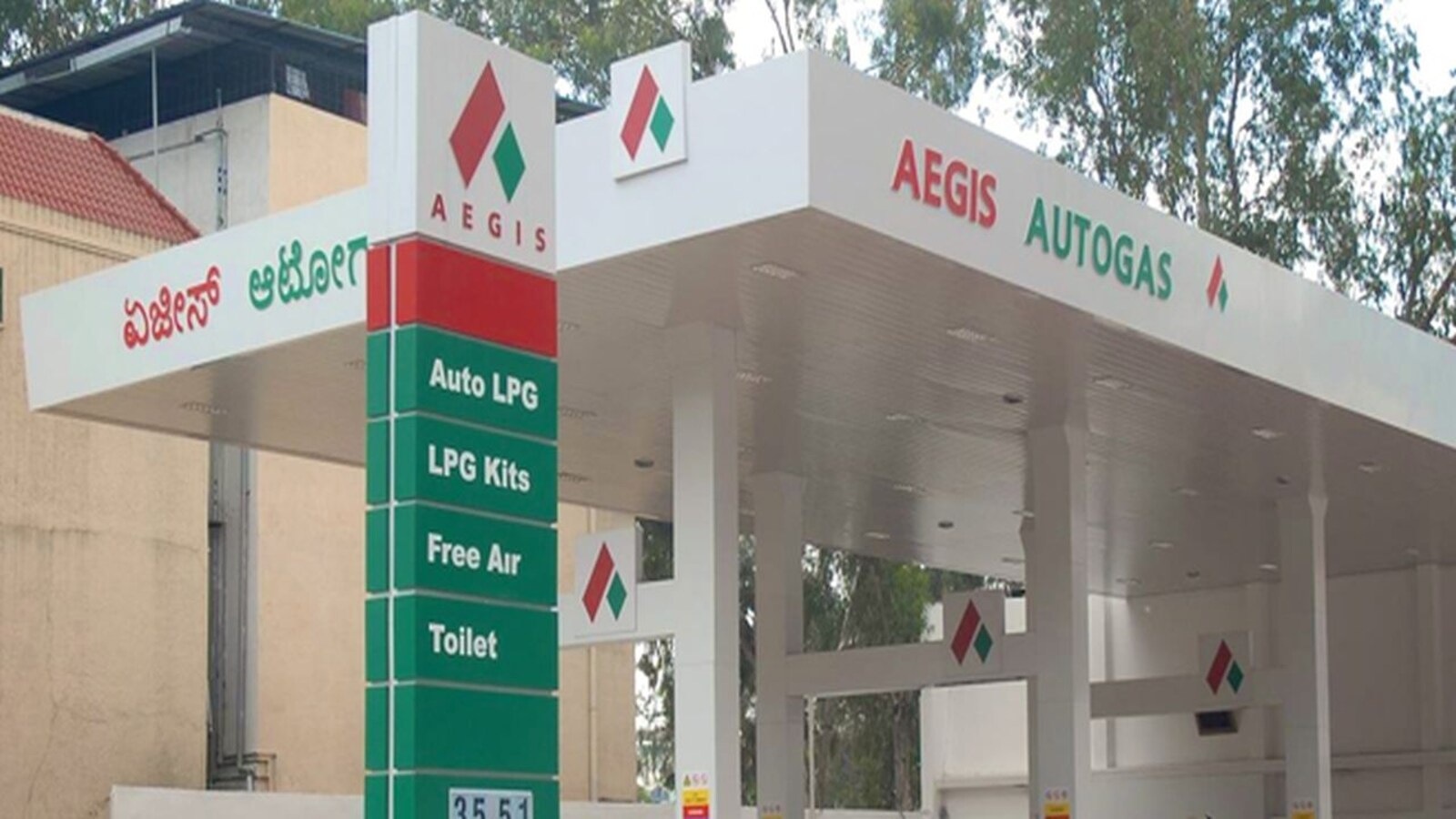
Second, the Gas Division (~70% of FY24 EBITDA): LPG sourcing (buying LPG globally and selling to Indian distributors), LPG terminalling (storage), LPG distribution (142 autogas stations + 290 retail distributors across 15 states), and LPG bottling (37 plants). They also have a sourcing JV with Itochu (Japanese trading company) to source LPG cheaper. The LPG story is fascinating: margins are thin on sourcing (they earn a fixed commission), but fat on distribution (margin per tonne: significantly higher than sourcing). Distribution volumes surged 35% in 9M FY26 — they’re literally replacing dirty fuels (coal, furnace oil) and natural gas with LPG in industrial applications. It’s a substitution play disguised as a logistics company.
The secret sauce: portfolio of ports + JV with Vopak (Royal Vopak, the world’s largest tank storage company) + vertical integration from sourcing to retail. Small competitors can do one thing. Aegis can do it all.
Liquids Capacity1.7M KL6 ports today
LPG Static Storage225K MTAnd growing
Market Share~30%India’s capacity
Distribution Reach432Station + distributors
The Vopak Relationship: Aegis owns 51% of Aegis Vopak Terminals (AVTL), the JV with Vopak that houses the LPG and liquid storage business across 5 ports (excluding Mumbai, which Aegis operates solo). In May 2025, AVTL filed a ₹2,800 crore IPO. If AVTL goes public and Aegis’s stake dilutes below 50%, the financial consolidation changes — but management control and operational synergy remain. This is either a genius unlock (raise capital, dilute stake, keep upside) or a sign they need more money (spoiler: both true).
💬 Would you invest in a logistics company just because it’s infrastructure, or do you care about returns on capital? Drop your philosophy in the comments.
04 — Financials Overview
Q3 FY26: The Numbers That Aren’t Lying
Result type: Quarterly Results | Q3 FY26 EPS: ₹5.04 | Annualised EPS (Q3×4): ₹20.16 | 9M FY26 EPS: ₹17.62 (cumulative)
| Metric (₹ Cr) |
Q3 FY26
Dec 2025 |
Q3 FY25
Dec 2024 |
Q2 FY26
Sep 2025 |
YoY % |
QoQ % |
| Revenue | 1,725 | 1,707 | 1,719 | +1.1% | +0.3% |
| EBITDA (Normalized) | 326 | 252 | 240 | +29.4% | +35.8% |
| EBITDA Margin % | 19% | 15% | 14% | +400 bps | +500 bps |
| PAT | 233 | 160 | 175 | +45.6% | +33.1% |
| EPS (₹) | 5.04 | 3.54 | 3.74 | +42.4% | +34.8% |
Parse the Numbers: Revenue is flat (+1.1% YoY), but EBITDA exploded +29%. How? Operating leverage. The Liquids terminal business hit 77% EBITDA margin in Q3 (vs 70% in Q3 FY25) — management credited “favorable product mix.” Meaning: they’re storing more high-margin stuff, less low-margin stuff. Mix shift from bulk petroleum to specialty chemicals = instant margin expansion. PAT is up 45.6% because of both EBITDA growth AND a lower tax rate (22% in Q3 FY26 vs 23% historically). The annualised EPS of ₹20.16 (Q3 × 4) is higher than last FY’s full-year EPS (₹18.90). This company is accelerating.
05 — Valuation: Fair Value Range
Is This Stock Worth the Price Tag?
Join 10,000+ investors who read this every week.