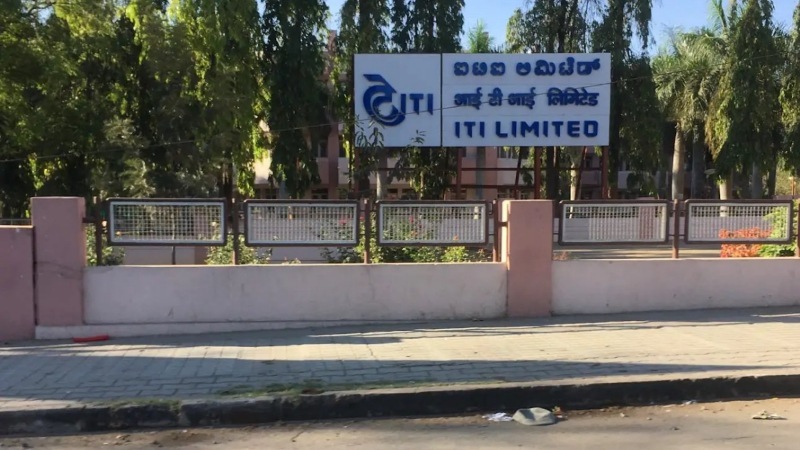
01 — At a Glance
The Government Oil Tanker That’s Trying to Sail Again
- 52-Week High / Low₹373 / ₹233
- TTM Revenue₹2,602 Cr
- 9M FY26 Loss₹143.27 Cr
- Latest Qtr EPS (Dec 2025)-₹0.27
- Book Value₹15.1
- Price to Book16.9x
- Debt₹1,311 Cr
- Order Book / TTM Revenue7.37x
- Promoter Holding90.0%
- Debtor Days337 days
⚠️ The Setup: ITI is a 1948-incorporated government PSU managing telecom infrastructure projects (BharatNet, ASCON, BSNL 4G). It’s posting losses. It’s bleeding working capital. It has ₹337 debtor days (11 months, basically unpaid). Yet it scored an ₹8,280 crore ASCON Phase IV order, has a revival package of ₹4,156.79 crore from GoI, and is monetizing 122 acres of land starting with ₹800 crore from K.R. Puram, Bengaluru. Three directors resigned in one quarter. The auditor gave a disclaimer. And somehow, the stock returned 26% over 10 years.
02 — Introduction
When Your Customer is the Government and Also Your Owner
ITI Limited is what happens when the government decides that telecommunications infrastructure is too important to outsource. Established in 1948, it’s been wiring India’s telephone networks for 76 years — through Partition, wars, license raj, liberalization, and now the BharatNet era where broadband is called a “right.”
The company operates six manufacturing facilities (Bengaluru, Naini, Rae Bareli, Mankapur, Palakkad, Srinagar), multiple R&D centres, and 11 regional offices. Its revenue model is brutal: 78% comes from turnkey projects (BharatNet, ASCON, E-governance, telecom rollouts). These are tendered, cost-plus deals where you execute on time, and if you don’t, you take a loss. GST and delays and design approvals compound the misery. Industrial margins are razor-thin. Tender-based businesses are volatile.
The latest financial result (Q3 FY26, 31 Dec 2025): ₹515 crore revenue in the quarter. But operating loss of ₹25.58 crore (net). Nine-month loss of ₹143.27 crore. An auditor disclaimer (they couldn’t verify something material). And board meeting notes: “ability of the company to ramp up execution and improve profitability remains critical from credit perspective.”
Translation: nobody knows if this works.
Yet, the order book sits at ₹19,198 crore. The land monetization could raise ₹800 crore by March 2026. The government owns 89.97% (basically all of it). And the rating agencies are saying, “we expect significant improvement in H2FY2026.” Infomerics gave it a BBB-/Stable rating in February 2026 because they think the land sale will reduce debt enough to make this work.
Let’s find out if they’re right or if this is a slow-motion train wreck dressed up as a PSU turnaround.
Board Note (Feb 13, 2026): “Q3/9M results: nine-month loss Rs14,327 lakhs; auditor disclaimer; ASCON Rs8,280.36Cr order; revival aid Rs415,679 lakhs.” That last number is ₹4,156.79 crore of government aid. And they’re still losing money. The setup is that good.
03 — Business Model: The Eternal Project Executioner
Why Government Contracts Don’t Make Anyone Rich (Except Politicians)
ITI’s business is simple in design and hellish in execution. The government calls for tenders on large telecom and infrastructure projects. ITI (often with government backing) bids. The tender specifies fixed prices, timelines, and penalty clauses. ITI wins, then tries to execute. Something always goes wrong — design approvals delay, supply chain snaps, government customer changes specifications mid-project, FX moves.
Result: cost-plus turns into cost-overrun. Margins compress. Projects that were supposed to earn 8% return 2%. Some years, they return negative numbers.
The three revenue segments are:
Turnkey Projects (78% of revenues): BharatNet Phase 2 & 3, ASCON (telecom network for armed forces), E-governance, FTTH rollouts. These are strategic and politically important. Execution is glacially slow. Payment cycles are 60-90 days government, but billing happens only after milestones. Unbilled revenue is enormous.
Services (19% of revenues): Contract manufacturing, equipment testing, defence-related assembly. Lower margins but more predictable. Defence orders are recurring and sticky.
Manufacturing/Trading (3% of revenues): Solar panels, WiFi equipment, telephones. The leftover category. Mostly irrelevant.
Key customers are BSNL, Ministry of Defence, MITCL, various state governments, and Bharti Airtel (FTTH). Each is a pain in a different way. BSNL is perpetually underfunded. Defence is security-obsessed and slow. State governments have their own budget cycles and political whims.
Turnkey Projects78%Revenue Share
Services19%Recurring Base
Margins-0.4%OPM (TTM)
Debtor Days Reality: ITI’s debtor days stand at 337 days as of 31 Dec 2025 (down from 403 days Sep 2024). That means: on average, it takes 11 months to get paid by government customers. Working capital is negative because payables (1,286 days!) exceed receivables by a huge margin. ITI’s suppliers give it nearly 4 years of credit, but customers take 11 months to pay. The gap is funded by bank loans.
💬 If you were a supplier to a government contractor, would you give them 4 years of credit? What leverage are they using?
04 — Financials Overview
Q3 FY26: The Math That Doesn’t Add Up
Result type: Quarterly Results | Q3 FY26 EPS: -₹0.27 | TTM Revenue: ₹2,602 Cr | 9M Loss: ₹143.27 Cr
| Metric (₹ Cr) |
Q3 FY26
Dec 2025 |
Q3 FY25
Dec 2024 |
Q2 FY26
Sep 2025 |
YoY % |
QoQ % |
| Revenue | 515 | 1,035 | 543 | -50.2% | -5.2% |
| Operating Profit | 25 | -11 | -1 | Swung Positive | Improved |
| OPM % | 5% | -1% | -0% | +600 bps | +500 bps |
| PAT (Net Profit) | -26 | -67 | -54 | +61.2% | +51.9% |
| EPS (₹) | -0.27 | -0.70 | -0.56 | +61.4% | +51.8% |
The Confusing Part: Revenue crashed 50.2% YoY (from ₹1,035 Cr to ₹515 Cr), yet the operating margin swung from -1% to +5% in absolute terms. That’s because other income of ₹8 crore in Q3 FY26 vs ₹20 crore in Q3 FY25 was much lower, so the loss expanded. But operating profit (EBIT) improved. The pattern is: small revenues, high fixed costs, sporadic one-time income items. 9-month cumulative loss is ₹143.27 crore. No dividend. TTM EPS is -₹1.54. The company is unprofitable and capital-light operations are subsidized by government contracts and land sales.
05 — Valuation: The Impossible Question
How Do You Value a Losing Government Company With a ₹19K Cr Order Book?
Join 10,000+ investors who read this every week.