02 — Introduction
Welcome to the Invisible War: Brakes Edition
You’ve never heard of ZF Commercial Vehicle Control Systems India. This is not because the company is small. It’s because you haven’t accidentally opened your Ashok Leyland truck’s dashboard. But if you own a truck, bus, or tractor in India — and nearly every commercial vehicle that moves cargo in this country relies on ZF’s systems — you’re indirectly funding one of India’s highest-ROCE businesses.
ZF Commercial (formerly WABCO) manufactures advanced braking systems, air suspension, electronic stability control, e-mobility technologies, and the kind of safety systems that prevent 40-tonne vehicles from becoming unguided missiles on the Bangalore-Chennai highway. Unglamorous. Utterly essential. The kind of business that shows up in earnings statements and never in news headlines.
Q3 FY26 was notable. Not for growth euphoria, but for execution precision. ₹1,105 crore consolidated revenue (+12.8% YoY). PAT ₹140.2 crore (+11.7% YoY). EPS ₹73.11 on an annualized trajectory of ₹292. The company has sustained production momentum even as India’s CV sector navigates tariff headwinds from the U.S., EV adoption curves, and the eternal Indian monsoon.
New management (Paramjit Singh Chadha took over as MD in Feb 2025). New factories (Oragadam plant inaugurated Feb 2026 for e-mobility tech). New regulations baking in ESC and ADAS requirements. The business is in transition — the kind of structural shift that analysts miss because it’s not a moonshot bet, it’s just a very profitable evolution.
Q3 FY26 Concall Note: “First time crossed revenues of INR 1,100 crores in a single quarter and sustaining >INR 1,000 cr in 3 of last 4 quarters.” ZF management stated this as fact, not as a victory lap. That’s the vibe of this company — steady, boring, competent.
03 — Business Model: WTF Do They Even Do?
They Make Trucks Stop. And Also Stop Tipping.
ZF operates in four revenue streams: Original Equipment (OE) at ~49% of revenue, Aftermarket at ~12%, Exports at ~28%, and Service Income at ~11%. Translation: they make systems for truck/bus manufacturers, then sell spare parts when those systems eventually need replacing, sell to global OEMs, and run the rest as service business.
The OE segment is the core. Customers include Ashok Leyland, TATA, Daimler, Audi, BMW, TAFE, JBM, Escorts, and basically every company that produces a vehicle heavier than your morals are. ZF supplies:
Advanced Braking Systems — ABS for commercial vehicles, air disc brakes, trailer ABS. When your truck driver realizes his 40-tonne load won’t stop in time and smashes the brake pedal, ZF’s system prevents the wheels from locking. No locking = no jackknife = no 40-tonne crematorium on the highway.
Air Suspension — ECAS (Electronically Controlled Air Suspension) is the luxury system. Instead of leaf springs, air suspension provides comfort, reduces vibration, and on city buses with ultra-low-entry floors, allows the bus to kneel so elderly passengers can board without climbing a ladder at 8 AM.
E-Mobility Tech — E-compressors for electric buses (because electric buses don’t have engine-driven compressors, they need independent electric ones), electronic braking systems for EVs, and new product launches like doors with door control systems and air disc brakes for electric trucks.
ESC (Electronic Stability Control) — Prevents skidding on wet roads. Regulations now mandate it in India. New requirement = new revenue stream. ZF estimates ESC content at ₹20–25k per vehicle.
The business model is contractual and sticky. An OEM qualifies ZF on a model once. Then every single unit of that model produced needs ZF components. You don’t swap suppliers mid-production just because competitors exist. Distribution network: 270+ Authorized Service Partners, ~550+ Aftermarket wholesale distributors. Manufacturing footprint: 6 plants across Chennai, Jamshedpur, Lucknow, and now Oragadam. Margins on this? Exceptional. Q3 EBITDA margin 20% of sales. PAT margin 12.7%.
OE Domestic49%Revenue Mix
Exports28%Revenue Mix
Aftermarket12%Revenue Mix
Services11%Revenue Mix
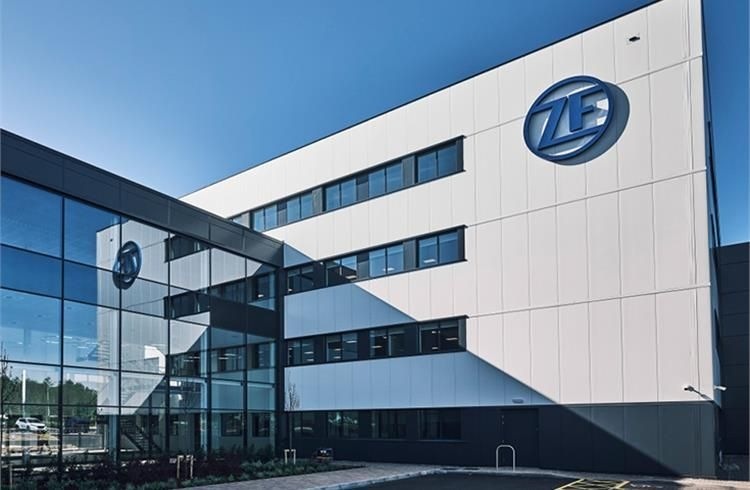
ZF Global Context: ZF Friedrichshafen is Germany’s third-largest automotive supplier globally. Commercial Vehicle Control Systems Division is their India growth engine. ZF is betting India becomes a regional engineering hub and manufacturing hub for CV systems — and they’re investing ₹1,800 crore in India by 2030 to make that bet real. The Oragadam plant is the physical manifestation of that conviction.
💬 How many of you knew your truck has an e-compressor? Comment if you just learned something new about the vehicle you own.