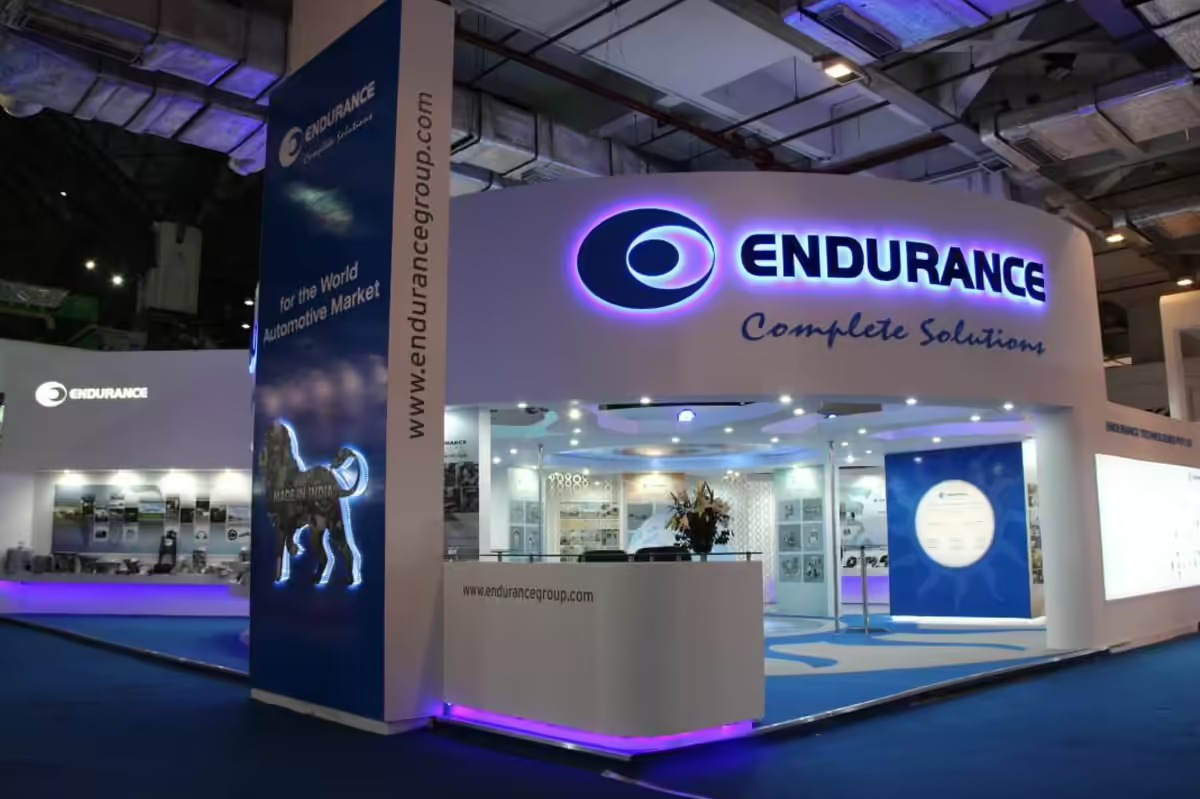
01 — At a Glance
The Auto Component Maker That Swallowed Its Own Growth
- 52-Week High / Low₹3,080 / ₹1,556
- TTM Revenue₹13,473 Cr
- TTM PAT₹926 Cr
- Full-Year EPS (TTM)₹65.4
- Annualised EPS (Q3×4)₹63.04
- Book Value₹445
- Price to Book5.41x
- Dividend Yield0.42%
- Debt / Equity0.20x
- Interest Coverage23.5x
Auditor’s Opening Note: Endurance Technologies closed Q3 FY26 with consolidated PAT of ₹236 crore (+28.2% YoY), consolidated revenue of ₹3,608 crore (+26.2% YoY), but traded at 36.5x P/E — roughly 40% higher than the auto component sector median (26.7x). The stock is priced for perfection, which means either management executes flawlessly on four greenfield plants, battery packs, EV braking systems, and a German acquisition — or it becomes a spectacular lesson in expectation setting. Also, 6-month returns: -19.4%. Welcome to the growth stock penalty box.
02 — Introduction
When an Auto Parts Supplier Decides It Wants to Be a Platform
Endurance Technologies manufactures aluminium die-casting components, suspensions, brakes, transmission parts, alloy wheels, and (recently) battery management systems for the world’s motorcycles, scooters, three-wheelers, and four-wheelers. Founded in 1985, it’s one of India’s most industrious companies — the kind that builds stuff that nobody notices until it breaks.
Here’s the thing: Endurance is not Tesla. It’s not Lucid. It’s not Rivian. It’s a tier-one automotive supplier that makes the unsexy, essential bits — gearboxes, brake discs, suspension arms, and increasingly, the electronic brains that manage EV battery cells. Bajaj Auto — Endurance’s single largest customer — accounts for 38% of overall revenue. So they’re dependent. So they’re executing. So they’re expanding into four continents, building four new manufacturing facilities, acquiring German precision casting specialists, and launching battery packs from a wholly-owned subsidiary called Maxwell Energy Systems.
This is the story of a ₹33,787 crore market cap company that’s trading at 5.4x book value, 36.5x P/E, with a -19.4% 6-month return — betting that EV adoption, mandatory ABS braking regulations, margin expansion through in-house manufacturing, and a disciplined M&A strategy will justify valuations that are already pricing in perfection. Let’s see if the perfection is actually there.
Concall Note (Feb 2026): “Manufacturing in-house versus outsourcing” and “new business with better profit margins… improving the product mix.” — Endurance Management. Translation: they’re not chasing volume anymore; they’re chasing ROCE. The tone has shifted from “growth at any cost” to “profitable growth or bust.”
03 — Business Model: WTF Do They Even Make?
The Unglamorous Art of Making Everything Your Bike Needs (Except the Bike)
Endurance sells components to nearly every two-wheeler and three-wheeler manufacturer in India, plus four-wheeler OEMs in Europe. The product mix is brutally simple: aluminium die-casting (43% of revenue), suspension systems (26%), disc brakes (12%), alloy wheels (8%), transmission (4%), and aftermarket sales (5%). Motorcycles represent 56% of revenues, followed by four-wheelers (26%), scooters (9%), and three-wheelers (8%).
For context: Bajaj Auto alone accounts for 38% of overall FY25 revenue. They supply to Maruti (Suzuki), Hero MotoCorp, Kia, Mahindra, Tata Motors, Royal Enfield, TVS, Honda, Yamaha. One relationship goes sideways, revenue takes a 30%+ haircut. Mitigating this risk is the entire strategy for the next 5 years.
Geography is split 77% India (including Maxwell Energy Systems subsidiary) and 23% Europe (through wholly-owned subsidiaries in Germany and Italy). Europe has been a slow grind, but they just acquired 60% of Stöferle GmbH — a German precision casting specialist with revenues of €75–80 million and existing orders from BMW, Volkswagen Group, and Stellantis stretching to 2030-2032.
Motorcycles56%Revenue Mix
4-Wheelers26%Revenue Mix
Scooters9%Revenue Mix
3-Wheelers8%Revenue Mix
Bajaj Dependency Note: Bajaj Auto (CRISIL AAA rated) accounts for 38% of Endurance’s overall revenue. Management is acutely aware. Their entire capex strategy is built around diversification into 4W (currently 25% of revenue; target 45% by FY28) and non-auto adjacencies (solar dampers, data centre cooling, battery packs). Watch whether their execution matches their ambition.
💬 Do you think Endurance can actually pull off 45% 4W revenue mix in 3 years, or is this more consultant-speak than reality? Drop your view in the comments!
04 — Financials Overview
Q3 FY26: The Numbers That Justify the Premium (Or Don’t)
Result type: Quarterly Results | Q3 FY26 EPS: ₹15.76 | Annualised EPS (Q3×4): ₹63.04 | TTM EPS: ₹65.4
| Metric (₹ Cr) |
Q3 FY26
Dec 2025 |
Q3 FY25
Dec 2024 |
Q2 FY26
Sep 2025 |
YoY % |
QoQ % |
| Revenue | 3,608 | 2,859 | 3,583 | +26.2% | +0.7% |
| Operating Profit | 477 | 373 | 477 | +27.9% | +0% |
| OPM % | 13% | 13% | 13% | Flat | Flat |
| PAT | 222 | 173 | 227 | +28.2% | -2.2% |
| EPS (₹) | 15.76 | 12.30 | 16.16 | +28.2% | -2.5% |
EPS Recalculation & Margin Reality Check: Q3 FY26 EPS ₹15.76 × 4 = ₹63.04 annualised. TTM EPS stands at ₹65.4. Current P/E: 36.5x. The company achieved 26.5% consolidated revenue growth YoY (₹3,645.6 cr consolidated vs ₹2,859 cr Q3 FY25), but operating margin stayed flat at 13%. Translation: they’re growing volume but not expanding profitability. OPM should be 14–15% given the scale and new capacity coming online. Instead, it’s 13%. This is either “growing pains from capex” or “pricing pressure from OEMs.” Neither is particularly bull-friendly. Standalone (India only) revenue grew 22.2% YoY to ₹2,678.3 cr, with OPM at 12.7% — even more margin-challenged than consolidated. Raw material cost increases (aluminium alloys forming 55% of purchases) and labour code-driven exceptional charges are eating into profits.
05 — Valuation Discussion: Fair Value Range Only
What’s This Company Worth When It’s Trading on Hope?
Join 10,000+ investors who read this every week.