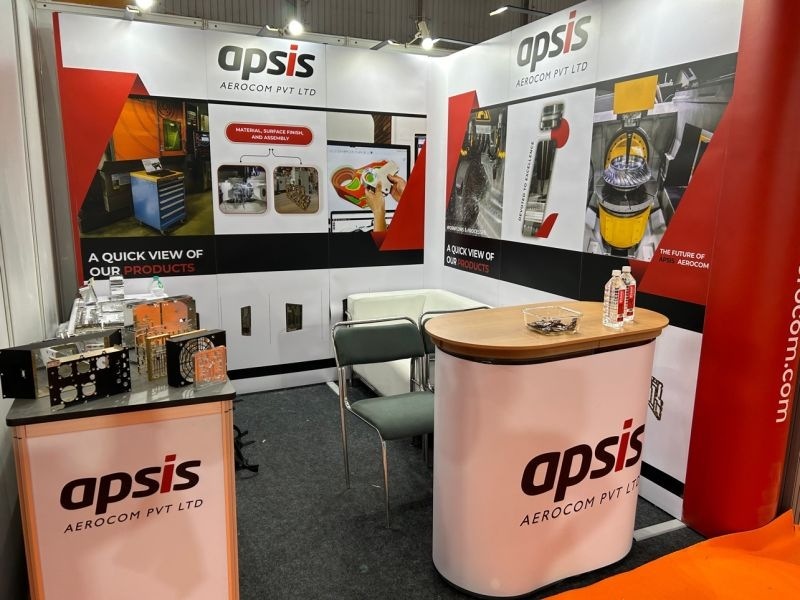
01 — At a Glance
The Aerospace Bet That Went From 0 to 100 in 18 Months
- IPO Issue Size₹35.77 Cr (Fresh)
- Price Band₹104–₹110
- Post-IPO Market Cap₹157.85 Cr
- Shares Offered32.52 lakh shares
- Book Value Per Share₹15.63
- Post-IPO P/E Ratio19.97x
- Post-IPO P/B Ratio6.53x
- FY25 Annualised EPS₹5.51
- Listing Date18 Mar 2026
- Promoter Dilution27%
IPO Context: Apsis Aerocom is a 4-year-old precision engineering company that went from ₹1.03 crore PAT in FY23 to ₹6.64 crore in FY25. That’s growth. Now the founders want public money to buy CNC machines. Post-IPO, you’ll own 27% of their story while they keep 73%. The IPO price of ₹104–₹110 values the company at ₹13.2–₹14.0 billion pre-IPO, which is… let’s talk about it.
02 — Introduction
Precision Engineering Meets IPO Fever: A Match Made in Bangalore
Apsis Aerocom Limited. Incorporated in 2022. Barely four years old. Manufactures precision-engineered components for aerospace, defence, and healthcare. It has two factories in Bangalore’s Peenya Industrial Area (Shed 1 and Shed 2), equipped with CNC machines that can handle parts up to 1,200 mm in length. Think: jet engine components. Missile parts. Surgical implants. The unglamorous backbone of systems everyone assumes will work.
The company’s growth trajectory is genuinely impressive. FY23 revenue: ₹10.41 crore, PAT ₹1.03 crore. FY25 revenue: ₹20.57 crore (97% growth), PAT ₹6.64 crore (545% growth). Even the H1 FY26 (April–September 2025) showed momentum: revenue ₹13.70 crore, PAT ₹3.12 crore. On paper, this is the kind of margin-and-growth combo that gets IPO bankers genuinely excited.
But here’s the catch. The profit surge happened almost overnight. FY25 PAT margins hit 32.39% — nearly a third of revenue turned into profit. Meanwhile, competitors and analysts are asking: Can an aerospace precision engineering company really sustain a ~50% EBITDA margin while selling to defence OEMs and complex supply chains? Or is this the peak-before-the-trough story that IPO investors have funded 10,000 times before?
The IPO goes live March 11–13, 2026. Lists March 18 on NSE SME (not mainboard NSE). The founders are raising ₹35.77 crore entirely for capex — buying machines and upgrading the Peenya facilities. Zero debt repayment. Zero working capital. Pure bet on capacity expansion. Interesting choice.
Fun Fact: Apsis Aerocom’s FY23 PAT of ₹1.03 crore is smaller than many early-stage startups’ monthly cash burn. By FY25, they hit ₹6.64 crore. That’s growth velocity. But velocity isn’t duration. Ask any IPO investor about Rajesh Masrangi or Anu Agarwal.
03 — Business Model: High-Complexity Stuff for Very Serious Buyers
CNC Precision Meets Aerospace Compliance. Marriage of Boredom and Volatility.
Apsis Aerocom manufactures components via CNC machining. Customers send them designs (CAD drawings). The company programs machines, sets up tooling, and produces precision parts — often with tolerances measured in micrometres. End products: aerospace brackets, defence connectors, surgical instrument shafts, thermal management components.
Revenue split (approximate): 40–50% aerospace and defence, 30–40% healthcare, remainder industrial/niche. Customer list includes global OEMs and Tier-1 suppliers. Domestic presence: Karnataka, Telangana, Maharashtra. International: USA, Netherlands, Spain, Israel. Employee count as of September 2025: 105 people (including founders).
Business model is straightforward but margin-dependent. High fixed costs (CNC machines, facility rent, skilled labour). High variable revenue (project-by-project contracts). High complexity (tight specs, audit trails, certifications). Low switching costs for customers (standard equipment). Razor-thin profit margins for most competitors. But somehow, Apsis Aerocom is hitting 32% PAT margins like they’re printing money.
The magic, if real, comes from three angles: (1) Global supply chain reshoring post-COVID — western companies moving production away from China. (2) Defence capex supercycle in India — Atmanirbhar Bharat, production-linked incentives, government push for domestic suppliers. (3) Founder expertise in aerospace procurement — relationships, certifications, compliance knowledge that took 20+ years to build.
Revenue CAGR (FY23–FY25)97%two-year compound
FY25 PAT Margin32.39%Nearly one-third of revenue
H1 FY26 PAT Margin22.88%Declining already. Uh-oh.
Margin Watch: FY25 PAT margin 32.39% → H1 FY26 PAT margin 22.88%. That’s a 950 basis point decline in half a year. The company is 105 people trying to scale while maintaining aerospace-grade quality. Fatigue happens. Scaling fails. Both show up in P&L.
💬 Have you seen a precision engineering IPO before? Do you think 30%+ margins are sustainable for a 105-person company in Bangalore?
04 — Financials Overview
The Rise and (Potential) Fall in One Chart
Result type: Annual Results | FY25 EPS (restated): ₹5.51 | H1 FY26 EPS: ₹3.12 | Post-IPO EPS basis: ₹5.51 (FY25 annualised)
| Metric (₹ Cr) |
FY23 |
FY24 |
FY25 |
H1 FY26 |
Growth (FY23–FY25) |
| Revenue | 10.41 | 16.88 | 20.57 | 13.70 | +97% |
| EBITDA | 1.93 | 4.10 | 10.20 | 4.78 | +427% |
| EBITDA Margin % | 18.5% | 24.3% | 49.6% | 34.9% | Volatile |
| PAT | 1.03 | 2.55 | 6.64 | 3.12 | +545% |
| PAT Margin % | 9.9% | 15.1% | 32.3% | 22.9% | Unsustainable? |
Red Flag Audit: EBITDA margin swung from 18.5% (FY23) to 24.3% (FY24) to 49.6% (FY25). Now it’s 34.9% in H1 FY26. That’s not smoothness. That’s inconsistency. Either the company is finding new high-margin products, or the FY25 profit was a one-time phenomenon (maybe a big government contract, export subsidy, or cost-cutting spike). The IPO document doesn’t explain this volatility. That’s a problem.
05 — Valuation: Fully Priced Already?
Is ₹104–₹110 a Fair Price, or IPO Fever Talking?
Join 10,000+ investors who read this every week.