01 — At a Glance
The Billion-Rupee Ship Builder That Makes Navy Ships (& Tests Your Portfolio’s Patience)
- 52-Week High / Low₹2,547 / ₹1,223
- FY25 Revenue (Full Year)₹4,745 Cr
- FY25 PAT (Full Year)₹711 Cr
- Full-Year EPS (FY25)₹27.03
- Q3 EPS (Dec 2025)₹5.23
- Book Value₹219
- Price to Book6.64x
- Dividend Yield0.66%
- Debt / Equity0.18x
- Order Book (as of Aug 2025)₹21,150 Cr
The Setup: Cochin Shipyard delivered its highest-ever quarterly revenue of ₹1,165 crore in Q3 FY26 (Dec 2025), though PAT dipped 25.3% YoY to ₹138 crore due to a challenging project mix and raw material headwinds. The order book stands at ₹21,150 crore — 4.5x FY25 revenue — guaranteeing visibility for years. Meanwhile, the stock trades at P/E 53.76x, which is either genius value-capture for a defence/shipbuilding play, or a reminder that retail investors are willing to pay astronomical premiums for the word “Government-backed.”
02 — Introduction
The Shipyard That Built the First Indigenous Aircraft Carrier (And Now Wants Your Money)
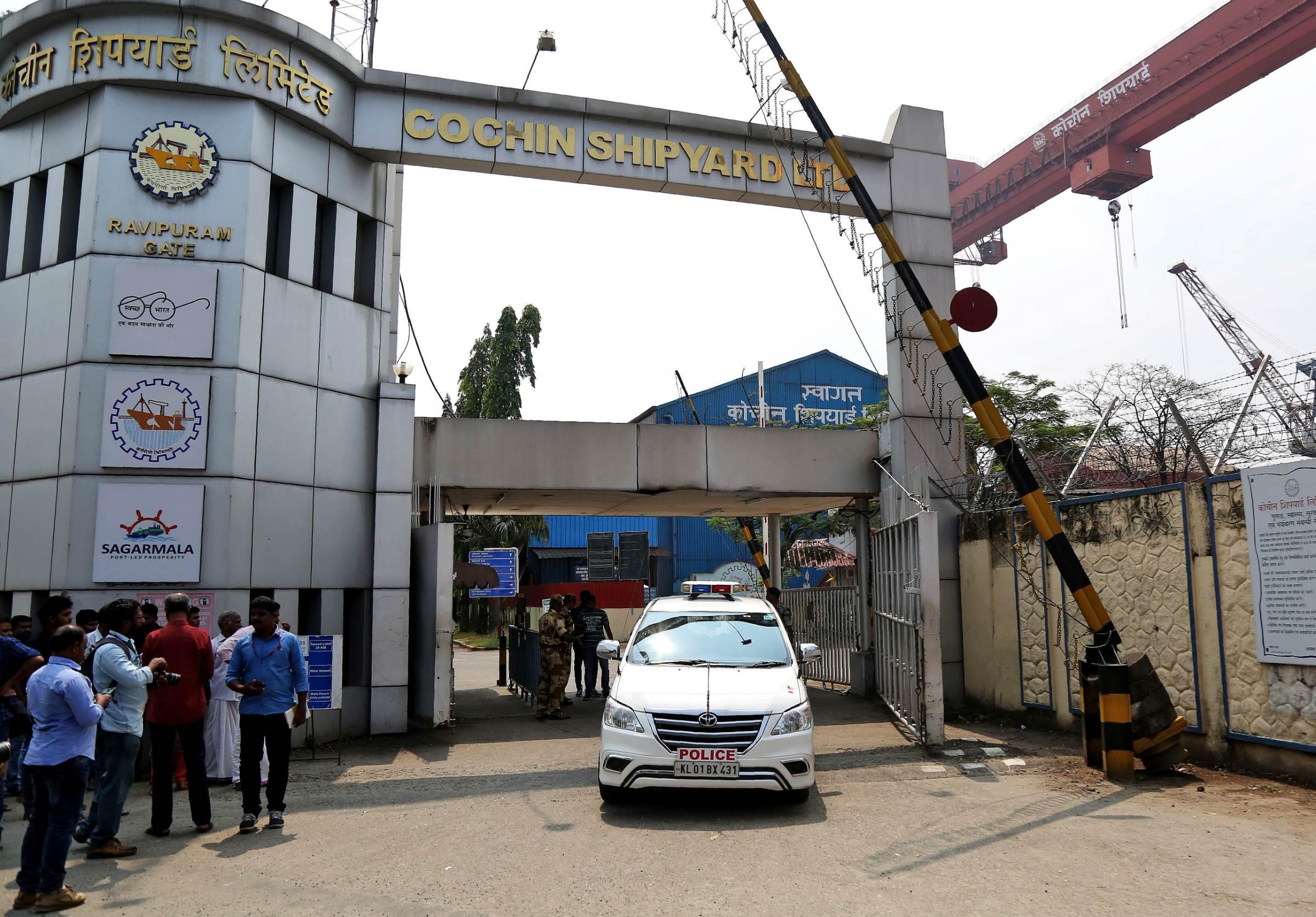
Cochin Shipyard Limited is incorporated in 1972. It’s the Government of India’s answer to building ships when foreign yards charge in dollars. A mini-ratna. A PSU. Strategic importance. All the buzzwords. 67.9% ownership by the President of India, listed on both BSE and NSE.
The company operates across three business verticals: defence shipbuilding (INS Vikrant, patrol vessels, missile corvettes), commercial shipbuilding (bulk carriers, product tankers, platform supply vessels), and ship repair (the cash cow, growing fast at 12–13% CAGR). Domestic operations are strongest, with 70%+ of the current order book earmarked for the Indian Navy.
What’s changed recently? Everything. In Feb 2026, CSL signed a mega contract to build six 1,700 TEU LNG-fuelled feeder vessels for CMA CGM (French shipping giant). Deliveries 36–64 months. Earlier, they were declared L1 (Lowest bidder) for a ₹5,000 crore tender from the Ministry of Defence to build five Next Generation Survey Vessels (NGSVs) for the Indian Navy. That’s not finalised yet, but the signal is clear: the yard is firing on all cylinders.
The catch? Q3 FY26 profitability took a hit. PAT fell 25.3% YoY despite revenue growing 8.93% YoY. The stock is down 7.89% in three months. And the P/E at 53.76x is testing whether “government-backed,” “strategic,” and “moat” are enough to justify any valuation.
Concall Snippet (Feb 2026 board meeting): CSL approved Q3 results, declared an interim dividend of ₹3.50/share, and greenlit a 23% stake acquisition in Conoship Netherlands BV (Dutch design house). Translation: they’re scaling globally while fighting margin battles at home.
03 — Business Model: WTF Do They Even Do?
Building Big Ships. Repairing Bigger Ships. Slowly Losing Money on Each One.
Cochin Shipyard’s business model is deceptively simple: acquire steel, diesel engines, and complex machinery from global suppliers; hire skilled workforce; assemble naval and commercial vessels at its shipyards in Kochi, Howrah, Kolkata, Mumbai, Andaman, and Udupi; deliver, get paid, repeat.
The company has built 194 ships lifetime: large vessels (bulk carriers, tankers), small & medium vessels (tugs, barges, OSVs), and defence vessels (corvettes, survey ships, the IAC-1 INS Vikrant). Repair operations are even more lucrative — ships come back repeatedly, no capital-intensive ramp-up required.
Revenue split: Shipbuilding contributes ~72% (down from 76% in FY23), Ship Repair ~28% (growing). The order book of ₹21,150 crore breaks down as Defence 78% (₹16,500 Cr estimated), Commercial Domestic 6%, Commercial Export 13%, Subsidiaries 3%. Visibility is multi-year. That’s the upside. The downside? Raw material (steel, engines, pipes) account for 45–50% of operating revenue, and there are zero escalation clauses in most contracts. When steel prices spike, CSL’s margin gets compressed. When they don’t, CSL still spends time arguing with bean-counters about “why the gross margin declined 2 percentage points.”
Shipbuilding~72%Revenue Mix
Ship Repair~28%Revenue Mix
Order Book Multiple4.5xvs FY25 Revenue
Escalation Clause Note: The absence of escalation clauses is CSL’s biggest structural risk. In a world of volatile steel/fuel/FX, signing a contract today for delivery 4 years hence at a fixed price is basically handing the supplier the right to make or lose money based on macroeconomic luck. CSL has been trying to negotiate escalation, but clients (especially govt) resist. So CSL eats the margin squeeze.
💬 If you were running a shipyard and a customer asked for a fixed-price 5-year contract, would you laugh, cry, or negotiate? What’s your move?
04 — Financials Overview
Q3 FY26: The Numbers (And Why They’re Headache-Inducing)
Result type: Quarterly Results | Q3 FY26 EPS: ₹5.23 | Annualised EPS (Q3×4): ₹20.92 | Full-year FY25 EPS: ₹27.03
| Metric (₹ Cr) |
Q3 FY26
Dec 2025 |
Q3 FY25
Dec 2024 |
Q2 FY26
Sep 2025 |
YoY % |
QoQ % |
| Revenue | 1,165 | 1,070 | 951 | +8.9% | +22.5% |
| Operating Profit | 166 | 242 | 56 | -31.4% | +196% |
| OPM % | 14.2% | 22.6% | 5.9% | -840 bps | +830 bps |
| PAT | 138 | 184 | 101 | -25.0% | +36.6% |
| EPS (₹) | 5.23 | 7.01 | 3.84 | -25.4% | +36.2% |
What Just Happened: Q3 FY26 revenue hit ₹1,165 crore (highest ever for a quarterly period), growing 8.9% YoY. But operating profit slumped from ₹242 crore to ₹166 crore. OPM compressed 840 basis points to 14.2% — the worst quarterly margin in recent memory. PAT fell to ₹138 crore from ₹184 crore. Why? The management blamed it on “varied project mix” and “milestone-based billing” — which is corporate-speak for “certain big contracts hit their recognition milestones when steel prices were high and margins were thin.” Expect margins to recover to 17–18% medium-term, they say. Hope springs eternal.
05 — Valuation: Fair Value Range
Is ₹1,455 a Screaming Deal or Screaming Overvaluation?
Join 10,000+ investors who read this every week.