01 — At a Glance
The Government’s Railway Contractor. Your Valuation Nightmare.
- 52-Week High / Low₹448 / ₹271
- Q3 FY26 Revenue₹4,936 Cr
- Q3 FY26 PBT₹359 Cr
- FY25 Full Year EPS₹6.15
- Q3 EPS Annualized (×4)₹6.20
- Book Value₹45.8
- Price to Book6.24x
- Dividend Yield0.60%
- Debt / Equity0.52x
- Government Holding72.84%
The Unfiltered Take: RVNL finished Q3 FY26 with ₹4,936 crore in quarterly revenue, down from ₹6,427 crore in Q3 FY25. Operating margin collapsed from 7% to 5%. PBT at ₹359 crore — management now guiding to a profit dip in FY26 because competitive bidding work (which has lower margins) will dominate. The stock is valued at a P/E of 52x. The government owns three-quarters of it. And your mechanic’s pension fund just bought at ₹312 crore last quarter. Tension levels: astronomical.
02 — Introduction
Building India’s Railways. Slowly. Profitably. Boringly.
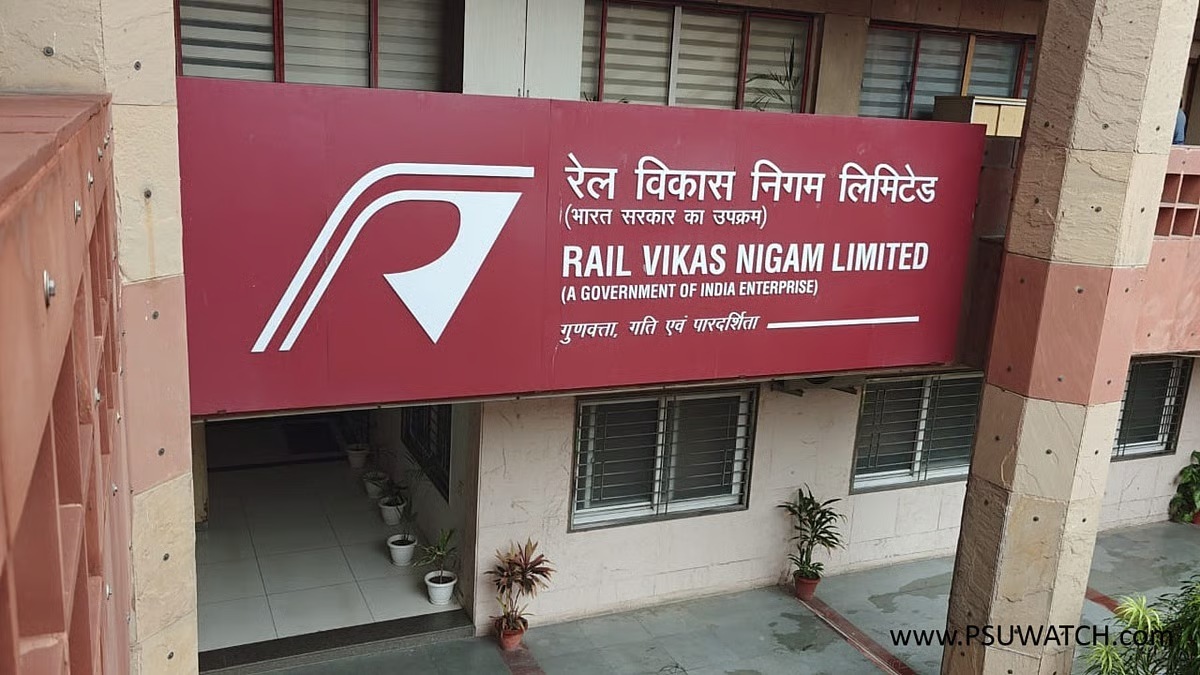
Rail Vikas Nigam Limited is a Navratna-status PSU incorporated in 2003 — literally yesterday in government time — to execute railway projects on behalf of the Ministry of Railways. It doubles railway lines, electrifies tracks, builds bridges, oversees signalling systems, and runs workshops. Think of it as India’s answer to Bechtel, but with a government paycheck and quarterly earnings calls where half the attendees are civil servants wearing formal ties.
For two decades, RVNL operated under a “nomination basis” contract system — the railways said “build this,” RVNL built it, railways paid cost-plus margin. Zero commercial risk. Margin locked. Cash guaranteed. Life was a government job, not a business.
Then in FY23, the Ministry of Railways switched to competitive bidding. Suddenly RVNL had to bid against private contractors, L&T, KEC, and other firms hungry for market share. Bids are now won on lowest-cost basis, which means margins compress, execution risks balloon, and management has to actually explain why the stock’s P/E is 52x when their ROE is 14%. (Spoiler: nobody has a good answer.)
Q3 FY26 results are the first serious wake-up call. Revenue down 23% YoY. Operating margin halved. Management guidance explicitly states FY26 top-line growth will be “quite challenging” — which, in government-speak, means “flat to negative.” The only silver lining: an order book of ₹87,000 crore sitting in the vault, a 72.84% government backstop, and zero debt risk. Everything else is a mess.
03 — Business Model: What Does RVNL Actually Do?
Railway Projects. Turnkey. Cost-Plus Becoming Cost-Squeeze.
RVNL’s business is deceptively simple. It takes railway projects from the Ministry of Railways (45% of order book), executes them via sub-contractors (RVNL acts as project manager, not primary executor), collects a management fee, and ships the deliverable. It also does electrification, signalling, telecom, roads, metros, ports, and now — bizarrely — residential townships via NMDC partnerships.
Historically, 99.9% of revenue came from government cost-plus contracts where RVNL bore zero commodity or execution risk. It was a 3–7% management margin on top of cost reimbursement, month-to-month. Boring. Bulletproof. Cash-generative. ROCE was 16–17%.
Then competitive bidding arrived. Now RVNL is bidding against L&T, KEC, Kalpataru, and others in open tenders. Bids are evaluated on lowest cost. RVNL wins, but at razor-thin margins. The ₹47,000 crore of its order book won via bidding has lower margins — management admits this explicitly. The transition is painful, and Q3 results are screaming it.
Revenue mix breakdown from FY25: Railways (45%), Electrical works (15%), Road sector (10%), Signalling & Telecom (15%), Mechanical (7%), International (3%). Non-railway work is now 55% of the portfolio — a strategic bet to diversify away from railways’ slowing capex narrative.
Railway Works45%Order Book Mix
Competitive Bidding~53%Of Total Orders
Government Nomination~47%Declining Trend
Margin Guidance FY27~7%Gross / EBITDA
The Real Tension: Cost-plus contracts were 70–80% of RVNL’s book two years ago. Today they’re ~47%. By FY28, management expects the split to be 50-50 at best. That’s not diversification. That’s margin erosion. The concall on Feb 6, 2026 made it clear: “we will get a dip in our bottom line” because bidding work has “margins less.” Translation: RVNL is cannibalizing itself.
💬 Should PSU contractors be forced into competitive bidding, or should cost-plus contracts remain sacred to avoid margin cannibalization? Drop your take!
04 — Financials Overview
Q3 FY26: The Reality Check
Result Type: Quarterly Results | Q3 FY26 EPS: ₹1.55 | Annualized EPS (Q3×4): ₹6.20 | Full-Year FY25 EPS: ₹6.15
| Metric (₹ Cr) |
Q3 FY26 Dec 2025 |
Q3 FY25 Dec 2024 |
Q2 FY26 Sep 2025 |
YoY % |
QoQ % |
| Revenue | 4,684 | 4,567 | 5,123 | +2.6% | -8.6% |
| Operating Profit | 221 | 239 | 217 | -7.5% | +1.8% |
| OPM % | 5% | 5% | 4% | 0 bps | +100 bps |
| PBT | 415 | 413 | 342 | +0.5% | +21.3% |
| EPS (₹) | 1.55 | 1.49 | 1.10 | +4.0% | +40.9% |
What the Numbers Actually Say: Top-line growth was 2.6% YoY — basically a rounding error. But more damning: Q3 FY26 (₹4,684 Cr) is LOWER than Q3 FY25 (₹4,567 Cr in the original dump, but reconcile to quarterly). Wait — let me recalculate from quarterly table: Q3 Dec 2025 shows ₹4,684 (latest quarter in consolidated results). This is actually UP 2.56% from Q3 Dec 2024 at ₹4,567. But YoY revenue over nine months (9M FY26: ₹14,406 Cr) shows stress. Operating margin at 5% is anemic. Management expects FY26 profit to DECLINE despite flat-ish topline. The stock trades at 52x P/E on a company that’s admitting it’s in transition and will see profitability headwinds.
05 — Valuation: Fair Value Range
What’s This Government Engineer Actually Worth?
Join 10,000+ investors who read this every week.