01 — At a Glance
The Steel Plate That Bent But Didn’t Break
- 52-Week High / Low₹168 / ₹101
- 9M FY26 Revenue₹79,997 Cr
- 9M FY26 PAT₹2,148 Cr
- 9M EPS (FY26)₹5.20
- Annualised EPS (Q3×4)₹3.64
- Book Value₹141
- Price to Book1.10x
- Dividend Yield1.03%
- Debt / Equity0.58x
- Crude Steel Capacity20 MTPA
The Auditor’s Note: Nine months into FY26, SAIL has ₹79,997 crore revenue (+9% YoY), PAT at ₹2,148 crore with a +60% jump driven by deleveraging and inventory liquidation rather than actual margin expansion. The company reduced debt by ₹5,000 crore in 9M and slashed interest costs by ₹500 crore. Crude steel production at 14.35 MT in 9M, capacity utilization near 98%, and the stock returned +19.4% in three months. On paper, things look shinier. In reality, the company is selling steel at higher volumes but lower realizations, using accounting tailwinds to dress up a cyclical downside. The ₹155 stock trades at 1.10x book value — which is basically saying: “We’ll give you steel assets at a 10% discount to their stated worth.” The market is unconvinced.
02 — Introduction
SAIL: The Maharatna That Everyone Forgets Is Even A Company
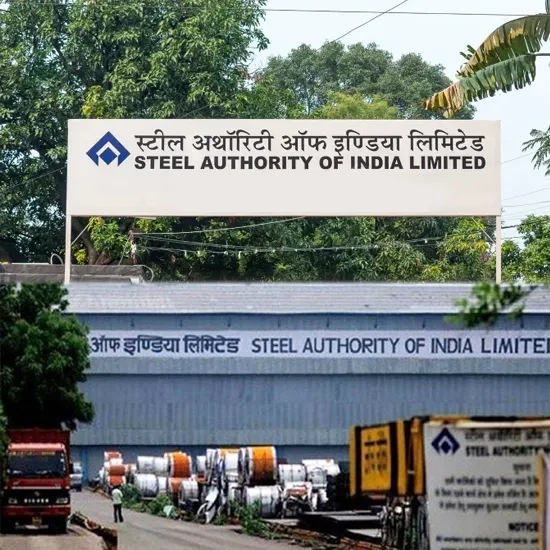
Steel Authority of India Limited (SAIL) is the government’s steel company. The kind of enterprise where board meetings are held in institutional grey tones and the managing director changes not because of market whims, but because someone hits superannuation and a file lands on an MoS desk. Since 1973, when the government bundled five integrated steel plants under one roof, SAIL has been the anvil on which India’s infrastructure was hammered.
It’s a Maharatna now — one of 13 in the entire country. It supplies steel for railways, highways, dams, defence projects, and metro systems. It owns captive iron ore mines across Jharkhand, Odisha, and Chhattisgarh. It commands ~51% market share in automotive lubricants… no wait, that’s Castrol. SAIL commands ~51% of India’s integrated steel capacity and operates at near 98% utilization. The numbers are solid. The problem is that solid numbers mean absolutely nothing when steel prices are falling, coking coal is expensive, and the global market is oversupplied.
FY25 was a story of margin compression. FY26 is a story of recovery through volume and deleveraging. Or is it? The concall in February 2026 revealed that management sees price momentum beginning only from Q4, with January hikes trickling into February and March realizations. Until then, the company is basically playing volume arbitrage — selling more steel at lower prices to clear inventory and reduce working capital debt. It’s not a bad strategy for a government-owned enterprise obligated to social responsibility. It’s a terrible strategy if you’re a shareholder looking for capital gains.
Concall Insight (Feb 2026): Management explicitly stated Q4 will see “an uptick in pricing,” with carryover hikes from January feeding into February and March realizations. Translation: Three months of trying to sell steel at better prices. If that fails, the story unravels.
03 — Business Model: Commodities Is Rough. Especially When The Government Owns You.
Five Plants. One Destiny. No Leverage.
EduInvesting runs entirely on reader support — ₹360 a year keeps the lights on.