Search for stocks /

PB Fintech:₹189 Cr Profit. 165% Growth. Insurance Is A Distribution Game.

PB Fintech Q3 FY26 | EduInvesting
Q3 FY26 Results · December 2025

PB Fintech:
₹189 Cr Profit. 165% Growth. Insurance Is A Distribution Game.

India’s largest digital insurance marketplace just posted its best quarter ever. Revenue up 37%. Profit surged 165%. And management is preparing to dilute everyone by going international. Plot twist: they’re probably right.

Market Cap₹66,091 Cr
CMP₹1,428
P/E Ratio114x
Return 1Y+2.2%
ROCE5.9%

The Digital Insurance Unicorn That Finally Learned How To Make Money

  • 52-Week High / Low₹1,978 / ₹1,311
  • Q3 FY26 Revenue₹1,771 Cr
  • Q3 FY26 PAT₹189 Cr
  • Q3 FY26 EPS₹4.09
  • Annualised EPS (Q3×4)₹16.36
  • Book Value₹146
  • Price to Book9.76x
  • Dividend Yield0.00%
  • Debt / Equity0.05x
  • EV / EBITDA84.9x
The Brutal Honesty Check: PB Fintech is valued at 114x P/E after delivering ₹189 Cr profit in Q3 FY26 — up 165% YoY. That’s not a price. That’s a leap of faith on steroids. The market is literally pricing in not just tomorrow’s growth, but three years of hypergrowth compounded and then some. Their 1-year return is 2.2%. Their P/B is 9.76x. The stock hasn’t moved much, but the company has. Now management wants to raise capital (QIP) to fund international expansion. The debate is simple: are they walking into a profit-extracting global business, or just burning capital to chase scale?

Welcome to Digital Insurance: Where a 93% Market Share Still Feels Fragile

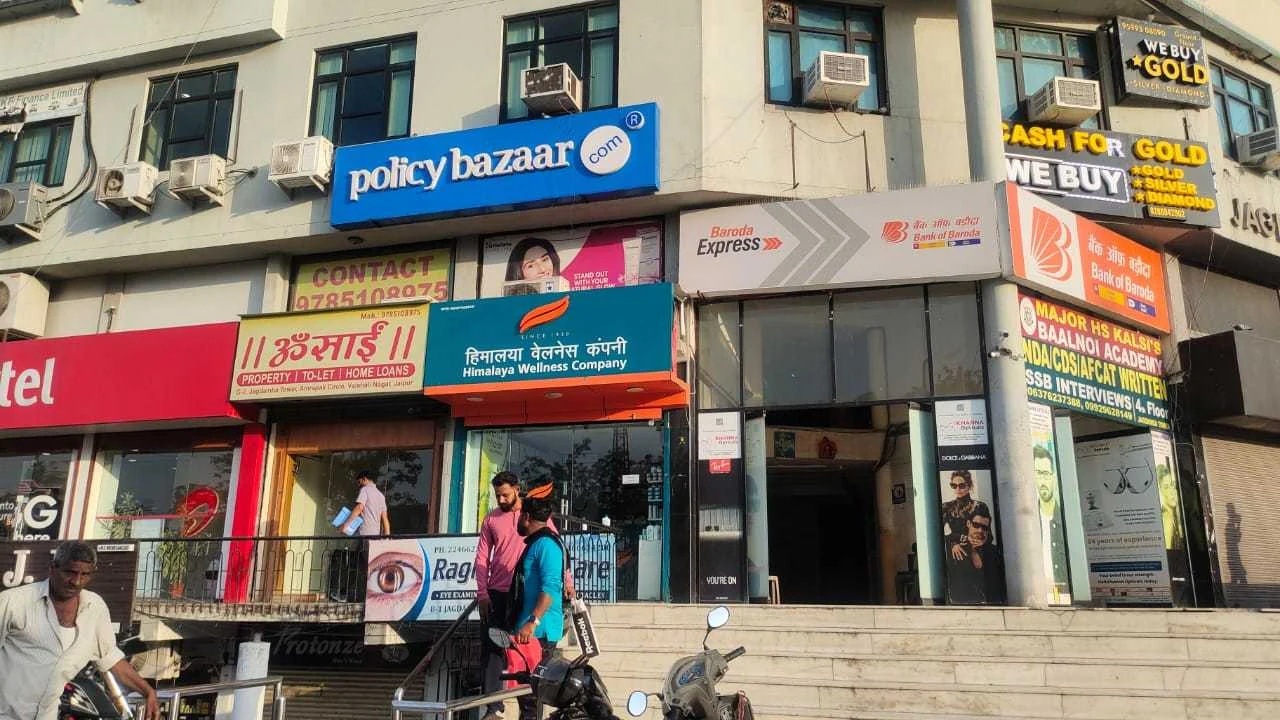
Let’s talk about Policybazaar. Not the green-and-yellow ads on YouTube. Not the celebrity endorsements screaming “compare insurance in 60 seconds.” But the actual business underneath: India’s largest online insurance marketplace, holding 93% market share in the digital space, with 86.9 million registered users and 18.3 million active users across Policybazaar and Paisabazaar (its lending arm).

The company has three platforms: Policybazaar (insurance), Paisabazaar (lending), and PB Partners (an agent enablement SaaS). In Q3 FY26, they fired on all three cylinders — insurance premium +44% YoY, lending disbursals +84% YoY, and core revenue up 37% while PAT exploded 165%. For a company that was losing money eight quarters ago, this is the redemption arc that venture capitalists dream about.

Except there’s a problem. They’re valued at ₹66,091 crore on a market cap that has hardly moved in 12 months, sitting at a P/E of 114x. To justify that, the company doesn’t just need to grow 30% annually — it needs to grow at that rate for the next 5+ years while expanding internationally, penetrating tier-4 cities, and converting digital market share into actual underwriting profitability. No pressure, right?

Then came February 2026. Management cancelled a board meeting on a rumoured $1 billion QIP. Yashish Dahiya (CEO) went on the concall to explain why going global makes sense. And suddenly, the narrative flipped from “fintech startup profiting” to “fintech startup preparing for war.” Let’s unpack what actually happened in Q3 FY26, why the numbers jumped, and whether the international dream is genius or just expensive hubris.

Feb 2026 Concall Headline: Management rejected a $1 billion QIP rumour. But they’re still considering QIP for “significant EPS accretion.” They’re just not saying how much or when. Smart PR move, or a tell that negotiations are ongoing?

Why Policybazaar Is Not An Insurance Company (And That’s The Whole Point)

Policybazaar doesn’t underwrite insurance. It doesn’t hold reserves. It doesn’t settle claims on its balance sheet. It’s a distribution platform. Customers come to compare insurance plans, Policybazaar earns a commission from the insurer. Simple. The insurer settles the claim. Policybazaar goes back to selling more policies.

This is important because it means Policybazaar is not a risk-bearing entity — it’s a customer acquisition and management engine. Insurers are the underwriters. Policybazaar is the trust layer in between. Revenue comes from two places: (1) commission on sold policies, and (2) trail revenue from renewals. The trail is the magic. A customer buys a policy in year one, Policybazaar gets an upfront commission. In years two and beyond, as the policy renews, Policybazaar gets renewal trail revenue — perpetual income with minimal new customer acquisition cost. That’s the annuity hidden inside digital distribution.

Paisabazaar (lending) is different. It’s a credit comparison and disbursement platform. Policybazaar sources leads. Partner NBFCs and banks disburse loans. Policybazaar earns origination fees (typically 1–2% of disbursals). It’s asset-light, customer-heavy, and scales fast — but trail revenue is lower because loans don’t have the same renewal dynamics as insurance.

PB Partners is the recent wildcard: an agent enablement platform for small insurance advisors. Instead of Policybazaar owning the customer entirely, it provides SaaS tools to independent insurance agents — essentially making it easier for agents to sell Policybazaar-sourced plans. Revenue here comes from software subscriptions and a revenue share on policies sold through agents.

Insurance85%Revenue Mix
Lending12%Revenue Mix
Other3%Revenue Mix
The Distribution Moat: Management says on the concall: “Insurance is a distribution business. 95-98% of insurance is sold by intermediaries.” Policybazaar is literally that intermediary, but digital. It has 93% market share in online insurance distribution. But hold up — 93% of what? Of online sales only. Overall, digital is still maybe 10–15% of total insurance market. The other 85–90% is still sold by offline agents, direct sales, and bancassurance. That’s actually good news for Policybazaar because the runway for digital adoption is massive. That’s also bad news because they’re not quite the unstoppable force they’re marketed as.
💬 Quick one: If Policybazaar has 93% market share in online insurance, why is their ROCE only 5.9% and ROE barely positive? Shouldn’t market dominance print money?

Q3 FY26: The Inflection Point That Actually Inflected

Result type: Quarterly Results  |  Q3 FY26 EPS: ₹4.09  |  Annualised EPS (Q3×4): ₹16.36  |  FY25 Full Year EPS: ₹7.69

Metric (₹ Cr) Q3 FY26
Dec 2025
Q3 FY25
Dec 2024
Q2 FY26
Sep 2025
YoY % QoQ %
Revenue1,7711,2921,614+37.1%+9.7%
Operating Profit1592898+468%+62.2%
OPM %9%2%6%+700 bps+300 bps
PAT18972135+165%+40%
EPS (₹)4.091.562.94+162%+39%
Wait, What Just Happened? Operating profit jumped from ₹28 Cr (Q3 FY25) to ₹159 Cr (Q3 FY26). That’s 468% growth on just 37% revenue growth. Either they discovered the secret to printing money, or something fundamentally changed in their cost structure. Answer: both. Revenue is scaling faster (insurance mix is higher margin). But also, all the losses from earlier years are finally gone. New initiatives in UAE, credit, and PB Partners were dragging down profitability. Now they’re near break-even or profitable. That’s the operational lift. Management explicitly said in the concall: “new initiatives approaching break-even.” Translation: expect consolidated profit margins to expand further as these bets start contributing positively instead of dragging down earnings.

Is 114x P/E Ever Justified? (Spoiler: Maybe. But Probably Not For This Company.)

Join 10,000+ investors who read this every week.
Become a member
error: Content is protected !!