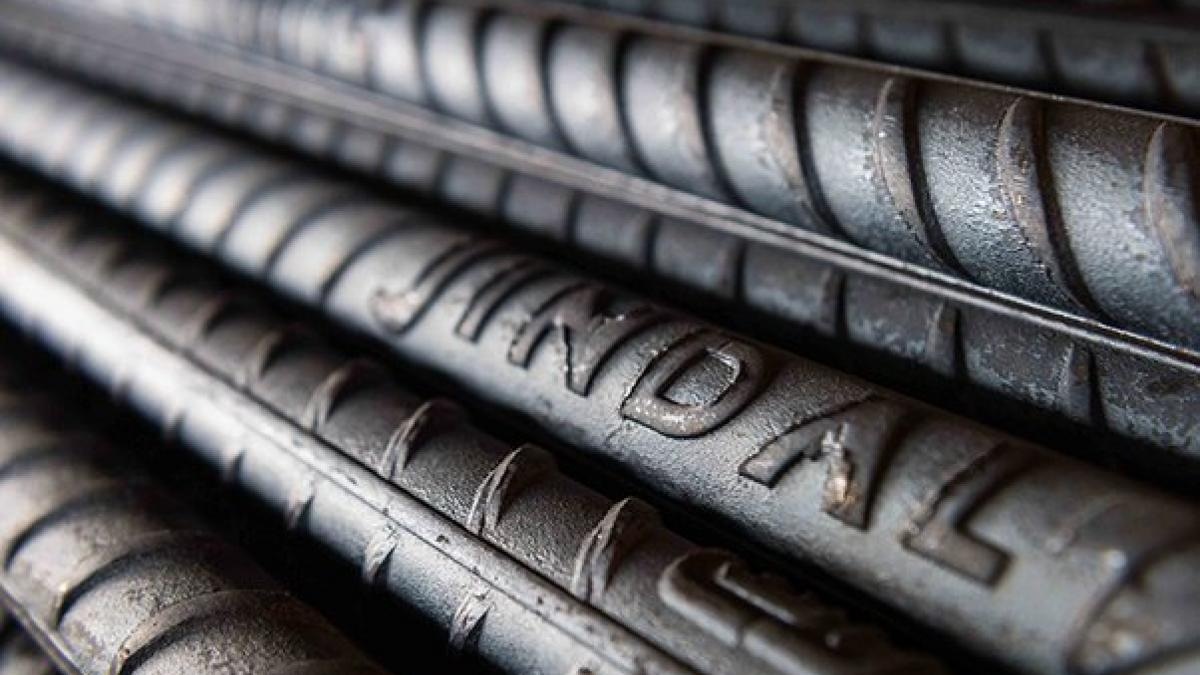
Jindal Steel:
₹2.51 MT Steel. ₹189 Cr PAT.
Capacity Doubling Amid China Chaos
Highest production in years. New blast furnaces roaring. One-time ₹350 crore start-up cost. And management is telling you to ignore half of Q3 and focus on Q4. Welcome to the game.
The Steel Beast That’s Learning To Walk Again
- 52-Week High / Low₹1,272 / ₹770
- Q3 Revenue₹15,172 Cr
- Q3 PAT (Reported)₹189 Cr
- Q3 EPS₹1.87
- Annualised EPS (Q3×4)₹7.48
- Book Value₹486
- Price to Book2.43x
- Debt / Equity0.39x
- Net Debt (Q3)₹15,443 Cr
- Net Debt/EBITDA1.72x
Steel: The Business That Never Stops Being Complicated
Jindal Steel is India’s second-largest private steel producer (after JSW Steel, depending on the metric you pick). They make plates, wire rods, TMT rebars, structural steel, and lately, they’re getting aggressive about “value-added products”—fancy code for “higher-margin stuff that sounds better in presentations.”
The company operates like a vertically integrated Russian nesting doll: they dig iron ore and coal from their own mines (in India, Mozambique, Australia, South Africa). They smelt it, heat-treat it, roll it, and ship it to construction sites, automakers, and exporters across 160+ countries. Revenue: ₹50,190 crore. Market cap: ₹1.2 lakh crore. And they’re in the middle of a ₹31,000 crore capacity expansion that’s supposed to double steel production by FY27.
Q3 FY26 (December 2025) happened to be the quarter when their new blast furnaces and steel-making units roared to life. Result? Highest production in years. Also result? A ₹350 crore one-time cost (mostly coke-related inefficiencies during start-up). And lowest reported quarterly PAT in two years.
The concall transcript is a masterclass in “we’re not worried about current metrics—wait for next quarter.” Management literally walked investors through the start-up economics, the temporary cost pressures, and then casually dropped that by Q4, things normalize. Some investors bought it. Some didn’t. All of them are now watching whether Q4 PAT actually rebounds or if this “temporary” story stretches longer.
They Dig. They Smelt. They Roll. They Ship. Rinse. Repeat.
Jindal Steel’s business model is old-school industrial: vertical integration from earth to finished steel. They own coking coal mines in Australia and Mozambique. They own iron ore mines in India, Mozambique, and South Africa. They own thermal coal, anthracite coal, and they even run a 1,634 MW captive power plant. Then they process all of this into steel at four plants (Chhattisgarh, Odisha, Jharkhand) and sell it to end-use industries.
Revenue mix (Q2 FY25): Infrastructure 40%, Distribution 31%, Building & Construction 15%, Engineering & Packaging 10%, Automotive 3%. Yes, automotive is tiny. No, they don’t seem overly concerned about EV disruption disrupting their long-term thesis. Their thinking: commercial vehicles and industrial machinery will need steel for another 20 years regardless.
Value-added products now comprise 50% of sales volumes (up from 44% a few years ago). High-tensile plates, heat-treated coils, rails, tensile structures, alloy wire rods—these carry higher margins than commodity hot rolled coils (HRC). Management’s medium-term play: shift the mix to 70% value-added and lower the volatility of earnings.
Capacity expansion at Angul (Odisha) is the kingmaker. Two new blast furnaces (9.6 MTPA combined) + three new steel-making units (9 MTPA combined) are being commissioned in phases. By end of Q4 FY26, the company expects total steelmaking capacity of 15.6 MTPA (up from 9.6 MTPA today). It’s a three-year capex marathon. The pain is now. The gain is Q4 onwards.
Q3 FY26: The Ramp-Up Reveals Its True Cost
Result type: Quarterly Results | Q3 FY26 EPS: ₹1.87 | Annualised EPS (Q3×4): ₹7.48 | One-time start-up cost: ₹350 Cr
| Metric (₹ Cr) | Q3 FY26 Dec 2025 | Q3 FY25 Dec 2024 | Q2 FY26 Sep 2025 | YoY % | QoQ % |
|---|---|---|---|---|---|
| Revenue | 15,172 | 11,751 | 13,683 | +29.2% | +11.0% |
| Operating Profit | 1,629 | 2,184 | 2,814 | -25.4% | -42.1% |
| OPM % | 10.7% | 18.6% | 20.6% | -790 bps | -990 bps |
| EBITDA (Adjusted) | 1,593 | 2,280 | 2,812 | -30.1% | -43.4% |
| EBITDA Margin % | 10.5% | 19.4% | 20.5% | -890 bps | -1000 bps |
| PAT | 189 | 951 | 635 | -80.1% | -70.2% |
| EPS (₹) | 1.87 | 9.32 | 6.26 | -79.9% | -70.1% |
What’s This Ramp-Up Story Actually Worth?
Method 1: P/E Based
Annualised EPS (Q3×4) = ₹7.48. But this is depressed by one-time costs. Normalized FY26 EPS likely ₹15–18 (assuming Q4 EBITDA-margin recovery). Sector median P/E for steel: 20.1x. Jindal’s justified range (given leverage): 15x–20x (pending deleveraging).
Range: ₹898 – ₹1,196
Method 2: EV/EBITDA Based
Q3 Adjusted EBITDA = ₹1,593 crore (quarterly). Annualized: ~₹6,372 crore (post-normalization). Peak capex/leverage cycle now—EV/EBITDA currently 14.9x. Peers trade 10x–18x. Fair range: 11x–15x post-deleveraging.
EV range (11x–15x on ₹6,400 Cr EBITDA): ₹70,400 Cr – ₹96,000 Cr → Per share:
Range: ₹927 – ₹1,268
Method 3: DCF Based
Base FCF (post-capex): ₹7,000–₹8,000 crore (FY27 onwards). Growth: 8–10% for 5 years. Terminal growth: 3%. WACC: 10.5%.
→ Terminal Value: ~₹78,000 Cr
→ Total EV (less net debt): ~₹95,000 Cr
Range: ₹950 – ₹1,250
The Angul Expansion: Three Furnaces Walk Into A Bar…
🔴 Blast Furnace 2 & Steel Unit 2 Now Live (With Teething Pain)
September 2025: 5 MTPA Blast Furnace (BF2) at Angul commissioned. October 2025: 3 MTPA Basic Oxygen Furnace (BOF2) operationalized. Combined, they lifted crude steel capacity from 6 MTPA to 9 MTPA. Q3 saw both units ramp: BF2 at 48% utilization (exit run-rate 58%), contributing significantly to the 2.51 MT crude steel production. The cost? ₹350 crore in one-time inefficiencies (mostly bought-out coke during commissioning). The plan? December 2025 onwards, another 3 MTPA BOF (BOF3) will be commissioned, taking total steelmaking to 15.6 MTPA by March 2026.
⚠️ Margin Squeeze Real (But “Temporary”)
- • Q3 OPM fell to 10.7% (from 20.6% Q2). Start-up costs are the culprit.
- • Coking coal costs up $2/ton QoQ; management guided for +$18–$20/ton in Q4.
- • Blended steel realization down ₹3,000/ton QoQ (product mix shift + pricing weakness).
- • By-product revenue lag because coke oven commissioned mid-Q3.
- • Management’s narrative: “This is Q3. Wait for Q4 normalization.”
✅ Capacity Milestones Delivered On Time
- • ₹32,925 crore capex deployed so far (out of ₹47,043 crore total).
- • Slurry pipeline 94% complete (expected ₹750–₹850/ton cost benefit).
- • New coking coal mines in Mozambique & South Africa ramping (15–20% of coking coal now sourced).
- • SBPP power turnaround complete (1,050 MW operationalized).
- • Utkal B1 iron ore mine opened (benefits “later, not this quarter”).
Is The Fort Stable Amid The Build-Out?
| Item (₹ Cr) | Mar 2024 | Mar 2025 | Sep 2025 | Dec 2025 (Q3) |
|---|---|---|---|---|
| Total Assets | 78,676 | 85,766 | 89,280 | 91,737 |
| Net Worth (Eq + Reserves) | 44,688 | 47,185 | 49,517 | 49,517 |
| Borrowings | 16,472 | 18,406 | 19,156 | 19,156 |
| Other Liabilities | 17,516 | 20,175 | 20,607 | 23,064 |
| Total Liabilities | 78,676 | 85,766 | 89,280 | 91,737 |
Borrowings up ₹684 crore QoQ (Sep to Dec). Net debt at ₹15,443 crore. Net debt/EBITDA at 1.72x (up from 1.58x in Sep). Peak leverage cycle. Management expects to bring it “sub-1.5x” once ramp-up cash flows normalize.
Interest expense ~₹406 crore (Q3). Operating profit before start-up costs: ~₹1,979 crore. Interest coverage 4.88x (not bad, but declining from 6.1x pre-capex blitz).
Capital Work-in-Progress (CWIP) down from ₹16,725 crore (Mar 25) to ₹12,193 crore (Dec 25) as units commission. Asset base growing. Hopefully, ROIC improving when capex capstone hits.
Operating CF Strong, But Capex Eating Everything
| Cash Flow (₹ Cr) | FY24 | FY25 | Q3 FY26 |
|---|---|---|---|
| Operating CF | +6,008 | +10,824 | +2,400 (Qtr) |
| Investing CF | -8,344 | -12,323 | -2,076 (Qtr) |
| Financing CF | +1,381 | +809 | +Debt draws |
| Free Cash Flow | -2,336 | -1,499 | +324 (Qtr) |
ROCE Compression. But Management Says It’s Temporary
Annual Trends: Rising Revenue, Compressing Margins (For Now)
| Metric (₹ Cr) | FY23 | FY24 | FY25 | FY26 (TTM) |
|---|---|---|---|---|
| Revenue | 53,212 | 50,354 | 50,129 | 50,190 |
| Operating Profit | 9,942 | 10,202 | 9,488 | 8,977 |
| OPM % | 19% | 20% | 19% | 18% |
| PAT | 3,974 | 5,943 | 2,846 | 2,016 |
| EPS (₹) | 31.11 | 58.21 | 27.57 | 19.45 |
The story: FY24 was peak (₹5,943 Cr PAT on normalized margins). FY25 was a bloodbath (one-off items dragged down PAT to ₹2,846 Cr, -52% YoY). FY26 TTM shows stabilization at ₹2,016 Cr, but that’s with three quarters of compressed margins due to ramp-up. If Q4 normalizes (management’s claim), FY26 PAT could be ₹3,200–₹3,500 crore. Credible, but not guaranteed.
Jindal vs The Lala Steel Empire (JSW Steel)
| Company | CMP | P/E | ROCE % | Net Debt/EBITDA | Qtr Revenue (₹ Cr) |
|---|---|---|---|---|---|
| Jindal Steel | ₹1,180 | 42.3x | 10.7% | 1.72x | 15,172 |
| JSW Steel | ₹1,234 | 38.6x | 8.1% | 0.89x | 45,991 |
| Tata Steel | ₹198 | 25.3x | 8.8% | 0.84x | 57,002 |
| SAIL | ₹155 | 21.1x | 6.8% | 0.41x | 27,371 |
| Jindal Stain. | ₹752 | 21.0x | 18.2% | 0.08x | 10,518 |
Jindal Steel is trading at the highest P/E among large-cap peers (42.3x) despite having the lowest ROCE (10.7%) and highest net debt/EBITDA (1.72x). JSW Steel trades at 38.6x with better deleveraging trajectory (0.89x). Tata Steel at 25.3x P/E looks cheaper in absolute terms. The valuation premium for Jindal is entirely dependent on the “capacity expansion recovery story” panning out. No margin of safety here. Only faith.
The Jindal Family Empire: Still In Full Control
- Promoters (Jindal Family)62.71%
- DIIs (incl. mutual funds)19.10%
- FIIs9.02%
- Public8.93%
- Others0.25%
Pledge: 10.9%. Institutional ownership rising (DIIs + FIIs at 28.1%). Public float only 8.9%. Retail is scarce. Promoter holding has been rock-solid for years—no dilution drama.
Promoters: The Jindal Brothers (And Cousins)
Naveen Jindal (the public face), Sajjan Jindal (JSW Steel owner—yes, same family, different branch), and a complex web of HUFs, trusts, and investment entities. Together, they control 62.71% directly and indirectly. Multi-generational wealth. No corporate governance red flags. But also: promoter voting power = ultimate control. Minority shareholders are passengers on the Jindal bus.
Recent Shareholding Shift (Feb 2026)
Skyhigh Sustainable Holdings acquired 4.87% stake from Gagan Infraenergy Limited (a Jindal entity) on Feb 20, 2026. Translation: minor reshuffling within the promoter ecosystem. No external PE player entering. Promoter consolidation, if anything. Shows Jindals are patient capital and not worried about short-term volatility.
ICRA Reaffirmed Ratings. Management Shuffles Happening
✅ ICRA Reaffirmation (Oct 2025)
- ✓ AA (Stable) on term loans and cash credit
- ✓ A1+ on short-term facilities
- ✓ AA (Stable) on NCDs
- ✓ ICRA notes strong operating profile & integrated operations
- ✓ Comfort from successful commissioning track record
- ✓ Management committed to maintaining net debt/EBITDA <1.5x
⚠️ Management Changes & Watchpoints
- ⚠ Oct 2025: Gautam Malhotra appointed CEO (replacing previous leadership structure)
- ⚠ Oct 2025: Sunil Agrawal appointed interim CFO; Parimal Rai appointed as independent director
- ⚠ Transition-related risk during peak capex + ramp-up phase
- ⚠ Promoter pledge at 10.9% (normal levels, but monitor if increases)
- ⚠ Working capital tight (current ratio 0.99x—below 1.0)
Auditor: Ernst & Young (statutory auditor). No qualifications noted. Annual reports filed on time. AGM scheduled for March 26, 2026. ESG disclosures ramping (included in S&P Global Sustainability Yearbook 2026). Overall: clean governance by Indian large-cap standards. Nothing screams red flag, but also no exceptional governance premium.
Steel: The China Dumping Ground, The India Hope Story
Global steel market in Q3 FY26: China is drowning in overcapacity. Production up, exports up (119 MT in CY2025—record). Prices down. “Low-price exports,” as management calls it, are flooding India. Domestic pricing pressure is real.
🔴 The China Overhang: Not Disappearing Anytime Soon
China’s crude steel production growth (2%) is slower than demand growth (0.5%). Net oversupply. Result: record exports at bargain prices. India has imposed a 3-year safeguard duty on select steel imports (12% Year 1, stepping down to 11% by Year 3). It’s a band-aid. Management noted Q3 pricing pressure but expects Q4 recovery as demand improves (auto, appliances, construction season kicking in). The macro winds are fickle. Don’t count on sustained pricing recovery.
✅ Domestic Demand Underpinned By Infra Capex & Auto Cycle
India’s domestic steel balance in Q3: crude production up 2% QoQ, demand up 0.5% QoQ (modest). But exports swung favorable for the first time in 6 quarters: +30% QoQ, imports -36% QoQ. India is becoming a net exporter. Government infra capex, defense spending, and commercial vehicle utilization remain strong supports. Capacity utilization is the key—JSL benefited from it in Q3, and management expects sustained domestic traction in Q4.
📈 EV Disruption: Slower Than The Doomers Think
Electric 2-wheelers and cars are growing, but base is tiny (~2–5% of new vehicle sales). The installed base of ICE vehicles will churn for another 15–20 years. Structural demand for automotive steel (even in EV era) remains resilient. JSL’s exposure to commercial vehicles (40% revenue from infra, distribution) is also defensive. The EV threat is real long-term, but not imminent enough to reprogram steel thesis today.
⚡ The Slurry Pipeline & Cost Competitiveness Play
Jindal’s Angul slurry pipeline (94% complete) will reduce iron ore transportation costs by ₹750–₹850/ton. That’s margin expansion locked in. When it’s operational (FY27), combined with new metallics capacity + coke ovens running full, EBITDA/ton will expand meaningfully. It’s the underrated catalyst. Not headline news, but financially consequential.
Competitive dynamics: JSW Steel is the only other private player with scale. SAIL is public sector (lower cost, lower quality execution). Tata Steel is legacy + global operations (better ROIC, more volatile). Jindal is mid-table by scale (₹50K Cr revenue) but catching up fast with Angul capex. By FY27, Jindal will have 13.75 MTPA finished capacity—third largest in India after SAIL (~14 MTPA) and Tata (~20 MTPA). Consolidation risk? Low. Pricing pressure? Moderate (depends on China exports).
The Ramp-Up Gamble
Jindal Steel is mid-journey in the largest capacity expansion in its history. ₹31,000 crore deployed. 13.75 MTPA finished capacity targeted. Operating margins compressed by 10–15% due to one-time start-up costs. Leverage at 1.72x net debt/EBITDA—peak of the cycle. The company is asking investors to ignore Q3 and believe in Q4–Q5 normalization. Some will. Some won’t.
The Case For Optimism: ICRA reaffirmed ratings. Capacity commissioning is on track. Q3 OPM was 10.7% due to one-time costs; excluding that, normalized margin is ~13%. Blended realization fell because of product mix shift (pushing HRC for throughput), not because of structural demand destruction. By Q4, third BOF comes online, coke ovens are self-sufficient, and pricing recovers. FY27 onwards, FCF turns positive, leverage drops, and normalized ROCE could be 14–16%. At that point, P/E compression from 42x to 25–28x is plausible, justifying ₹1,200–₹1,400 per share within 2 years.
The Case For Caution: Revenue growth is flat for 3 years (CAGR -0.68%). Demand is modest (India’s crude steel balance was barely positive in Q3). China dumping is ongoing. The one-time cost narrative could extend: what if Q4 still sees inefficiencies? What if slurry pipeline delays? What if global prices collapse further? P/E is already 42x—there’s no margin of safety. And working capital is tight (current ratio 0.99x); liquidity could be pinched if capex overruns. Execution risk during a leadership transition (new CEO in Oct 2025) is real.
Historical Context: Jindal Stock delivered 29.9% return in 1 year, 27.1% over 3 years, and 29.5% over 5 years. The market rewards capacity expansion stories when they work. But they don’t always work. Overcapacity is steel’s worst nightmare. If Jindal ramps 13.75 MTPA capacity into flat demand, margins compress for 3–5 years. The promoter has the patience. Minority shareholders don’t.
✓ Strengths
- Vertical integration: captive coal, iron ore, power = cost advantage
- Established track record of greenfield/brownfield commissioning
- Q3 production 2.51 MT (highest in years) proves capacity ramp is real
- ₹750–₹850/ton cost savings from slurry pipeline (locked-in)
- New coke ovens + pellet plants + DRI units ramping (captive supply improving)
- Promoter holding 62.7% (no exit risk; long-term orientation)
✗ Weaknesses
- Negative revenue growth over 3–5 years (capacity race into flat demand)
- ROCE 10.7% is below cost of capital (capex-heavy model destroys value short-term)
- Current ratio 0.99x; working capital tight (liquidity risk during downturns)
- Leadership transition (new CEO, CFO changes) amid peak capex
- ₹32,925 Cr cumulative capex; still ₹14K Cr to go (FY27 drawdowns material)
→ Opportunities
- Ramp-up of BOF3, slurry pipeline, Utkal B1 mine (FY27 normalization catalysts)
- Domestic demand from infra capex supercycle (government spending holding up)
- Value-added products mix (from 50% to 70% target) = margin uplift
- Cost savings from new coal mines (Mozambique, South Africa) ramping
- Paradip port development (infrastructure play that’s not yet modeled)
⚡ Threats
- China overcapacity dumping depressing global + Indian prices
- Demand growth slower than capacity growth (capacity utilization risk)
- Capex overruns or commissioning delays extending margin compression
- EV adoption accelerating faster than expected (long-term structural headwind)
- Global recession impacting infra + construction demand
Jindal Steel is a capacity-expansion story masquerading as a value-add narrative.
The company is at the inflection point: either the biggest margin expansion of the decade (if demand keeps up with capacity), or a 3–5 year margin drag (if overcapacity emerges). Q4 FY26 and Q1 FY27 will be critical. Management’s track record of commissioning is solid. But track record doesn’t guarantee demand pickup.
Current valuation (42x P/E) prices in perfection: all capex on schedule, all margins normalizing, all demand holding. There’s a very narrow band of outcomes that justify it. Most investors are betting on management’s narrative that Q4 is the inflection. A few are betting it extends to Q1 FY27. No one is betting it doesn’t happen. That asymmetry of risk is worth considering.