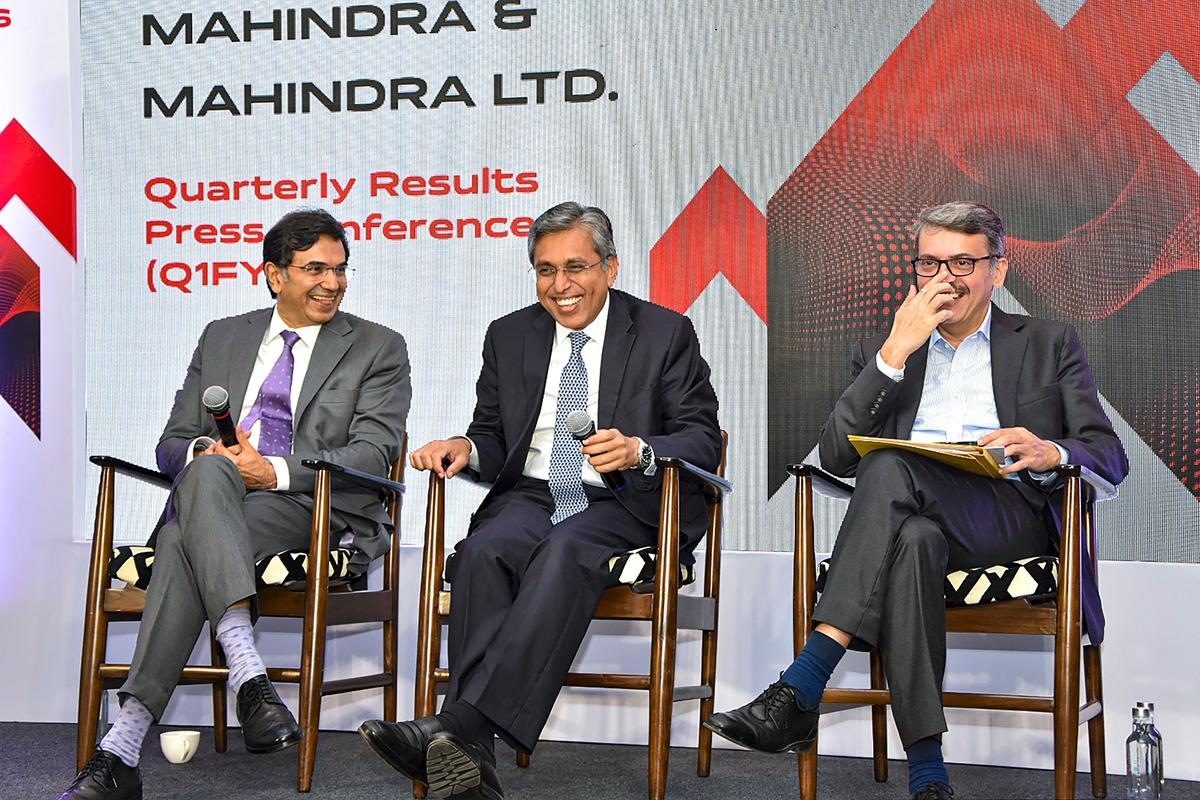
Mahindra & Mahindra:
₹4,917 Cr PAT. 54% Profit Surge.
SUVs on Fire, Tractors Humbled.
The world’s most diversified auto-tractor-finance conglomerate just recorded its highest quarterly group revenue in history. And yet, at ₹3,332, the stock trades like a tired commuter on a Monday morning.
The Diversification Bet That’s Finally Paying Off
- 52-Week High / Low₹3,840 / ₹2,360
- Q3 FY26 Revenue₹52,100 Cr
- Q3 FY26 PAT₹4,917 Cr
- Q3 EPS₹36.59
- Annualised EPS (Q3×4)₹146.35
- Book Value₹666
- Price to Book5.00x
- Dividend Yield0.76%
- Debt / Equity1.53x
- Free Cash Flow (TTM)Negative
The Conglomerate That Owns Half of Everything. Badly. But Getting Better.
Mahindra & Mahindra was born in 1945 as a jeep company. Today, if you squint hard enough, it’s a finance company, a tractor powerhouse, a real estate developer, a hospitality chain, a logistics operator, an IT services play (Tech Mahindra at 29% stake), and somewhere in there, an actual automobile maker. With 22 industries across 100+ countries, it’s the kind of business that shows up in diversification case studies—usually as a cautionary tale.
Until recently, that is. Because in Q3 FY26, all those disparate engines fired at once: Auto division margin up 90 bps, Farm margin up 240 bps (barring international drag), Mahindra Finance recording its first profitable inflection in three years, Logistics hitting profitability after 11 quarters of losses, and Lifespaces printing 5x profit YoY. Management’s own concall words: “breakthrough inflections… execution-led, not volatility.”
The stock? Down 10.4% in three months. Down 6.4% in six months. This is either a massive misprice or a really sophisticated way of asking “have you read the footnotes?” We’re going to read them. All of them.
Tractor Emperor. SUV Challenger. Finance Fixer. Logistics Starter. All At Once.
The Automotive Division (72% of standalone FY25 revenue): Mahindra makes SUVs, passenger vehicles, light commercial vehicles (LCVs), commercial vehicles, electric 3-wheelers, and two-wheelers. The SUV business holds 22.5% revenue market share and 39% volume share in cars. LCVs under 3.5T? 51.9% share. The company is #1 in electric 3-wheelers with 42.9% market share. Two flagship EV launches in Nov 2025—XEV 9e and BE 6e on the INGLO platform. Combined bookings in Jan 2026: 93,689 units worth ₹20,500+ crore, against a ₹6,500 Cr initial capex outlay.
The Farm Equipment Division (25% of standalone revenue): The tractor king. 43.3% domestic market share as of March 2025. Farm machinery business (OJA, Target, Naya Swaraj) growing at 29% CAGR over three years. In Q3, volumes +23% YoY, but market share slipped due to Swaraj stockouts (resolved by January, management says). Farm machinery revenue jumped 45% YoY, crossing ₹100 Cr/month run-rate.
The Financial Services (M&M Financial Services, 52% stake): An NBFC focused on rural/semi-urban financing. Once a problem child (asset quality blowup in 2022). Now? In Q3, operating profit +97% YoY. Gross Stage 3 (GS3) sitting consistently below 4%. Digitisation via “Project Udaan” reduced customer friction: instead of “76 signatures,” one digital signature. Cross-sell ratio “the worst in the industry” per management—upside disguised as insult.
The Misfit Pile: Tech Mahindra (IT services, 29% stake), Lifespaces (real estate), Mahindra Holidays & Resorts, Mahindra Logistics (finally profitable), and a sprawling subsidiary empire. Each is being managed by a “road to 15-18% ROE” philosophy. Those not meeting it? Being pruned or restructured.
Q3 FY26: The Numbers
Result type: Quarterly Results | Q3 FY26 EPS: ₹36.59 | Annualised EPS (Q3×4): ₹146.35 | FY25 Full-year EPS: ₹103.97
Source table
| Metric (₹ Cr) | Q3 FY26 Dec 2025 |
Q3 FY25 Dec 2024 |
Q2 FY26 Sep 2025 |
YoY % | QoQ % |
|---|---|---|---|---|---|
| Revenue | 52,100 | 41,470 | 46,106 | +25.6% | +13.0% |
| Operating Profit | 10,160 | 8,231 | 8,940 | +23.4% | +13.6% |
| OPM % | 20% | 20% | 19% | Flat | +100 bps |
| PAT (Reported) | 5,021 | 3,624 | 3,964 | +38.5% | +26.8% |
| PAT Operating Basis* | 5,020 | 3,020 | 3,964 | +66.2% | +26.6% |
| EPS (₹) | 36.59 | 25.58 | 29.54 | +43.0% | +23.8% |
*Operating basis excludes Labour Code impact (~₹220 cr group share) and foreign subsidiary impairments.
What’s a Conglomerate Actually Worth When Half Its Businesses Are In Turnaround?
Method 1: P/E Based
FY25 full-year EPS = ₹103.97. Annualised Q3 EPS (Q3×4) = ₹146.35. Using conservative FY26E range (10–12% earnings growth): FY26E EPS ≈ ₹115–₹117. Sector median P/E is 29.9x. Mahindra at 25.9x trades at a discount despite higher ROCE potential post-turnarounds. Fair P/E band: 20x–28x (reflecting conglomerate discount + execution risk).
Range: ₹2,300 – ₹3,270
Method 2: EV/EBITDA Based (Consolidated)
TTM EBITDA ≈ ₹35,239 Cr. Current EV ≈ ₹5,18,930 Cr (Market Cap + Net Debt). EV/EBITDA = 14.7x. Diversified industrials/auto play at 11x–15x EBITDA. Given execution risk in turnarounds + growth optionality from EV/Farm/Finance, fair band: 12x–16x.
EV range: ₹4,22,868 Cr – ₹5,63,824 Cr → Per share:
Range: ₹2,157 – ₹2,876
Method 3: Sum-of-Parts (SOTP)
Breaking down consolidated FY25 PAT (~₹14,073 Cr) by segment:
→ Farm division: ~₹2,100 Cr PAT (18x P/E) = ₹37,800 Cr
→ Mahindra Finance: ~₹2,400 Cr PAT (12x P/E post-turnaround) = ₹28,800 Cr
→ Other (Logistics, Lifespaces, etc.): ~₹1,073 Cr PAT (16x P/E) = ₹17,168 Cr
→ Total EV: ~₹2,53,768 Cr → Per share (assuming 124 Cr shares):
Range: ₹2,048 – ₹2,900
Breakthroughs, Capex Spree, and Exit Plans
✅ Nagpur Greenfield Facility
- • ₹15,000 Cr capex for 5 lakh vehicles + 1 lakh tractors
- • Production starts 2028 with 8–10k units/month year-1
- • Capacity to scale to 500k vehicles over time
- • IQ platform SUVs (Vision S/T, Vision X) to be housed here
⚠️ Exits & Impairments (Feb–Mar 2026)
- • Turkey foundry (Erkunt) impairment taken; “not strategic”
- • MAM Japan impairment; ongoing restructuring costs Q4 onwards
- • Automobili Pininfarina merged (de facto exit)
- • CIE Automotive stake sold (~€119M) in Dec 2025
✅ EV Frenzy & Bookings Bonanza
- • XEV 9S: 93,689 bookings (7-seater EV, ₹19.95L starting)
- • XUV 7XO: Bookings included in above; strong order pipeline
- • XEV 9e & BE 6e: 41,000+ units sold (32.5 Cr km driven)
- • EV profitability: ₹175 Cr EBITDA impact (consolidating to profitability)
⚠️ LCV Revival (Demand Shift)
- • LCV market showing “first positive replacement cycle in years”
- • GST cut impact seen as structural, not one-time (4–5% profit lift)
- • Share up to 51.9% (+10 bps), but comp getting tougher
The Leverage Story: Good Enough, But Watch The Capex
Source table
| Item (₹ Cr) | FY24 (Mar 2024) | FY25 (Mar 2025) | Sep 2025 |
|---|---|---|---|
| Total Assets | 2,34,722 | 2,76,013 | 2,92,930 |
| Total Equity (Reserves + Capital) | 66,190 | 77,039 | 82,844 |
| Borrowings | 1,08,647 | 1,29,025 | 1,26,709 |
| Other Liabilities | 59,884 | 69,950 | 83,376 |
| Total Liabilities | 2,34,722 | 2,76,013 | 2,92,930 |
They Make Cash. They Spend It. The Circle of Corporate Life.
Source table
| Cash Flow (₹ Cr) | FY24 | FY25 | 9M FY26* |
|---|---|---|---|
| Operating CF | -5,630 | 3,176 | Likely positive |
| Investing CF (Capex) | -5,615 | -18,616 | -10,392 (FY25 run-rate) |
| Financing CF | 12,281 | 15,834 | Strong |
| Free Cash Flow | -11,245 | -15,440 | Negative (Capex-heavy) |
*9M FY26 (Apr–Dec 2025) approximated from quarterly data and press releases.
The Efficiency Engine is Humming. The Price Tag, Less So.
Revenue Compounding. Margins Expanding. Profits Accelerating.
Source table
| Metric (₹ Cr) | FY22 | FY23 | FY24 | FY25 |
|---|---|---|---|---|
| Revenue | 90,171 | 1,21,269 | 1,39,078 | 1,59,211 |
| Operating Profit | 14,683 | 20,285 | 24,892 | 30,518 |
| OPM % | 16% | 17% | 18% | 19% |
| PAT | 7,253 | 11,374 | 12,270 | 14,073 |
| EPS (₹) | 52.91 | 82.68 | 90.62 | 103.97 |
Top-line growing at >20%, bottom-line at ~11%, and OPM expanding. That’s not a company losing ground—it’s a company still finding its feet in emerging businesses while the core solidifies.
The Diversified Auto Conglomerate Showdown
Source table
| Company | CMP | P/E | Market Cap | ROCE % | ROE % | Revenue TTM |
|---|---|---|---|---|---|---|
| Mahindra & Mahindra | ₹3,332 | 25.9x | ₹4,14,486 Cr | 13.9% | 18.0% | ₹1,86,334 Cr |
| Maruti Suzuki | ₹14,159 | 29.8x | ₹4,45,121 Cr | 21.7% | 15.9% | ₹1,71,774 Cr |
| Hyundai Motor | ₹2,094 | 29.9x | ₹1,70,107 Cr | 54.3% | 42.2% | ₹68,101 Cr |
| Tata Motors (PV) | ₹351 | 21.5x | ₹1,29,159 Cr | 20.0% | 28.1% | ₹3,49,637 Cr |
The Verdict: Mahindra trades at the lowest P/E (25.9x) in this group and has legitimate growth optionality (EV platforms, Nagpur capex, Farm margin upside). But ROCE is lower than Maruti (21.7%) and Hyundai (54.3%), reflecting capital intensity and diversification drag. The stock isn’t screaming “buy me,” but it’s not a screaming overvalue either. It’s a “show me execution” story priced at a reasonable-to-fair multiple for that story.
Mahindra Dynasty: Low Promoter Stake, High Institutional Backing
Latest Shareholding (Dec 2025)
- Promoters18.43%
- FIIs37.49%
- DIIs (incl. LIC 6.39%)30.39%
- Public & Others13.69%
The Mahindra Inner Circle
Promoter holding: 18.43% (Prudential Management 10.81%, M&M Benefit Trust 6.90%). Anand Mahindra is on the board (and increasingly visible in concalls). The founder family has "carefully managed" dilution over decades via rights issues, stake sales, and strategic reinvestment. Low promoter stake (vs Ambani, Adani, Tata) means less insider firepower but also less risk of sudden strategy shifts.
No pledges. Clean board with 50% independent directors. Dividend payout: 20.1% (historical average). The money stays in the business.
CARE Ratings Says AAA. But Watch the Capex Appetite.
✅ The Good Stuff
- • CARE AAA credit rating (reaffirmed Sep 2025)
- • 80+ years operational history
- • Strong market leadership (tractors, SUVs, LCVs)
- • Cash balance ₹30,829 Cr (FY25)
- • Capex-driven growth (good long-term, risky short-term)
- • Board with 5 independent directors out of 10
- • Clean audit (no material qualifications)
⚠️ The Risks
- • Conglomerate structure (value dilution risk)
- • Capex ₹37k Cr planned (execution, timing risk)
- • EV competition intensifying (domestic + global)
- • Mahindra Finance turnaround still incomplete
- • Low promoter stake (18.4%) means less insider conviction
- • Overseas impairments (Turkey, Japan) suggest portfolio weighting risks
- • ROCE (13.9%) below WACC implies value destruction in some units
Management Quality: Anand Mahindra is articulate, strategic, and owns some skin-in-the-game. CFO is clear on capex phasing and cash management. The “roadmap to 15–18% ROE” discipline is evident. Not a red flag. But execution on Nagpur, EV ramp, and turnarounds is the real test.
India’s Auto Growth is Real. But So Is Global Copycatting.
The Indian Auto Market Tailwind: Vehicle parc growing, rural incomes rising (good monsoons), commercial vehicle replacement cycles restarting, and EV adoption accelerating. Management’s own guidance: 8–10% real GDP growth potential over the long term, backed by infrastructure capex, reforms, and demographics. This isn’t “Uber to the moon”—it’s steady, prosaic, real.
The EV Paradox: Mahindra says the EV threat to lubricant demand (a Castrol problem) is overstated for them—EVs still need gearbox oil, thermal fluids, and brakes. But EV adoption does cannibalize the easy-margin ICE business. Their response: launch faster, price competitively, capture market share. XEV 9S bookings (93k+) suggest they’re winning this race. But global OEMs (VW, Tesla) also have plans. The question isn’t “will EVs grow?” It’s “will Mahindra own the margin pool?”
GST Cut: Structural or One-Off?
GST reduction on vehicles (especially CVs and tractors) effective in October 2024. Management called it “structural”—4–5% profit improvement per operator on LCVs, increased industry size in CVs. Not just pent-up demand. Real. But comps will toughen next year, and margins may give back some gains. Watch in FY27 for evidence.
Farm Machinery: The Dark Horse
Farm machinery revenue +45% YoY. Run-rate now ₹100 Cr/month. This is a higher-margin, faster-growing, less-competitive segment than tractors. Mahindra’s portfolio (OJA, Target, Naya Swaraj) is resonating. This segment could be 20% of farm division revenue in 3 years vs. ~10% today. Early-stage optionality not yet reflected in valuations.
CAFE & BS7 Norms: Headwinds or Speedbumps?
CAFE (Corporate Average Fuel Efficiency) norms still being finalized. BS7 (emissions) timeline unclear. Management’s internal EV target is 25% by FY27–FY28; actual CAFE may be “much lower.” The implication: capex for EV platforms is largely hedged against regulatory pushback. Good risk management. Unclear guidance is the only risk.
The Mahindra Advantage: SUV market share 22.5%, tractor share 43.3%, LCV share 51.9%. Distribution network depth (1.5 lakh+ touchpoints across vehicles and farm). Mahindra Finance captive funding. This is durability, not just a quarter. The stock’s real question isn’t “can they grow?” but “will capex spend deliver the promised returns?”
The Conglomerate at an Inflection
Mahindra & Mahindra is a company caught between two narratives. One says: “diversified, capex-hungry, conglomerate-discounted, optionality-rich.” The other says: “execution-heavy, capex-risky, ROCE-challenged, turnaround-dependent.” Both are true. Which one you believe determines whether ₹3,332 is a gift or a trap.
The Bull Case (Summary): Q3 delivered 54% profit growth on operating basis. SUV volumes +26%, farm machinery +45%, Mahindra Finance turning around, Logistics finally profitable. XEV 9S bookings north of 93k units. Nagpur capex will add 500k vehicle capacity over time. The company is simultaneously defending market share and building tomorrow’s platforms. If execution lands, ROCE expands to 16–18%, earnings compound at 12–15%, and the stock deserves 28–32x P/E by FY28. That’s ₹4,500–₹5,200 per share.
The Bear Case (Summary): Conglomerate discount is real. ROCE (13.9%) is below WACC. Capex ₹37k Cr is aggressive; if execution slips, leverage balloons. EV market share is fragmented, and Mahindra’s gross margins in EVs are still negative (they admitted it in the concall). Mahindra Finance and Logistics turnarounds are nascent—one negative quarter unravels the narrative. At ₹3,332, you’re betting on everything working perfectly. Markets don’t reward such certainty.
The Middle Ground (Our View): Mahindra at ₹3,332 is neither screaming cheap nor dangerously overpriced. Fair value range of ₹2,100–₹3,270 suggests the stock is at the upper band, implying modest margin for error. The company has optionality (EV platforms, Nagpur, Farm machinery acceleration, Finance turnaround), but execution risk is real. The concall was transparent about challenges (impairments, turnarounds, capex timing). That transparency is worth a premium. But not a massive one.
✓ Strengths
- Market leadership in SUVs (22.5% revenue share), tractors (43.3%), LCVs (51.9%)
- Operating profit margin expanding (+100 bps YoY)
- Mahindra Finance stabilized (GS3 <4%, ROA improving)
- Logistics & Lifespaces hitting profitability milestones
- EV bookings robust (93k+ for XEV 9S)
- Cash ₹30k Cr provides capex flexibility
- Diversification reduces single-sector risk
✗ Weaknesses
- ROCE (13.9%) below WACC (~11%), destroying value in capital deployment
- Conglomerate structure dilutes per-share returns vs. focused competitors
- EV gross margins negative (path to profitability unclear)
- Low promoter stake (18.4%) suggests reduced insider conviction
- Capex intensity will pressure FCF for next 2–3 years
- Overseas operations (Turkey, Japan) showing losses, impairments taken
→ Opportunities
- Nagpur greenfield (500k capacity by 2030s, ₹15k capex): incremental 5% to volumes
- Farm machinery (45% YoY growth, high margin potential)
- Mahindra Finance cross-sell (currently “worst in industry” per mgmt—upside disguised)
- LCV market revival (GST cut, replacement cycle underway)
- EV market share capture (XUV 7XO, XEV 9S in high-demand segments)
- CAFE/BS7 compliance via EV platforms already designed
⚡ Threats
- Global OEM EV competition intensifying (Tesla, BYD, VW)
- Memory chip supply bottleneck (explicitly called out in concall)
- EV margin pressure (industry-wide, not Mahindra-specific)
- Capex execution risk (Nagpur ramp, platform launches)
- Regulatory headwinds (CAFE finalization, BS7 timing)
- Farm tractor market facing comps headwinds (Maharashtra subsidy didn’t repeat)
Mahindra & Mahindra is neither the next disruptor nor the last-generation incumbent. It’s the complicated middle child of Indian industry.
It makes tractors like no one else, SUVs like the next guy, finances like it’s learning, and diversifies like it’s hedging bets on its own future. The stock trades at ₹3,332—not cheap, not expensive, precisely at the point where hope meets skepticism. Q3 results were genuinely good. Guidance is clear. Capex is massive. Execution is the only question. And execution, by definition, cannot be priced in advance. It can only be demonstrated.
For the next 12 months, watch: (1) EV ramp-up to 7–8k units/month target, (2) Mahindra Finance cross-sell ratio improving toward 2.4–2.5% ROA, (3) Nagpur project milestones, (4) Farm machinery sustaining 40%+ growth, and (5) LCV market share stability post-GST comp reset.