01 — At a Glance
The EV Dream That Fell Off a Cliff — With Full Automation
- 52-Week High / Low₹71.2 / ₹21.2
- Q3 FY26 Revenue₹470 Cr
- Q3 FY26 PAT-₹487 Cr
- Q3 FY26 EPS-₹1.10
- Annualised EPS (avg Q1–Q3 × 4)-₹4.08
- Book Value₹9.84
- Price to Book2.53x
- Debt / Equity0.72x
- 3-Month Return-33.3%
- 1-Year Return-57.0%
Wake-Up Call: Ola Electric posted Q3 FY26 revenue of ₹470 crore — down a staggering 55% year-on-year from ₹1,045 crore. Net loss of ₹487 crore. Market share cratered from ~48–50% at peak to 9.3% in December 2025. The stock has lost 57% in one year and is now trading near its all-time low of ₹21.2. Management’s response? They called it a “Structural Reset” and said they’re not worried about market share. The market, respectfully, is very much worried. Meanwhile, a going-concern note was added to the financials. As one does when things are going well.
02 — Introduction
The Scooter That Wanted to Be Tesla. And Ended Up Being a Case Study.
Let’s talk about Ola Electric. The company that promised to make India the EV capital of the world. The company whose factory can theoretically produce 1 million scooters a year. The company that also received 2,994 quality complaints in FY24 and is now dealing with a South Goa Consumer Commission warrant against its CEO (since stayed by the High Court, but still — what a sentence). Bold vision meets bold consequences.
The IPO in August 2024 raised ₹6,415 crore at a valuation that suggested Ola was either a world-class EV disruptor or the most expensively priced hope in Indian market history. Within 18 months of listing, the stock has lost over half its value and is flirting with its 52-week low of ₹21.2. The market has a way of recalibrating ambition.
To be fair — the fundamentals tell a complex story. Gross margins hit a record 34.3% in Q3 FY26. The Gigafactory is scaling to 6 GWh. India’s first 4680-format lithium-ion cell has been commercially deployed. And management has systematically cut operating expenditure from a peak of ₹840 crore per quarter to ₹484 crore, with a target of ₹250–300 crore. The operational reset is real. The problem is that revenue also reset — violently downward. When you halve your revenues and reduce your costs, you’ve earned the right to be called “disciplined.” You haven’t earned profits yet.
The company now carries a going-concern disclosure in its quarterly filings, has approved a fundraise of up to ₹1,500 crore, and changed its CFO in January 2026 — the second CFO change in recent memory. There’s a lot of story here. Some of it inspiring. Some of it cautionary. Let’s do what we do best: go through the numbers, explain the chaos, and try not to cry.
Concall Note (Feb 2026): “Q3 marks a structural reset… We chose to fix the fundamentals rather than optimize for short-term volume.” — Ola Electric CFO. Sir, the fundamentals include ₹2,203 crore in losses for FY25 TTM. We’ll need a bigger reset.
03 — Business Model: WTF Do They Even Do?
They Make Electric Scooters. And Cells. And BESS. And Possibly Everything.
The original pitch was elegantly simple: make electric two-wheelers, sell them directly to consumers through a D2C model (bye-bye dealer margins), manufacture at a 2,000-acre Futurefactory in Tamil Nadu with 91% automation, and become the Ola equivalent of what Tesla is to cars — only for India’s 80-crore motorcycle-riding population.
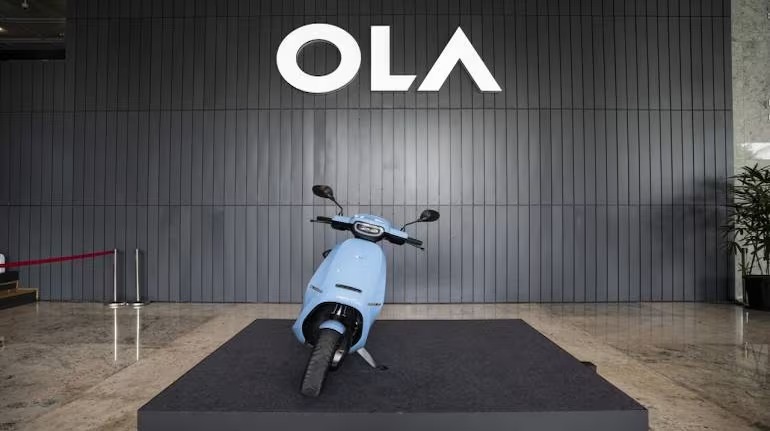
The current reality is more textured. Ola Electric now has four scooter models (S1 Pro, S1 Air, S1 X+, S1 X), the Gen 3 platform accounting for ~80% of total scooter sales, and a newly launched Roadster X motorcycle. They operate 870 experience centres and 431 service centres — though service quality has been a recurring complaint that management publicly acknowledged in the February 2026 concall as the single biggest barrier to growth right now.
What changed in Q3 FY26 is that the company pivoted hard on vertical integration. India’s first domestically produced 4680-format lithium-ion cell (branded “Bharat Cell”) was commercially deployed. The Ola Shakti BESS (Battery Energy Storage System) was launched — priced between ₹1.49 lakh to ₹2.49 lakh — opening an entirely new business vector. Management is now pitching energy storage as potentially “a much bigger business than automotive over time.” That sounds exciting. Actual revenue from Shakti in Q3: not yet material. Deliveries in Q3: 32,680 units. That’s the context.
Q3 Deliveries32,680Units
Mkt Share Dec’259.3%Peak was ~48%
Gross Margin34.3%Record high Q3
Cell Capacity6 GWhTarget by Mar’26
R&D Note: Ola spends 7.4% of revenue on R&D, runs centres in India, UK, and the US, and holds 222 patents granted as of latest data. For a company that loses money at industrial scale, the tech foundation is genuinely impressive. For a company whose scooters are showing up on Consumer Commission dockets — the on-ground execution is still catching up to the slides.
💬 Have you test-ridden or owned an Ola Electric scooter? What’s been your honest experience with their service? Drop it in the comments!
04 — Financials Overview
Q3 FY26: The Numbers (Hold Onto Something)
Continue reading with a premium membership.