01 — At a Glance
The World’s Largest Pepsi Dealer Had a Terrible, Horrible, No Good, Very Wet Year
- 52-Week High / Low₹568 / ₹426
- CY25 Revenue (Full Year)₹21,685 Cr
- CY25 PAT (Full Year)₹3,036 Cr
- Full-Year EPS (CY25)₹8.98
- Q4 CY25 EPS₹0.74
- Book Value₹57.9
- Price to Book7.44x
- Dividend Yield0.23%
- Debt / Equity0.13x
- CRISIL RatingAAA / Stable
At a Glance: Varun Beverages closed CY25 with ₹21,685 Cr revenue (+8.4% YoY), ₹3,036 Cr PAT (+16.2% YoY), and volumes of 1,213.1 million cases — 8th consecutive year of growth. The stock delivered -6.7% in one year despite the company getting a CRISIL AAA upgrade, acquiring a South African bottler (BevCo), announcing another acquisition (Twizza), entering Africa with alcohol (Carlsberg partnership), and launching snacks across three territories. Apparently delivering everything except the weather is not enough. Markets, ladies and gentlemen.
02 — Introduction
Pepsi. In Bottles. Across 14 Countries. Also Now Beer.
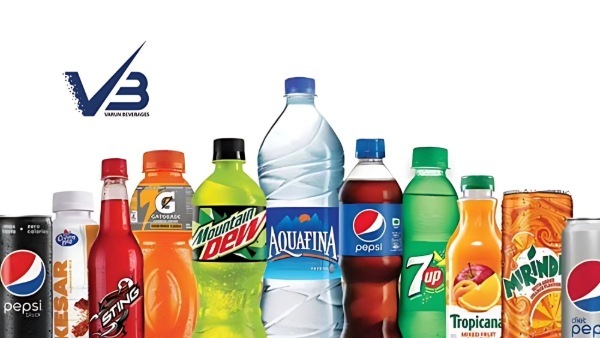
Let’s talk about Varun Beverages. Yes, the company that fills up those blue and orange Pepsi bottles your cousin cracks open at every family gathering while someone else pretends to prefer “just water.” VBL is the second-largest PepsiCo franchisee in the world outside the US, operating across 10 countries with franchise rights and 4 more with distribution rights. They fill cans and bottles for Pepsi, 7UP, Mountain Dew, Tropicana, Sting, Mirinda, Aquafina, Lipton, Doritos, and Kurkure. They also own brands like Creambell ice cream and Reboost energy drink — because why settle for just being the world’s biggest Pepsi dealer when you can also have your own energy drink that no one has heard of.
The company has been Ravi Kant Jaipuria’s project since 1995. What started as a PepsiCo bottling licence in India has quietly become a ₹1.46 lakh crore market cap company, with 36 manufacturing plants in India, 12 internationally, 130+ owned depots, 2,500+ owned vehicles, and 10.2 crore visi-coolers installed across the world. That last stat alone should terrify any competition — they literally own the fridge that sits in your neighbourhood kirana store.
CY25 was supposed to be VBL’s operating leverage year. New greenfield plants commissioned. African territories ramping up. South Africa BevCo now fully integrated. And then the monsoon arrived. Management described CY25 as “the worst season we have ever seen.” Revenue still grew 8.4%. PAT still grew 16.2%. They still upgraded their CRISIL rating to AAA. And they still announced two new business lines — snacks and alcohol. In the worst year. One wonders what a good year looks like.
Concall Gem (Feb 2026): “This year was the worst season with the rains.” — Ravi Kant Jaipuria, Chairman, VBL. And yet they still posted ₹3,036 Cr PAT. Imagine if it had rained normally.
03 — Business Model: WTF Do They Even Do?
They Bottle Pepsi. 1,213 Million Cases of It. Per Year.
The model is beautifully simple and deceptively complex. PepsiCo invents the concentrate and the brand. Varun Beverages buys the concentrate, mixes it with local water, carbonates it, bottles it, puts it in a truck, drives it to your local paan shop or Big Bazaar, and charges you ₹20 for the privilege. The margin between concentrate cost and retail price is VBL’s playground. They own every step of the supply chain from preform manufacturing to distribution.
Backward integration is their secret weapon — VBL produces its own PET preforms, crown corks, corrugated boxes, plastic closures, and shrink-wrap films. This is the corporate equivalent of a chef who grows his own vegetables, makes his own flour, and still finds time to deliver the food. It keeps margins stable and gives leverage over input costs. Operating margins have held at 23–24% for three consecutive years. That’s not luck — that’s systems.
The geographic mix is evolving fast. India contributes ~83% of revenues but the Africa story is real — Morocco, Zambia, Zimbabwe, South Africa (via BevCo), plus DRC now operational. International volumes hit 374 mn cases in CY25 (374.1 mn = 1213.1 – 839 mn India). Africa also gives VBL a seasonal hedge since southern hemisphere summers coincide with India’s winter. And now they want to sell beer in Africa. Via a Carlsberg partnership. We did not have that on our CY25 bingo card.
CSD~74%Volume Mix
Packaged Water~16%Volume Mix
Juices/Others~10%Volume Mix
Low/No Sugar~59%Consolidated Vol.
Franchise Note: VBL’s PepsiCo licence in India runs until April 30, 2039 — extended in 2019 from the original 2022 expiry. Every Pepsi you drink in India from 26 States and 6 UTs is a Varun Beverages bottle. The only exceptions are Andhra Pradesh, J&K, and Ladakh. Three states that are apparently handling their carbonated beverage needs independently.
💬 Drop a comment: Did you know that when you drink Pepsi in India, you’re funding Ravi Jaipuria’s African beer expansion? Does that change how the Pepsi tastes?
04 — Financials Overview
Q4 CY25: The Numbers That Deserve an Umbrella
Continue reading with a premium membership.