Calcom Vision Ltd Q3 FY26: ₹55.1 Cr Revenue (+23.4% YoY) but ₹0.85 Cr Loss — P/E Looks “42”, My Math Says “~51”, and the LED Bulb Is Flickering
1) At a Glance (Quick Roast, Quick Facts)
Calcom Vision (CVL) is that classic Indian “we make stuff for big brands” story—ISO stamps (9001, SA8000, 14001), LED bulbs everywhere, and a client list that reads like your living room’s shopping history: Philips, Thomson, BPL, LG, Samsung, Panasonic, Bajaj, Osram, Ledvance, USHA, Havells, etc. The market is valuing it at ~₹132 Cr with a current price ₹94.2 (13 Feb 2026 close), which is down ~23.4% in 3 months—so yes, the stock has recently behaved like a cheap emergency lamp: works only when it wants.
Key ratios at the moment: Stock P/E shown as 42.2, P/B 1.53, ROCE 7.21%, ROE 3.26%, Debt ~₹61.6 Cr, D/E 0.71, EV ~₹185 Cr, EV/EBITDA 11.1, OPM 6.70% (TTM). And then comes the twist: Q3 FY26 (quarter ended 31.12.2025) delivered Revenue ₹55.13 Cr (+23.44% YoY) but Net Loss ₹0.85 Cr. So the top line is shouting “growth!”, while the bottom line is whispering “bro… interest and productivity issues”.
Question: if your “mass-volume” LED bulb business is booming, why is the profit still doing yoga stretches between profit and loss?
2) Introduction (Scene Setting, with Mild Sarcasm)
Calcom Vision is not a “glamour consumer brand” company. It’s the factory + design + supply chain type of business that usually stays invisible—until a quarterly result punches you in the face. CVL operates as:
EMS (Electronics Manufacturing Services): manufacture electronic components/products for OEMs.
ODM (Original Design & Manufacturing): do the whole thing—design to finished lighting product.
This model is attractive because big brands love outsourcing—especially when they want “asset-light” vibes and quick product cycles. The downside is: you can become a margin sponge. The brand keeps pricing power, you keep working capital stress, and if automation goes sideways, your profitability goes full Bollywood tragedy.
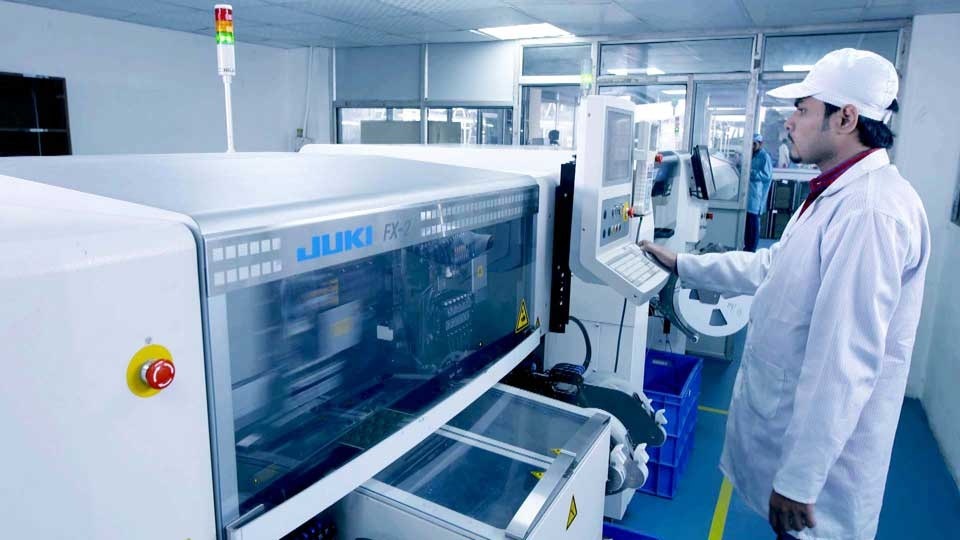
And Calcom has openly described a key operational headache: it started manufacturing Driver on Board (DOB) bulbs, and because the production process differs from driver-based bulbs, earlier automation became partly redundant. They shifted many operations to manual, leading to higher manpower cost, lower productivity, and lower profitability. That’s not “macro headwind”. That’s “our own factory said no”.
Now add debt (~₹61.6 Cr) and interest costs (latest quarter interest ₹1.81 Cr), and you get a business where revenue can grow, yet net profit can still stumble.
So the real question isn’t “can Calcom sell LEDs?”—it’s: can Calcom convert sales into durable profits while managing debt, productivity, and governance drama?
3) Business Model – WTF Do They Even Do?
CVL makes LED lighting products and related electronics, across domestic and industrial applications. The company’s portfolio includes:
LED bulbs (all wattages) — the mass-volume bread and butter
LED battens (including emergency & industrial)
Downlighters, panels, floodlights, street-lights
Drivers, strip lights
PLL lamps, ceiling lights
It has installed capacity of ~3 million LED lamps/month and ~1 million LED battens/month. Historically, it has produced 15+ million LED lamps and 10+ million drivers of different wattages/applications. In FY23 production was hefty: LED Lamps ~30 million, LED Battens ~12 million, Emergency Lamps ~2.5 million.
Sales mix (FY23) was heavily tilted:
LED Lamps ~85%
Emergency lamps ~8%
LED battens ~4%
Others ~3%
So it’s basically: “Bulbs, and then some more bulbs, and then emergency lamps for when profits go out.”
Growth strategy includes:
Shifting from niche to mass volume low wattage bulbs
Launch plans/ventures in EMS and BLDC fans & drivers in FY24
Venturing into smart lighting, home automation, LED wallwashers, PAR lights
A 50:50 JV with Korea’s Taehwa Enterprise Co. Ltd to launch fans (initial phase plan: 100K fans)
Also, exports exist (Germany, USA, Malaysia, China, Singapore), and the company even formed a subsidiary Calcom Astra to expand exports in US and Europe (with COO appointment mentioned).
Now here’s the practical reality: EMS/ODM is a scale + execution game. You can’t “vibe” your way into margins. You either run a tight production system, or you become an interest-paying machine that occasionally sells LEDs.
Comment section question: Do you prefer a company that sells under its own brand, or one that manufactures for everyone else and prays for stable margins?
4) Financials Overview
Q3 FY26 vs YoY vs QoQ (₹ Cr)
Metric
Latest Quarter (Dec 2025)
Same Qtr Last Year (Dec 2024)
Previous Quarter (Sep 2025)
YoY %
QoQ %
Revenue
55.13
44.66
50.06
+23.44%
+10.14%
Operating Profit (EBITDA proxy)
1.92
4.29
3.88
-55.24%
-50.52%
PAT
-0.85
0.31
2.09
-374%
-140.67%
EPS (₹)
-0.61
0.22
1.49
-377%
-140.94%
Witty but painful commentary: Revenue grew nicely, but operating profit got demolished. That’s like inviting more guests to a wedding and then running out of food. The OPM fell to 3.48% in Dec 2025 from 9.61% a year ago. And PAT flipped negative.
Also note: interest (₹1.81 Cr) and depreciation (₹1.39 Cr) in the latest quarter are not tiny compared to operating profit (₹1.92 Cr). So once the operating margin dips, the P&L immediately starts coughing.
So yes—displayed P/E is 42.2 (based on a different EPS basis like TTM EPS 2.25), but on Q3 annualised EPS as per rule, it’s closer to ~51.
Question: Do you value this on the past (TTM) or on the present reality (Q1–Q3 run-rate)?
5) Valuation Discussion – Fair Value Range Only
Important disclaimer (must read): This fair value range is for educational purposes only and is not investment advice.
Method A) P/E Range Method (Using annualised EPS ₹1.84)
Step 1: Annualised EPS (Q1–Q3 average × 4) = ₹1.84 Step 2: Choose a reasonable P/E band.
Industry P/E shown = 35.7
Company shown P/E = 42.2
Our recalculated “run-rate” P/E is ~51
For education, let’s use a broad, sanity-checked band: 30× to 45× (because this is a small company with volatile margins and debt).
Step 3: Fair value range
Lower = 1.84 × 30 = ₹55.2
Upper = 1.84 × 45 = ₹82.8
P/E-based fair value range: ~₹55 to ₹83
Method B) EV/Operating Profit (EBITDA proxy) Method
We have:
Enterprise Value (EV) = ₹185 Cr
TTM Operating Profit = ₹14 Cr
EV/EBITDA shown = 11.1 (we will stay close to this context)
Step 1: Use TTM Operating Profit as EBITDA proxy (interpretation, because only operating profit is provided clearly in the dataset). TTM Operating Profit = ₹14 Cr
Step 2: Choose EV multiple band: 9× to 13× (around current 11.1, but allowing for volatility)
Step 3: Implied EV range
Lower EV = 14 × 9 = ₹126 Cr
Upper EV = 14 × 13 = ₹182 Cr
Step 4: Convert EV to equity value (simplified, using debt proxy)
Debt shown = ~₹61.6 Cr (borrowings around ₹62 Cr in the latest balance sheet column) Equity value range ≈ EV − Debt
Lower equity value = 126 − 62 = ₹64 Cr
Upper equity value = 182 − 62 = ₹120 Cr
Step 5: Convert equity value to per-share value (approx using equity capital)
Equity capital latest = ₹14 Cr, face value ₹10 → shares ≈ 1.4 Cr shares
Per share range:
Lower = 64 / 1.4 = ₹45.7
Upper = 120 / 1.4 = ₹85.7
EV-multiple fair value range: ~₹46 to ₹86
Method C) DCF “Reality Check” (Based on actual cash flow history)
Step-by-step DCF logic (data-only, no fantasy growth):
Base free cash flow is negative on this simplified CFO+CFI basis for 3 years.
If free cash flow is persistently negative, a traditional DCF produces no meaningful positive intrinsic value unless we assume a turnaround (assumption = not allowed for a clean valuation claim).
Therefore, DCF range is effectively “not supportive” at present, and serves as a warning: the stock is currently valued more on expected execution improvement than on demonstrated free cash generation.
DCF takeaway: With recent “FCF-like” numbers negative, DCF does not justify a premium; it’s a scoreboard showing the company must convert growth into cash.
Overall educational fair value range (blending A & B, with DCF as caution): ~₹55 to ₹86 This fair value range is for educational purposes only and is not investment advice.
6) What’s Cooking – News, Triggers, Drama
Let’s list the spicy items the company has officially disclosed:
Q3 FY26 update: Revenue ₹55.1 Cr (+23.4% YoY), but Q3 loss ~₹0.95 Cr / PAT loss ₹0.85 Cr (numbers are consistent across releases with rounding).
Company Secretary resignation: Ms. Rakhi Sharma resigned effective 10 Feb 2026 citing personal reasons.
KMP contact details update: Updated CFO and CS contact details dated 13 Feb 2026 (fresh paperwork energy).
Preferential issue drama: In Nov 2025, the board approved a preferential issue of warrants (₹114 each; aggregate ₹8,99,99,922), then later deferred it and considered alternate routes like rights/QIP with a committee.
Fraud disclosure: Annual secretarial compliance report disclosed a ₹2.31 Cr fraud by an ex-employee; a forensic audit was done, ₹42.5 L recovered, legal action and control measures initiated.
Credit rating downgrade: CRISIL downgraded bank loan rating to BB+/A4+ from BBB-/A3 (weaker financials and liquidity cited).
PLI upgrade & investment: The company got upgraded in the PLI scheme category and deployed ₹25 Cr investment to expand LED manufacturing capabilities.
Exports push: Formation of Calcom Astra subsidiary to expand exports in US and Europe; COO appointment mentioned.
If you’re a shareholder, this is the emotional range: PLI investment optimism + export expansion story + fraud + rating downgrade + quarterly loss. Basically, a masala movie with a suspense interval.
Question: Which matters more to you—PLI + exports narrative, or the immediate hit in margins and governance headlines?
7) Balance Sheet (Latest Available Column Focus)
We must use the latest available column in the dataset for balance sheet: Sep 2025 is the rightmost/latest.
Balance Sheet Snapshot (₹ Cr)
Item
Mar 2024
Mar 2025
Sep 2025 (Latest)
Total Assets
153
189
198
Net Worth (Equity + Reserves)
13+63 = 76
14+69 = 83
14+72 = 86
Borrowings
47
62
62
Other Liabilities
30
43
51
Total Liabilities
153
189
198
3 sarcastic bullets (because you deserve honesty):
Assets grew to ₹198 Cr, but profits didn’t get the memo consistently.
Borrowings at ₹62 Cr are not “evil”, but with interest coverage 1.64, it’s like carrying EMI with a moody salary.
Net worth ₹86 Cr is improving, but one bad margin quarter and the P&L starts acting like a power cut.
8) Cash Flow – “Sab Number Game Hai”
Cash flow (₹ Cr):
Year
CFO (Operating)
CFI (Investing)
CFF (Financing)
Mar 2023
-1
-9
10
Mar 2024
-4
-17
22
Mar 2025
11
-26
15
What this screams:
The company is investing heavily (CFI negative), especially Mar 2025 -₹26 Cr.
Financing cash inflow is also strong (CFF positive), meaning funding support exists.
Operating cash flow finally popped positive in Mar 2025 (₹11 Cr), but the 3-year picture is still volatile.
Translation in desi: paise aate hain, paise jaate hain, aur investor beech mein EMIs gin raha hota hai.
Question: Would you rather see stable CFO first, or are you okay funding capex while margins are still unpredictable?
9) Ratios – Sexy or Stressy?
Here are key ratios using the provided dataset + our required recalculation for P/E:
Ratio
Value
ROE
3.26%
ROCE
7.21%
P/E (recalculated on annualised EPS ₹1.84)
~51.2
PAT Margin (TTM PAT ₹3.12 Cr / TTM Sales ₹211 Cr)
~1.48%
Debt to Equity
0.71
Judgement (with a smile):
ROE 3.26% is not “consumer electronics rockstar”. It’s more like “steady internship stipend”.
ROCE 7.21% is okay-ish, but not enough to justify recurring drama.
PAT margin ~1.5% means one small operational hiccup and PAT vanishes—like your UPI balance after one Zomato order.
10) P&L Breakdown – Show Me the Money
P&L snapshot (₹ Cr)
Year
Revenue
Operating Profit
PAT
Mar 2023
160
13
6
Mar 2024
160
9
1
Mar 2025
157
12
1
TTM
211
14
3
Comedy + reality:
Revenue is growing on TTM (₹211 Cr), so demand isn’t the villain.
PAT has been low despite decent operating profit—interest and execution are quietly eating the dessert before you reach the table.
11) Peer Comparison (And Who’s Flexing)
Peer set (from the same peer list) — ₹ Cr for quarterly sales and quarterly net profit: