₹240 crore market cap. ₹83 stock price. Book value ₹149. Price-to-book just 0.55. Sounds like a value investor’s dream, right? Hold your chai.
Latest quarterly sales (Dec 2025) came in at ₹295.17 crore, up 25.7% YoY. Impressive. But PAT? A loss of ₹1.50 crore versus profit last year. OPM? Just 3.91%. ROCE? 3.74%. Interest coverage? A barely breathing 1.03. Debt? ₹311 crore.
And the stock has quietly delivered -11.4% in the last 3 months and -18.1% in one year.
On paper, Jay Shree Tea & Industries Ltd looks like a diversified agri-FMCG hybrid. In reality? It’s a 1945 vintage tea-sugar-fertilizer cocktail trying to survive modern capital markets.
So the real question: Is this an undervalued plantation play or a legacy business stuck in a low-margin time loop?
Let’s pour the numbers.
2. Introduction – 1945 to 2026: A Legacy That Refuses to Retire
Incorporated in 1945, Jay Shree Tea & Industries Ltd is part of the B.K. Birla Group. That surname carries weight in Indian industry.
The company manufactures tea (bulk CTC and orthodox), sugar, ethanol, chemicals, fertilizers, and also does warehousing and investing. Basically, if it grows in soil or can be crushed in a mill, they’ve probably tried it.
They operate 17 tea estates across India and East Africa. Uganda too. So yes, your Darjeeling morning ritual may have African cousins.
But here’s the twist: despite scale, capacity, history, and brand legacy, profitability is inconsistent. Over the last three years, ROE has averaged negative 7.85%. Five-year sales growth? Just 3.65% CAGR.
Yet FY25 full-year PAT stood at ₹126 crore (boosted by other income), and TTM PAT is ₹41 crore.
So what’s happening here? Operational excellence or accounting-assisted recovery?
Let’s dissect.
3. Business Model – WTF Do They Even Do?
Jay Shree Tea has four main verticals:
Tea (~58% of FY23 revenue)
Sugar (including ethanol) (~17%)
Chemicals & Fertilizer (~15%)
Other operating revenue (~10%)
Tea Business
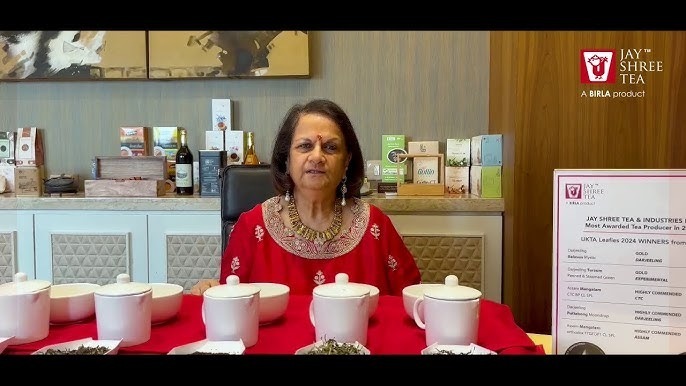
They offer 68 tea sub-varieties — from Darjeeling First Flush to Oolong and Organic White Tea. Sounds premium. But remember: most revenue is bulk tea, not fancy Instagram pyramid bags.
Capacity: 211 lakh kg annually. Utilization: 68–72%.