Jyothy Labs Ltd Q3 FY26: ₹740 Cr Revenue, 37% ROCE, but Stock Down 34% YoY – Detergent King Having an Identity Crisis?
1. At a Glance – Blink and You’ll Miss the Irony
₹9,193 crore market cap. ROCE of a spicy 37%. ROE flirting at 29%. Net profit of ₹345 crore. Dividend yield of 1.39%. And yet… the stock is down 34% over one year. Welcome to Jyothy Labs, where the business is doing Surya Namaskar daily, but the stock price has decided to do silent meditation.
At ₹250 per share, the company trades at 26.6x P/E, slightly below the industry PE of ~29x. Not dirt cheap, not nosebleed expensive. Sales for Q3 FY26 came in at ₹740 crore, up 5.1% YoY. PAT stood at ₹81.1 crore, down 7.2% YoY. That single line explains the entire mood swing in the stock.
This is a classic FMCG story: strong brands, deep distribution, low debt (almost zero, actually), but growth that has started to jog instead of sprint. Investors want Nestlé speed. Jyothy is offering KSRTC bus pace—reliable, but not thrilling.
So what’s going on? Is this a temporary detergent stain or a fabric tear? Let’s open the washing machine and check.
2. Introduction – From Kerala Kitchen to National Shelf
Founded in 1983 in Thrissur, Kerala, Jyothy Labs is one of those rare Indian FMCG stories where a single product (Ujala fabric whitener) quietly conquered Indian households without Bollywood drama or IPL sponsorships—at least initially.
Ujala didn’t just enter the market; it owned it. An 84% market share in fabric whiteners is not leadership—it’s monopoly behaviour with better PR. Over the years, Jyothy expanded from a one-product wonder into a multi-category FMCG player spanning fabric care, dishwashing, household insecticides, and personal care.
Today, the company sells across 3.6 million outlets, directly reaching 1.3 million of them. That’s not distribution—that’s retail invasion. Urban contributes 60%, rural 40%, which is a pretty balanced FMCG footprint.
But here’s the catch: Jyothy Labs is no longer a “small challenger”. It’s a mid-sized FMCG incumbent, and incumbents are judged harshly. Growth slows? Stock gets punished. Margins wobble? Analysts panic. Volume growth decent but PAT flat? Welcome to correction town.
3. Business Model – WTF Do They Even Do?
Jyothy Labs makes products you use daily but never brag about on Instagram.
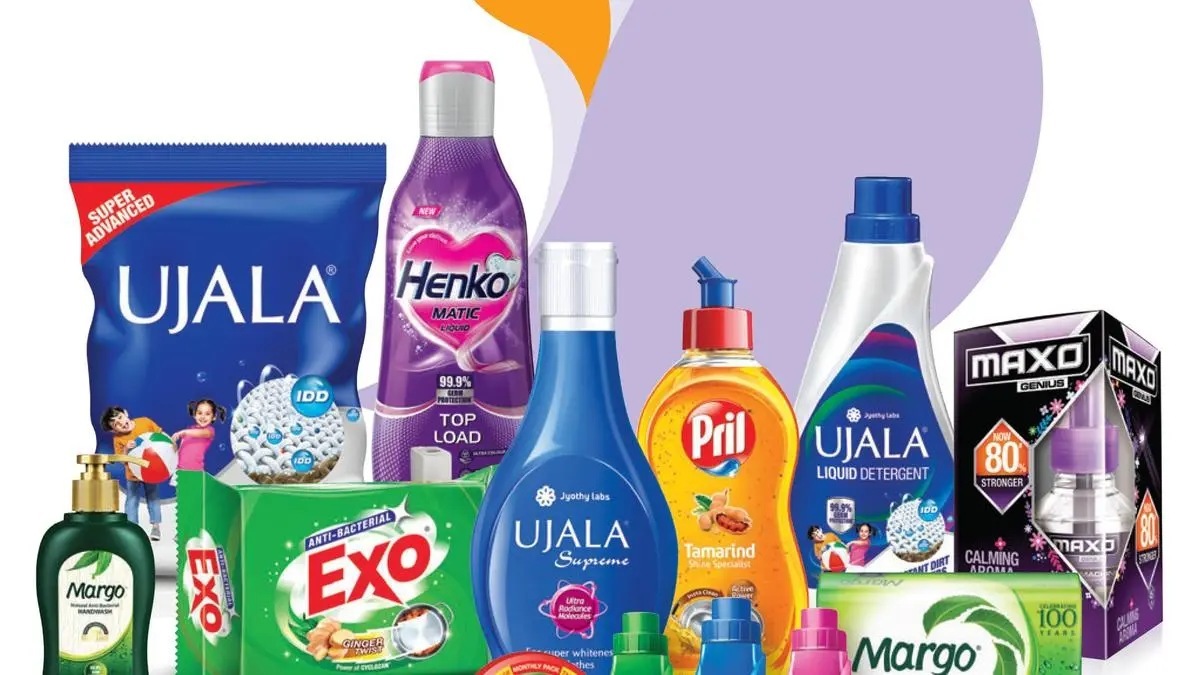
Fabric Care (34% of Q1 FY26 revenue) This is the OG segment. Ujala Supreme dominates fabric whiteners with an absurd 84% market share. Henko plays in detergents, while newer launches like Ujala Young & Fresh fabric conditioner aim to ride the premiumisation wave. Kerala alone gives Ujala detergent a 22.9% market share—which basically means half the state is loyal.
Dishwashing (33%) Exo bars and Pril liquids are the backbone here. Exo dishwash bar and Pril liquid are the second-largest products in their categories with 13.7% market share. Not No.1, but comfortably No.2—like the student who always scores 85% and never tops.
Personal Care (13%) Margo soaps, handwash, toothpaste—and now Jovia beauty soap in mass variants. This is Jyothy trying to flirt with HUL territory. Early days, high competition, low forgiveness.
Household Insecticides (6%) Maxo coils and vaporizers. Market shares: 23.8% in coils, 8.3% in vaporizers. But Q1 FY26 revenue declined 9.7% YoY. Mosquitoes are winning this round.
Others (4%) Laundry services (now shut), niche experiments, and things management doesn’t talk about too loudly.
Simple model: mass FMCG, strong brands, heavy distribution, moderate innovation. Works well… until growth expectations rise faster than detergent foam.
4. Financials Overview – Numbers Don’t Lie, They Just Smirk
Revenue grew. Volumes grew (~7.2%). But margins slipped. EBITDA margin fell to ~15%. PAT took the hit. Classic FMCG story when ad spends, input costs, and mix refuse to cooperate.
Question for you: would you rather have 5% revenue growth with margin pressure or flat sales with expanding margins?
5. Valuation Discussion – Fair Value, Not Fantasy
Current Price: ₹250 Market Cap: ₹9,193 crore TTM EPS: ₹9.33
Method 1: P/E
Conservative FMCG multiple: 22x → ₹205
Optimistic but sane: 28x → ₹261
Method 2: EV/EBITDA
EV: ₹9,232 crore
EBITDA (TTM): ~₹465 crore
EV/EBITDA ≈ 19.8x Fair range FMCG: 16–20x → largely where it already trades.
Method 3: DCF (High-level sanity check)
Growth assumption: high single digit
Stable margins
Discount rate ~11–12%
Fair Value Range:₹210 – ₹270
This fair value range is for educational purposes only and is not investment advice.