1. At a Glance
Azad India Mobility Ltd is what happens when a sleepy legacy steel bar company wakes up one morning, looks at the EV party next door, and decides to crash it with a preferential allotment and a press release. Incorporated in 1960, reborn in FY24, and now trading at around ₹101 with a market cap of roughly ₹551 crore, this company has pulled off a business pivot so dramatic that even Bollywood scriptwriters would ask for edits.
The latest quarter shows ₹28.7 crore in sales, ₹0.66 crore PAT, and ₹0.12 EPS, which annualised gives you an EPS that still struggles to justify a P/E north of 500. ROCE is negative, ROE is barely awake, and yet the stock has delivered wild swings — down nearly 39% in three months, up over 70% in three years. Debt is almost nonexistent, cash flows are… creative, and promoter holding is a modest 15.5% after a long dilution marathon.
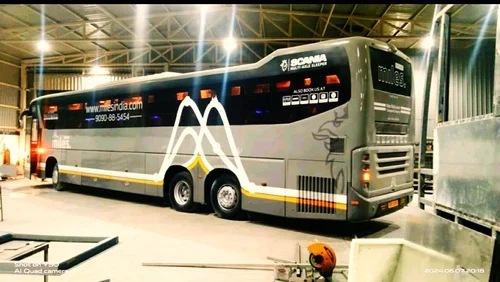
The real headline though? The company has gone from zero operating revenue to rolling out EV luxury buses, acquiring NAE Mobility, and announcing order books — all within about 18 months. Is this a phoenix moment or just financial cosplay with lithium batteries? Let’s find out.
2. Introduction
If corporate pivots had a sound effect, Azad India Mobility’s would be a sudden tyre screech followed by a dramatic U-turn.
For decades, this company quietly existed as Indian Bright Steel Company Limited, manufacturing steel bars and mostly minding its own business. Then FY24 happened. The board decided steel was passé, EVs were sexy, and the future clearly involved buses, rickshaws, vans, scooters, carts, and pretty much anything with a battery and wheels.
So the company:
- Changed its name
- Changed its business object
- Changed its share capital structure
- Changed its management
- Changed its peer group (at least in theory)
What it didn’t change immediately was profitability, return ratios, or valuation sanity.
The result today is a fascinating creature: a company with negligible historical operating performance, suddenly valued like a growth unicorn, sitting in the industrial products category but narratively pitching itself as an EV mobility play.
The question you should already be asking: Is this a real operating turnaround or a balance-sheet-powered rebranding exercise?
3. Business Model — WTF Do They Even Do?
Earlier: steel bars.
Now: everything electric with wheels.
As of April 30, 2024, Azad India Mobility formally adopted a new business objective covering:
- Electric buses
- Electric cars
- Electric rickshaws
- Electric vans & carts
- Electric cycles and scooters
- Basically, if it moves and plugs in, they’re interested
The real operational engine behind this pivot is NAE Mobility Private Limited, which Azad acquired first partially and then fully by March 2025. NAE Mobility is engaged in the manufacturing of electric vehicles, and Azad India Mobility is now effectively the listed wrapper around this EV operation.
Think of it like this: Azad is no longer trying to build EV tech from scratch. It has bought itself an operating EV business and is now using capital markets to scale it.
Is that bad? Not necessarily.
Is that risky? Absolutely.
Because when your listed entity has:
- Barely any operating history in the new segment
- Thin margins
- Heavy working capital needs
- And a valuation that assumes success before execution
…the business model needs to run, not just roll downhill.
So here’s the real business model today:
Raise capital → Acquire EV ops → Announce capacity, orders, rollouts → Hope execution catches valuation.
Fair enough. But execution is where the fun