1. At a Glance — Tight Briefs, Tighter Valuations
Page Industries is that rare Indian company which sells chaddi-baniyan at luxury-brand margins and convinces investors to pay Ferrari multiples for it. As of 6 Feb, the stock sits around ₹35,395, down ~19% YoY and ~10% over three months—yet still commands a market cap of ~₹39,479 Cr. Why? Because this business runs on a licensing moat so deep that even competitors wearing boxers can’t jump it.
Q3 FY26 (Dec 2025) came in with Revenue of ₹1,387 Cr (+5.6% YoY) and PAT of ₹190 Cr (+5.2% YoY). Margins stayed muscular with OPM ~23%, and ROCE clocked an absurd 59%—numbers that would make FMCG CEOs quietly cry into their annual reports. Debt is modest at ₹268 Cr (D/E 0.19), dividend yield is a respectable 2.56%, and payout ratios are… let’s say “generous to the point of philanthropy.”
The catch? Valuation. At ~51× P/E and ~33× EV/EBITDA, Page isn’t just priced for perfection—it’s priced for never wearing loose elastic. Is the market paying for durability, dividends, and dominance—or simply nostalgia for a stock that once felt invincible? Let’s unpack.
2. Introduction — The Jockey Who Refuses to Slow Down
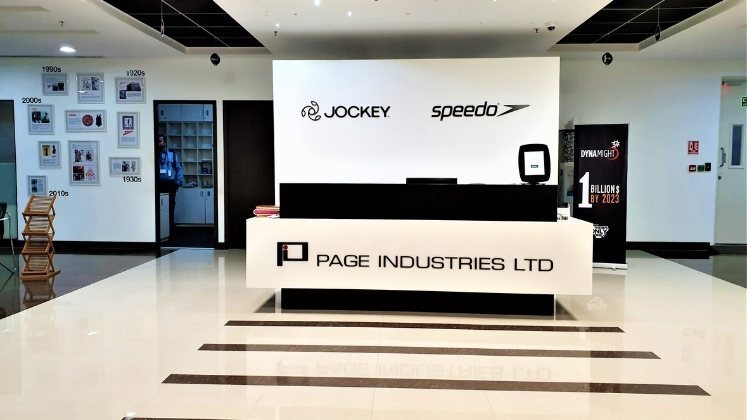
Founded in 1995, Page Industries is the exclusive licensee of Jockey International Inc. across India and select overseas markets, and of Speedo International Ltd. in India. In plain English: Page doesn’t just sell underwear; it sells permission. Permission granted by two global brands that trust Page to manufacture, distribute, and market their products across a massive geography.
That permission has translated into decades of pricing power, pristine margins, and enviable cash flows. But the Indian innerwear market has grown noisier—regional brands, D2C upstarts, celebrity-backed launches, and e-commerce discount wars