1. At a Glance – The 1893 Vintage Balm with a 2026 Marketing Budget
Amrutanjan Health Care Ltd (AHCL) is that rare Indian company which was already selling pain relief when your great-great-grandfather still believed doctors were optional. Fast forward to Q3 FY26, and this 120-plus-year-old brand just reported ₹141 Cr quarterly sales, ₹19.45 Cr PAT, and EPS of ₹6.73 — not bad for a company whose flagship product smells like nostalgia and menthol.
At a market cap of ~₹1,684 Cr and a stock price of ~₹583, AHCL trades at roughly 29x earnings, almost identical to the industry median. Returns, however, have been grumpy: -18.6% in 3 months, -12.1% in 1 year, and a humbling -6.3% over 3 years. Meanwhile, ROCE sits comfortably at ~22%, ROE at ~16.5%, and debt is basically non-existent (₹1.94 Cr).
This is a company that prints cash, pays dividends, and still gets ignored by Mr. Market. Is it boring? Maybe. Is it broken? Not really. Is it trying to become a ₹1,000 Cr FMCG story by FY28? Absolutely. But can a balm brand pull off a modern FMCG glow-up without tearing a muscle? Let’s investigate.
2. Introduction – From Freedom Movement Era Balm to Instagram-Ready FMCG
Founded in 1893, Amrutanjan has survived British rule, World Wars, License Raj, and now faces its toughest enemy yet: attention-deficit modern consumers. Pain balm alone doesn’t excite Dalal Street anymore. Everyone wants “brands + growth + narrative + optionality.”
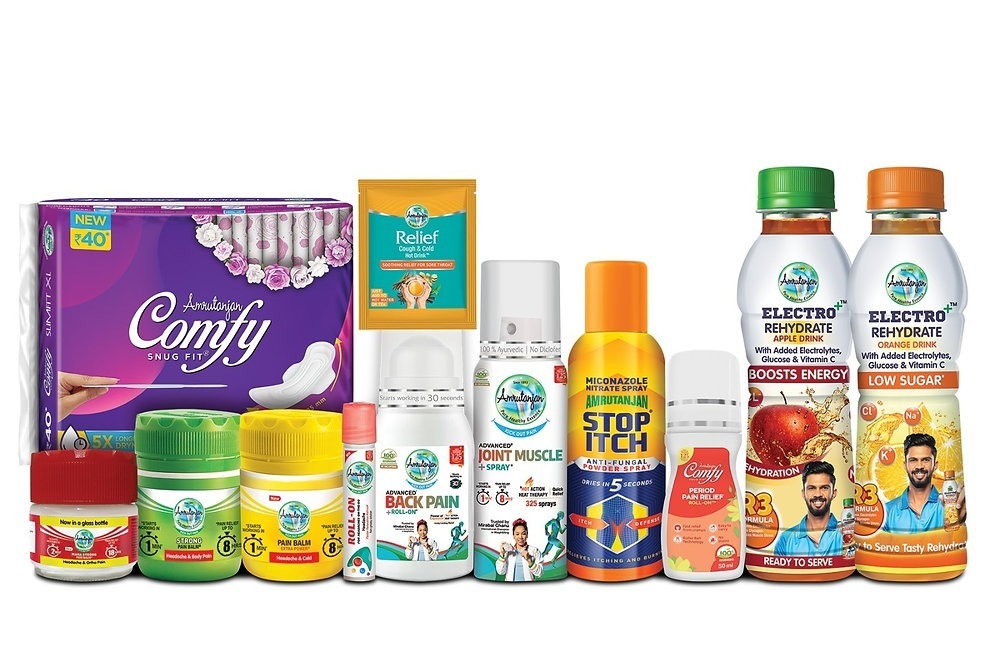
AHCL knows this. That’s why it has quietly transformed from a one-product legend into a three-pillar OTC FMCG company — pain management, women’s hygiene, and beverages. The problem? Execution speed versus ambition.
Financially, the company is clean. No debt drama, no pledge circus, no governance horror stories. Promoters still own ~46.5%, institutions are slowly nibbling, and auditors aren’t losing sleep. Yet stock returns have been flat because sales growth over the last 3 years is just ~4% CAGR.
So here’s the central question:
👉 Is Amrutanjan an undervalued, cash-generating FMCG compounder in disguise, or a heritage brand stuck doing yoga while competitors sprint?
Let’s break it down, balm tin by balm tin.
3. Business Model – WTF Do They Even Do? (Apart from Burning Your Nose)
AHCL operates primarily in OTC (Over-the-Counter) healthcare, where prescriptions are optional and branding is king.
Segment 1: OTC Pain & Congestion (≈90% of revenue)
This is the OG business — balms, roll-ons, patches,