Search for stocks /

Bharat Seats Ltd Q3 FY26 – ₹491 Cr Quarterly Revenue, 60% YoY Growth & a 23x PE… Is This a Seatbelt-On Moment or a Speed Bump Ahead?


1. At a Glance – Blink and You’ll Miss the Rally

Bharat Seats Ltd is trading around ₹152, sitting on a market cap of ~₹952 crore, and casually posting a 60.3% YoY jump in quarterly revenue like it’s no big deal. Q3 FY26 sales came in at ₹491 crore, while PAT clocked ₹9.9 crore, up 43.6% YoY.

ROE stands at 18%, ROCE at 15.6%, and the stock trades at ~23x trailing EPS of ₹6.43 — notably below the industry PE of 28.1x. Over the last one year, the stock is up ~94%, though the last three months have been rough with a -25% correction, reminding investors that gravity still exists.

Debt? ₹132 crore, translating to a 0.64 debt-equity ratio — manageable, but not exactly debt-free yoga either. Dividend yield is a polite 0.73%, basically chai money.

The headline takeaway: this is a smallcap auto-ancillary riding the Maruti–Suzuki express, growing fast, spending aggressively on capex, and daring the market to decide whether it deserves a mid-cap valuation multiple.

So the big question: Is this a structural growth story or just Maruti’s shadow dancing on the wall?


2. Introduction – A Seat Maker That Accidentally Became a Growth Stock

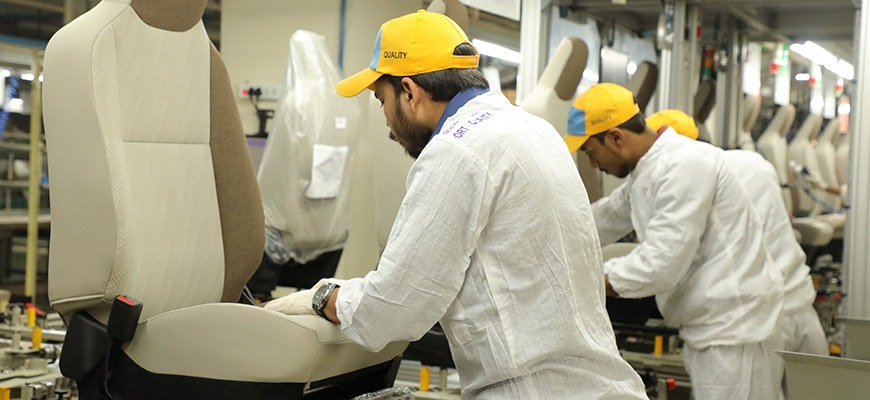
Bharat Seats Ltd was incorporated in 1986, back when Indian cars had cassette players and power steering was a luxury. Today, it manufactures complete seating systems and interior components for automobiles, two-wheelers, and even Indian Railways.

What makes it interesting (and dangerous) is that BSL is a joint venture involving Suzuki Motor Corporation Japan, Maruti Suzuki India Ltd, and the Relan family, with Suzuki + Maruti together holding ~29.6% equity. Translation: this company doesn’t chase customers — customers are already sitting in its lap.

But before you get too comfortable, remember one thing: ~88% of FY23 revenue came from the Suzuki–Maruti ecosystem. That’s not customer concentration; that’s customer monogamy.

Over the last few years, Bharat Seats has quietly transitioned from a sleepy ancillary to a high-growth supplier, tracking MSIL’s volume surge and new model launches. FY25 TTM sales stand at ₹1,770 crore, with TTM profit of ~₹40 crore, and growth rates that suddenly make smallcap investors sit upright.

But growth has a cost — and Bharat Seats is paying it upfront through heavy capex, rising borrowings, and thin margins.


3. Business Model – WTF Do They Even Do?

Imagine you buy a Maruti car. Congratulations — there’s a very high probability you’re sitting on a Bharat Seats product.

BSL manufactures:

  • Complete seating systems for four-wheelers, two-wheelers, and railways
  • NVH components like carpets
  • Body sealing parts such as extrusions and windshield moldings
  • Metal frames for two-wheelers

The company operates manufacturing plants across Haryana (Gurgaon, Manesar, Bhorakalan) and Gujarat (Surendranagar, Hansalpur), strategically located near OEM hubs to keep logistics costs low and OEM bosses happy.

Technically, BSL isn’t winging it. It has technical collaborations with Toyo Seats Co. (Japan) for seating systems and Hayashi Telempu (Thailand) for carpets. Certifications include IATF 16949, ISO 14001, and OHSAS 18001, which in auto-land basically means “approved by OEM gods.”

Revenue mix FY23:

  • Seating systems: ~89%
  • Carpets: ~5%
  • Extrusions: ~1%
  • Other goods: ~5%

So yes, despite all the diversification talk, this is a seating company first, last, and always.

Ask yourself: If Maruti sneezes, does Bharat Seats catch a cold or pneumonia?


4. Financials Overview – Growth Is Loud, Margins Are Whispering

Quarterly Performance Snapshot (Figures in ₹ crore)

MetricQ3 FY26 (Dec’25)Q3 FY25 (Dec’24)Q2 FY26 (Sep’25)YoY %QoQ %
Revenue491.01306.39458.6060.3%7.1%
EBITDA25.1318.5822.6535.2%11.0%
PAT9.907.599.9043.6%0.0%
EPS (₹)1.581.211.5830.6%0.0%

This is Quarterly Results, so EPS treatment stays quarterly — no funny annualisation gymnastics mid-article.

Commentary:

  • Revenue growth is explosive, driven by higher volumes from MSIL and SMIPL.
  • EBITDA margins hover around 5–6%, which is… fine, but not “wow”.
  • PAT growth is solid, but note that QoQ PAT is flat — growth momentum is strong but not accelerating every quarter.
  • Interest costs and depreciation are rising, courtesy of ongoing capex.

Here’s the uncomfortable truth: this is a volume story, not a margin expansion story — at least for now.


5. Valuation Discussion – Fair Value Range (Not a Lottery Ticket)

Method 1: P/E Multiple

  • TTM EPS: ₹6.43
  • Conservative multiple: 18–22x (below premium ancillaries, above boring suppliers)

Fair value via P/E:
₹116 – ₹141


Method 2: EV / EBITDA

  • EV: ₹1,079 crore
  • TTM EBITDA: ~₹92 crore
  • Current EV/EBITDA: ~11x
  • Reasonable range for this business: 9–12x

Implied EV range:
₹830 – ₹1,100 crore

After adjusting for net debt, equity value lands broadly in the ₹120–₹155 zone.


Method 3: DCF (Simplified Sanity Check)

Assumptions (educational, not predictive):

  • Revenue growth moderates from 50%+ to mid-teens over time
  • EBITDA margins stay around 5–6%
  • Capex remains elevated
Join 10,000+ investors who read this every week.
Become a member
error: Content is protected !!