1. At a Glance – Synthetic Leather, Real Cash
Mayur Uniquoters Ltd is that rare Indian midcap which doesn’t scream on Twitter, doesn’t sponsor IPL teams, yet keeps minting cash like an obedient CA student. At a market cap of ₹2,226 Cr, the stock is chilling near ₹512, down ~6% over three months while earnings are doing bhangra in the background.
Q3 FY26 numbers came in spicy: ₹237 Cr revenue (+21.6% YoY) and ₹52.9 Cr PAT (+77% YoY). Operating margins touched 25%, which in manufacturing land is basically IPL auction money. ROCE stands tall at ~21%, debt is almost nonexistent (₹7.5 Cr, yes that’s not a typo), and dividend yield sits near 1%—small, but consistent.
The company sells synthetic leather, but ironically its financials look very real. While peers are still figuring out survival, Mayur is arguing with analysts about how much cash is too much cash. So why is the stock sleepy? Is the market ignoring a compounder or waiting for a plot twist?
2. Introduction – The Boring Company That Keeps Winning
Mayur Uniquoters has mastered the art of being boring and profitable—an underrated superpower in Indian equities. No flashy fintech pivot. No AI buzzword slides. Just PVC, PU, and discipline.
Founded decades ago and run by the Poddar family, the company dominates India’s synthetic leather space, supplying everyone from Maruti to Relaxo. If you’ve sat on a car seat, worn budget footwear, or touched artificial leather furniture in India—congrats, you’ve probably experienced Mayur’s product without knowing it.
Despite steady earnings growth and a squeaky-clean balance sheet, the stock has underperformed in the last year. This disconnect between price and performance is exactly what makes Mayur interesting—and also suspiciously ignored.
Is this a classic “manufacturing is boring” discount? Or is the market worried about growth saturation? Let’s open the factory shutters and inspect the books.
3. Business Model – WTF Do They Even Do?
In simple terms: Mayur makes fake leather that behaves like real leather, costs less, and doesn’t annoy animal activists.
They manufacture 400+ variants of PVC-coated and PU-coated fabrics used in:
- Footwear (budget kings like Bata, Relaxo)
- Automotive OEMs (Maruti, Tata, Hyundai, Kia, VW)
- Auto replacement market
- Furnishings & exports
They also run a small but aspirational furnishing retail business via their WOS Mayur Tecfab under the brand Texture & Hues. Think of it as management’s weekend passion project—not yet a revenue monster.
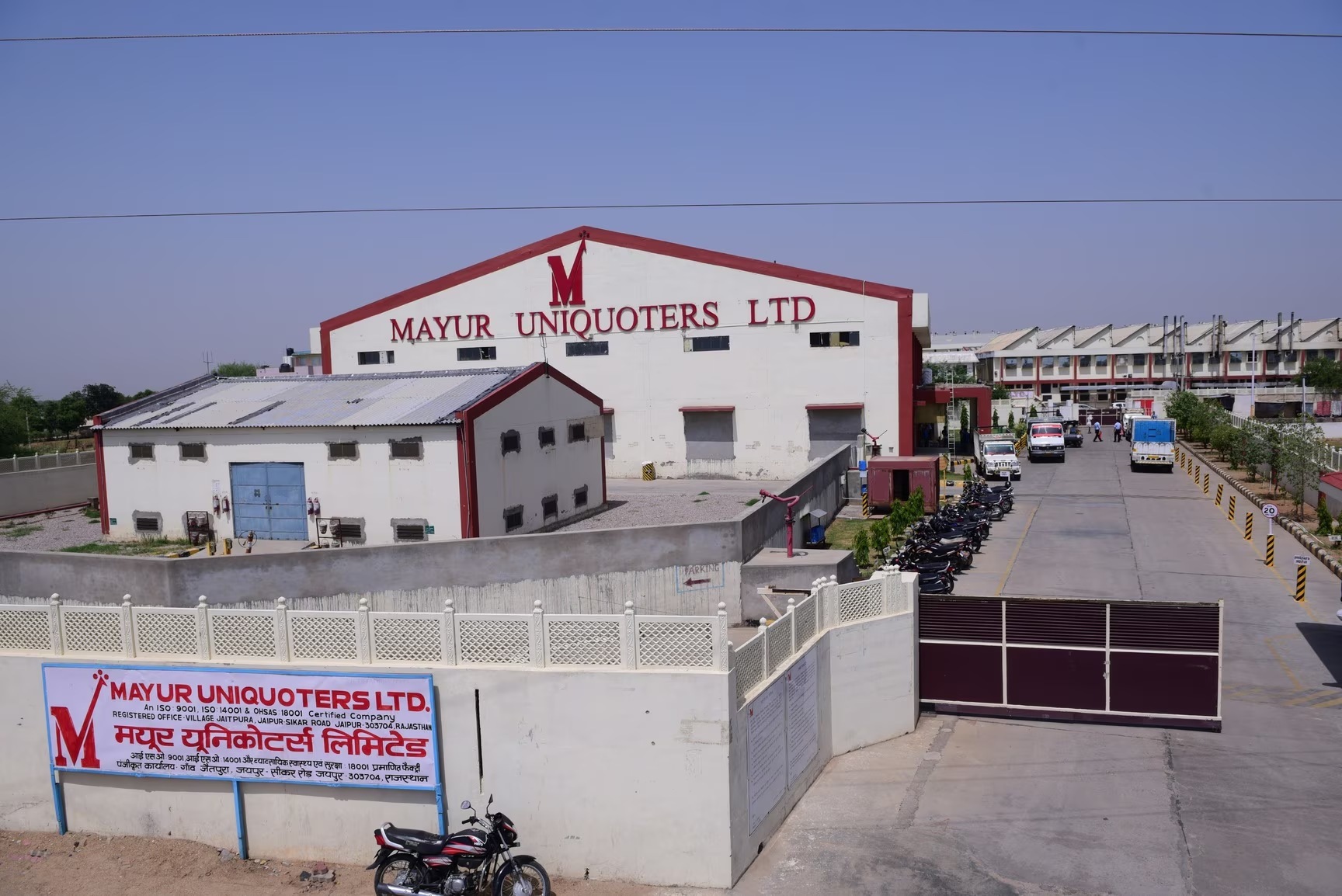
Manufacturing happens across 2 PVC plants near Jaipur and 1 PU plant in MP, with total capacity of ~54 Mn linear meters. Capacity utilisation in Q3 FY26 was ~70%, which means there’s room to grow without lighting another capex bonfire.
Question for you: would you rather own a company selling dreams—or one selling car seats at 25% margin?
4. Financials Overview – Numbers That Don’t Shout, They Whisper Confidence
Quarterly Performance Table (₹ Cr)
| Metric | Latest Qtr (Q3 FY26) | YoY Qtr | Prev Qtr | YoY % | QoQ % |
|---|---|---|---|---|---|
| Revenue | 237 | 195 | 238 | 21.6% | -0.4% |
| EBITDA | 58 | 46 | 59 | 26% | -1.7% |
| PAT | 52.9 | 29.8 | 48 | 77.4% | 10.2% |
| EPS (₹) | 12.18 | 6.87 | 11.07 | 77% | 10% |
Annualised EPS (Q3 rule):
Average of Q1–Q3 FY26 EPS = (9.49 + 11.07 + 12.18) / 3 = 10.91
Annualised EPS = ₹43.6
At current price, P/E ~11.7, while industry trades near 34x. Either Mayur is undervalued—or the industry is on Red Bull.
5. Valuation Discussion – Not Cheap, Not Expensive, Just Ignored
P/E Method
- Annualised EPS: ₹43.6
- Conservative multiple: 12–15x
- Fair Value Range: ₹520 – ₹655
EV/EBITDA
- EV: ₹2,162 Cr
- EBITDA TTM: ~₹206 Cr
- EV/EBITDA: ~10.5x (reasonable for a debt-free manufacturer)
DCF (Simplified)
- Revenue growth: high single digit
- Stable margins, low capex intensity
- Strong cash flows
Indicative fair value range aligns with ₹550–₹650.
Disclaimer: This fair value range is for educational purposes only and is not investment advice.
6. What’s Cooking – News, Triggers, Drama
- Mexico plant (₹250 Cr) is on hold due to tariff drama—probably a blessing, not a curse.
- Lithuania acquisition (UAB Futura Textiles) adds export optionality.
- Buyback announced in Aug 2024 at ₹800—management clearly thought stock was cheap.
- No promoter pledging. No balance sheet stress. Just boring execution.
When management buys back stock at ₹800 and market quotes ₹512, who looks confused—you or them?
7. Balance Sheet – Clean Enough to Eat From
Latest Consolidated: Sep 2025 (₹ Cr)
| Item | Sep 2025 |
|---|---|
| Total Assets | 1,134 |
| Net Worth | 1,014 |
| Borrowings | 7 |
| Other Liabilities | 112 |
| Total Liabilities | 1,134 |
Snarky Observations:
- Debt so low it needs a microscope
- Net worth compounding quietly
- Balance sheet looks like it went to therapy
8. Cash Flow – Sab Number Game Hai
Operating cash flow in FY25: ₹159 Cr
Capex & investments: controlled
Free cash flow: healthy
Mayur doesn’t just report profits—it collects them.
9. Ratios – Sexy or Stressy?
| Ratio | Value |
|---|---|
| ROE | 15.4% |
| ROCE | 20.7% |
| PAT Margin | 17% |
| Debt/Equity | 0.01 |
| P/E | ~12.6 |
Verdict: Sexy in a boring accountant way.
10. P&L Breakdown – Show Me the Money
Revenue growth has been ~9–10% CAGR, profits faster at ~12–19% CAGR. Margins expanding despite input cost cycles. This is how operating leverage politely flexes.
11. Peer Comparison – Class Topper Syndrome
Mayur trades at 12x P/E, peers average 30–40x with weaker ROCE and debt. Either Mayur is misunderstood—or peers are overhyped.
Who do you think cracks first when the cycle turns?
12. Shareholding & Promoters – Poddar & Sons, No Drama
Promoters hold ~58.6%, stable for years. FIIs ~3%, DIIs declining. No pledges. No sudden exits. Just boring family business energy.
13. Corporate Governance – Angels Wearing Slippers
Regular board meetings, clean audit history, management continuity till 2029. No headline risks. No Twitter apologies.
14. Industry Roast & Macro Context
Synthetic leather is a volume + margin game. China dominates exports, but India is quietly becoming a reliable alternative. Auto interiors, budget footwear, and furniture demand aren’t cyclical—they’re demographic.
The industry suffers from:
- Fragmentation
- Margin pressure at the bottom end
Mayur survives because it sits above the chaos, supplying OEMs who care about quality, not jugaad.
15. EduInvesting Verdict – Slow Compounder or Value Trap?
Mayur Uniquoters is not a story stock. It won’t double because of one press release. It will grind, quarter after quarter, minting cash, buying back shares, and annoying momentum traders.
Strengths:
- Debt-free
- Strong ROCE
- OEM relationships
- Cash generation
Weaknesses:
- Moderate revenue growth
- Low narrative excitement
Opportunities:
- Exports, auto premiumisation
- Capacity utilisation upside
Threats:
- Input cost volatility
- Fashion cycles
Final thought: this is the kind of company markets ignore—until they don’t.
Would you rather chase noise—or quietly let compounding do the talking?
Written by EduInvesting Team | Date