1. At a Glance
CMX Holdings Ltd is that one stock which shows up on your 6-month return filter (+240%) and immediately makes you doubt your screener settings. A ₹56.6 crore market cap company, zero operating revenue, negative net worth, and yet trading at nearly ₹50 per share — welcome to the Indian stock market’s version of abstract art.
In Q3 FY26 (Dec 2025), CMX reported zero sales, a net loss of ₹0.18 crore, and an EPS of -₹0.16. ROCE is sitting at a majestic -1,250%, which is not a typo — it’s a cry for help expressed in percentage terms. The balance sheet has negative reserves of ₹17.29 crore, borrowings of ₹6.76 crore, and total assets of just ₹0.91 crore as of Sep 2025.
Yet the stock is up 51% in 3 months and 240% in 6 months. Clearly, fundamentals took a long vacation, while corporate announcements decided to hit the gym daily.
This is not a company you “analyze” — this is a company you observe, like a science experiment where chemicals are mixed without a lab manual.
So what’s going on here? Why is a dormant ex-NBFC suddenly talking about ₹2,500 crore authorised capital and green energy dreams?
Let’s open the files. Slowly. With gloves.
2. Introduction – From SIEL to CMX: The Art of Corporate Reincarnation
CMX Holdings Ltd was earlier known as Siel Financial Services Ltd, incorporated in 1983 with the ambition of becoming a Non-Banking Financial Company. Ambition was present. RBI registration was not.
The company applied for NBFC status. The RBI politely declined — by never issuing a certificate. Since then, CMX has been operationally dormant for years. No lending business. No financial services. No meaningful employees. Just a few Key Managerial Personnel to keep the lights on and the filings signed.
For most of the last decade, CMX’s “business model” has been:
- Recover old debtors
- Earn interest on fixed deposits
- Book occasional fair value gains
- File annual reports
- Survive
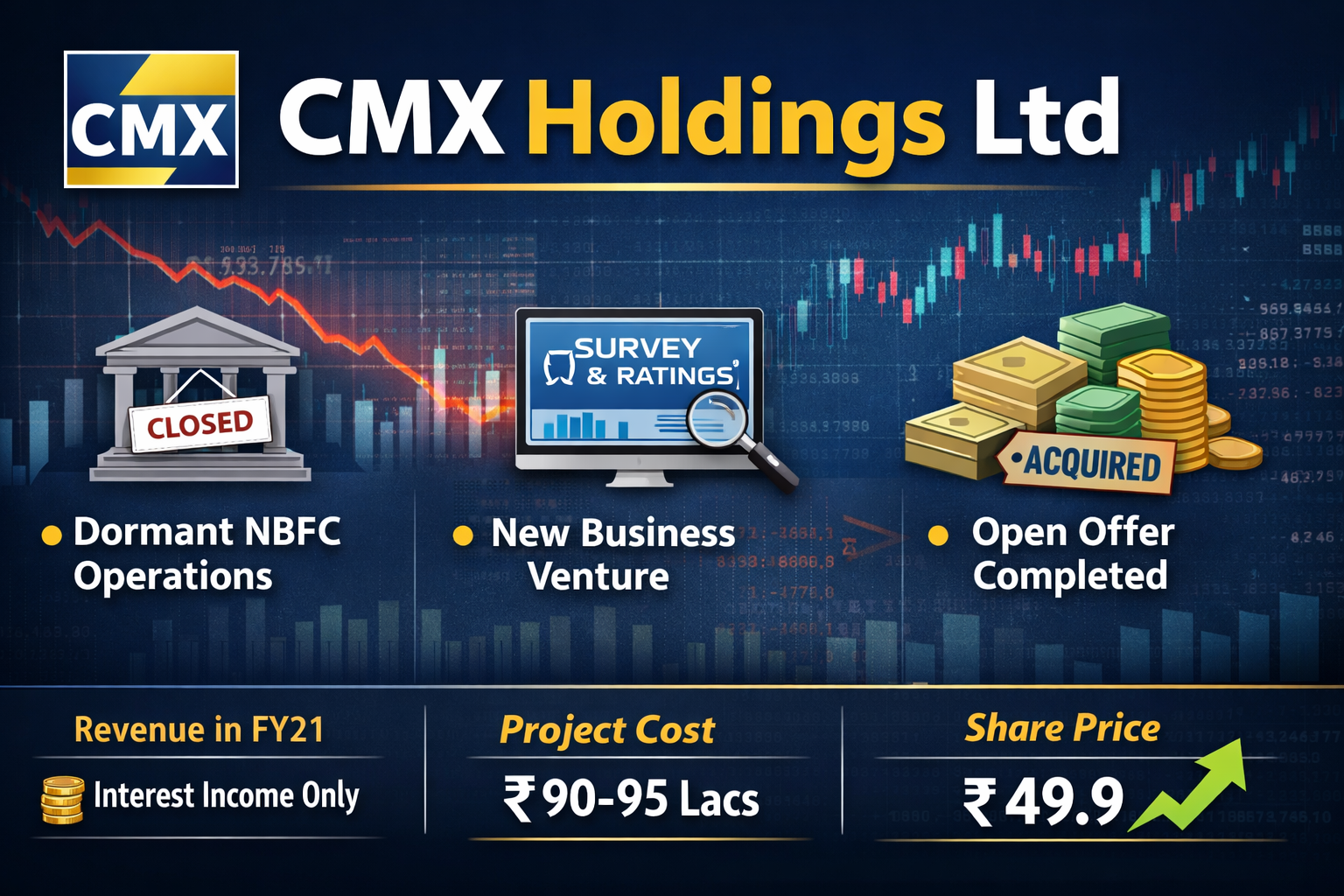
In FY21, 89% of income was interest on fixed deposits and 11% came from fair value gains. In recent years, even that has dried up.
But Indian markets have a soft corner for turnaround stories — especially those that start with:
- Change in promoter
- Board resignations
- MOA alteration
- Capital increase
- Buzzwords like platform, green energy, or technology
CMX has ticked every box. Multiple times.
So while the P&L sleeps, the corporate action section has been doing cardio.
3. Business Model – WTF Do They Even Do?
Let’s be honest: as of today, CMX Holdings does not have an operating business.
Historically:
- Intended NBFC
- Never received RBI license
- Operations restricted to interest income and recovery
In June 2021, management announced plans to enter a new digital platform business involving:
- Survey reports
- Ratings
- Financial products
- Maintenance workers
- Business networking for manufacturers, suppliers, partners, and consumers
Total project cost was estimated at ₹90–95 lakh, and CMX paid ₹18 lakh as advance to DAIS World Endeavour