Introduction: The Eternal Temptation to “Buy Low, Sell High” (and Why We Rarely Do)
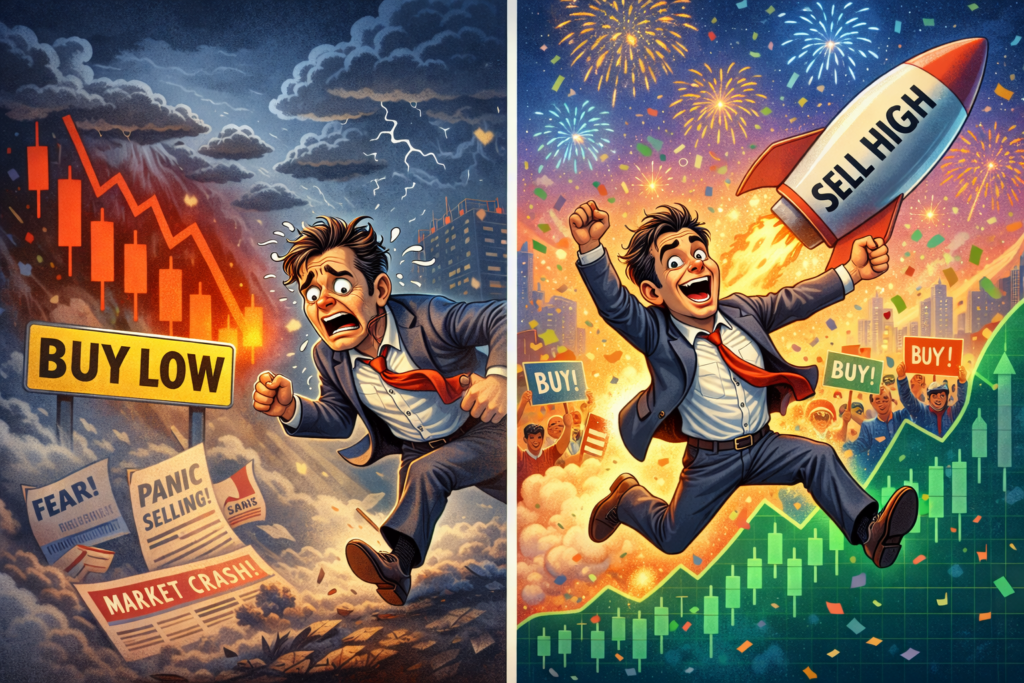
Buy low, sell high — it’s the ultimate no-brainer, right? It’s the investing equivalent of “just eat healthy and exercise” in personal fitness: everyone knows it, yet so few actually pull it off. The financial world is littered with people who intended to enter at rock bottom and exit at the peak, only to do the exact opposite while muttering a four-letter word: hope.
Consider the simple logic: if you buy stocks when they’re cheap and unloved, then sell when they’re expensive and everyone’s throwing confetti, you should make a fortune. So why isn’t every investor relaxing on a beach from perfectly timed trades? Because executing “buy low, sell high” in real life is psychologically brutal. When prices plunge, your brain screams “Run away!”; when prices skyrocket, the fear of missing out (FOMO) kicks in, and suddenly chasing that hot stock at its peak seems irresistible. Research shows emotion-driven decisions are one of the biggest threats to long-term investment success – euphoria tempts us to chase high prices, while fear leads to panic selling at exactly the wrong time. In other words, our ancient instincts are terrible stock-pickers.
In this article, we’ll explore why relying on hope is a recipe for heartbreak in capital markets, and what to do instead. But first, let’s dig into why the obvious advice of “buy low, sell high” so often goes in one ear and out the other of even seasoned investors.
Buy Low, Sell High: Easy in Theory, Hard in Practice
In theory, it’s simple. In practice, asking investors to actually buy low and sell high is like asking a cat to take a bath — natural instincts rebel. Herd mentality and greed make us want to buy what everyone else is buying (which is usually already expensive). Fear and loss aversion make us dump investments at the worst possible moments. The result? Many investors do the opposite of the old adage: they end up buying high in a frenzy and selling low in a panic. As one wealth advisory put it, emotional biases like fear, greed, and FOMO often drive people to buy high and sell low, hurting their long-term returns. It’s not because investors are dumb – it’s because they’re human.
Remember the classic Warren Buffett quip about being “fearful when others are greedy, and greedy when others are fearful”? Brilliant advice, but following it feels like swimming upstream during a tsunami. Our inner lemming wants to do what everyone else is doing. If all your friends are bragging about doubling their money on TechStock Du Jour, it takes Herculean willpower (or monk-like detachment) to not join the party. Conversely, when the market is tanking and your portfolio is a sea of red, hitting the sell button to stop the pain feels perfectly rational – even if it means locking in losses.
In short, buying low often means stomaching pessimism and doom-and-gloom news (not exactly a feel-good exercise), while selling high means overriding the greedy voice that says “maybe it’ll go even higher!” Little wonder that even experienced folks struggle: it’s easy to say “buy low, sell high,” but market psychology often leads us to do the exact opposite when volatility hits. So the next time you hear someone casually say “just buy low and sell high,” feel free to laugh (or cry) at the oversimplification. It’s a bit like a diet guru saying “just eat fewer calories than you burn” while you’re staring at a donut – simple, yes, but far from easy.
Hope Is Not a Strategy (So Stop Treating It Like One)
A tongue-in-cheek sketch sums it up: buying an investment at a silly price solely on the hope that someone else will later buy it at an even sillier price is not a real strategybehaviorgap.com. Yet investors do this every day, convincing themselves they’ll get out before the crash. Spoiler alert: if your plan is literally “I hope this goes up!”, you might as well consult a Magic 8-Ball for financial advice.
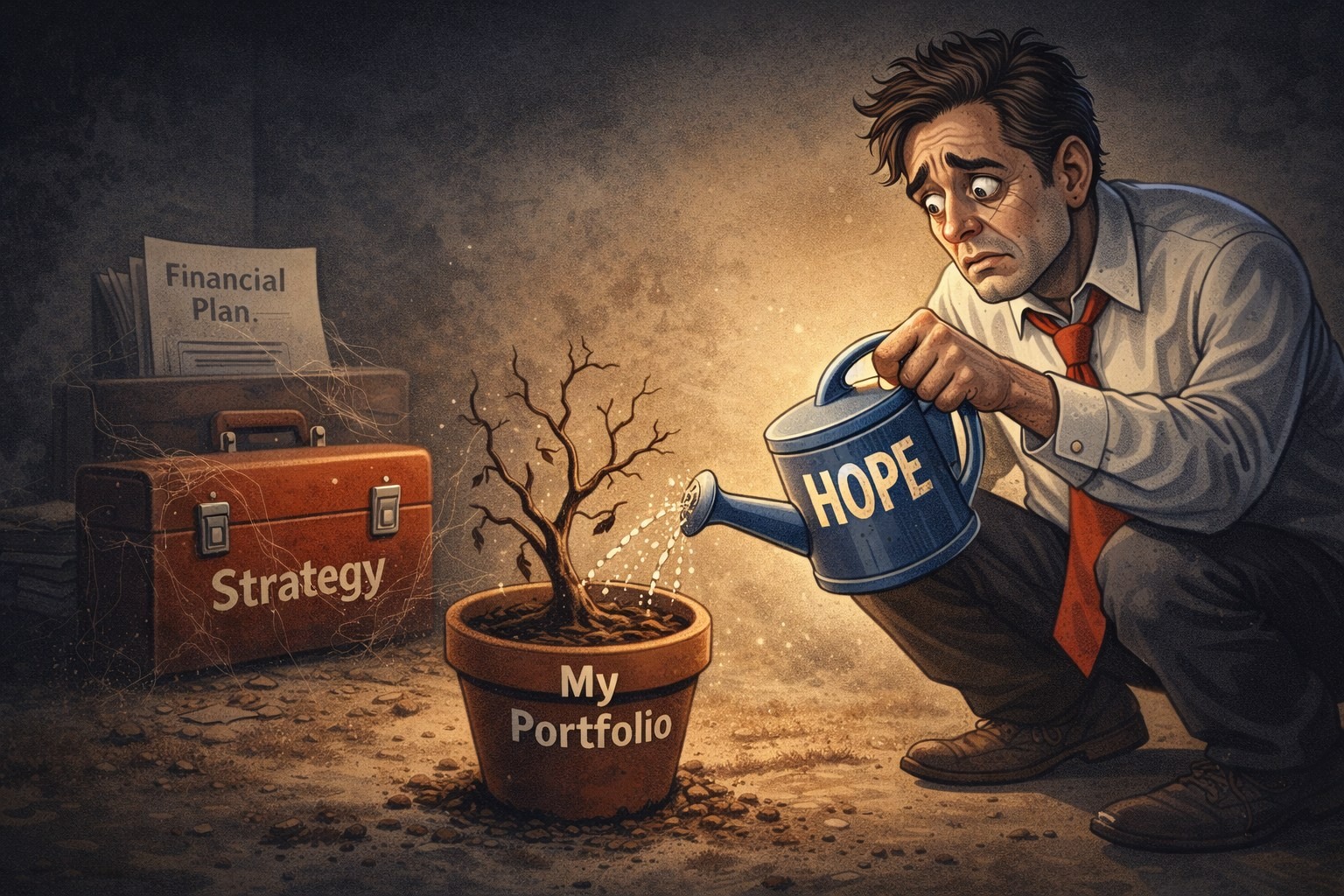
Relying on hope in the markets is like relying on hope to fix a flat tire – you’re going to end up stuck on the side of the road. Hope is a wonderful human emotion, but as a portfolio strategy it ranks up there with wishful thinking and lottery tickets. When investors start saying things like, “I know it’s down 50%, but I hope it comes back,” it’s a sign of what wags call an addiction to hopium (hope + opium, the intoxicating drug of denial). For example, picture a hapless investor watching a plummeting stock and whispering, “Come on, baby, Daddy needs a new all-time high!” while his account balance dwindles. It’s funny until you realize it’s your buddy – or worse, you – doing the praying. Many of us have held onto a losing investment way too long basically because we couldn’t bear to admit we were wrong. Instead of cutting losses, we cling on, hoping for a miraculous rebound. Newsflash: “hope” is not a recovery plan; sometimes it’s just procrastination in a fancy costume.
In behavioral finance, there’s a well-documented sunk cost trap – throwing good money (or time) after bad because you can’t let go of your earlier investment. It’s like continuing to watch a terrible movie because you already paid for the ticket. With stocks, it means holding (or even buying more of) a dud investment just because you hope to get your money back. As one investment explainer puts it, emotional commitment to bad investments only makes things worse. Likewise, there’s the Greater Fool Theory at work: you know an asset is overpriced, but you’re betting you can unload it to someone even more foolish at an even higher price. Sure, in a roaring bubble, some people manage to pull this off – for a while. But as a long-term plan, it’s about as sturdy as a sandcastle at high tide. In fact, for every lucky soul who gets rich from a hope-fueled gamble, there are ten others who get financially wrecked when reality sets in. The last ones into the party (the greatest fools) are often left holding the bag of confetti after the music stops.
The takeaway: banish “hope” from your investment vocabulary (or at least put it in the same bucket as “wish” and “pray”). Hope is a feeling, not a strategy. In the stock market, it’s often just code for I don’t have a real plan. If you ever catch yourself thinking hope will bail you out, remember the wise warning: Hope is not an investment strategy (and it never will be).
Common Investor Delusions and Emotional Traps: A Field Guide
At this point you might think, “Okay, emotions mess some people up, but I am a logical investor. I won’t fall for those silly delusions.” Oh, you sweet summer child. The annals of investing are chock-full of smart people doing very dumb things with money because of cognitive biases and emotional traps. Let’s look at some of the greatest hits — see if you recognize any of these in yourself (be honest):
FOMO Fever (Herd Mentality): “If everyone is buying it, they must know something I don’t!” This trap lures you into crowd-following. You see a stock on a rocket ride, your neighbor is bragging about his gains, and suddenly you feel dumb for not owning it. Next thing you know, you’re buying right near the top because everyone else is doing it. Herd mentality is powerful; nobody wants to be the only person not making easy money at the block party. Unfortunately, by the time everyone and their dog is piling in, you’re usually closer to the euphoria peak of a bubble than the ground floor of an opportunity. When the hype fades, the herd can quickly become a stampede for the exits – and you don’t want to be the last one out the door.
The Bagholder’s Creed: “It’ll come back… I just have to hold on!” This is the sunk cost fallacy in action. You can’t bear to sell a loser, so you grip it like Rose clinging to the plank in Titanic. Maybe you even double down, throwing more money in “to lower your average cost” – but deep down it’s just hope and an inability to accept a mistake. Falling in love with a stock is dangerous romance. Remember, the market doesn’t know or care what price you need to break even. That stock doesn’t feel obligated to return to your buy price. As one analysis bluntly notes, clinging to a sinking investment because you can’t admit you were wrong just makes things worse. Sometimes a stock never comes back (RIP, Pets.com, Lehman Brothers, Enron…). Don’t be left holding zero because you married your investment and hoped for a miracle.
Confirmation Bias (Echo Chamber Investing): You bought a hyped investment, and now you only seek out opinions that tell you you were right. You join online forums of fellow true believers and high-five each other about “🚀 to the moon” and “diamond hands.” If any negative news or dissenting voice appears, you ignore it or label it “FUD” (fear, uncertainty, doubt). This trap can lead you straight off a cliff, hand-in-hand with your fellow lemmings. If you ever catch yourself saying, “Our stock is down 30%, but surely it’s best to just hang on, right?” and only listening to others who are in the same boat, you’re engaging in collective self-delusioninvestopedia.com. In investing, groupthink is dangerous – a chorus of biased voices won’t save you when the fundamentals collapse. Don’t get stuck in an echo chamber that drowns out reality.
Overconfidence (“I’m a Genius… Until I’m Not”): After a few winning trades, it’s easy to start believing you have the Midas touch. Maybe you turned $5k into $50k on a hot stock or a crypto bet – clearly you’re the next Warren Buffett! (Narrator: You’re probably not.) Bull markets have a cruel way of making everyone look and feel like a genius. Overconfidence leads to taking outsized risks and ignoring the role of luck. It’s when your humility goes on vacation that Mr. Market loves to smack you the hardest. Many portfolios have blown up because an investor assumed “I can’t lose – I’m special.” The reality is, the market is a great humbler. As the saying goes, everyone’s a genius in a bull market. The true test is how you behave when things go south. A healthy respect for uncertainty goes a long way; if you ever catch yourself feeling invincible, go splash some cold water on your face (or check the histories of folks who got cocky and lost big).
These are just a few of the psychological gremlins that plague investors. Recognizing these mental pitfalls is half the battle. We all like to think we’re rational, but when markets swing wildly, our lizard brain often tries to take the wheel. The key is to catch yourself in these moments of self-sabotage and course-correct before you do something you’ll regret. Next up, let’s visit the ghost of market past – some historical cautionary tales of hope and hype leading to epic wipeouts.
Hope-Fueled Market Disasters: When “This Time It’s Different” Wasn’t
History has no shortage of episodes where hope and hype drove markets into bubbles, only to end in tears. Here are a few infamous cases that show what happens when investors collectively rely on hope over reality:
The Dot-Com Bubble: Betting on the Internet (and Ignoring Reality)
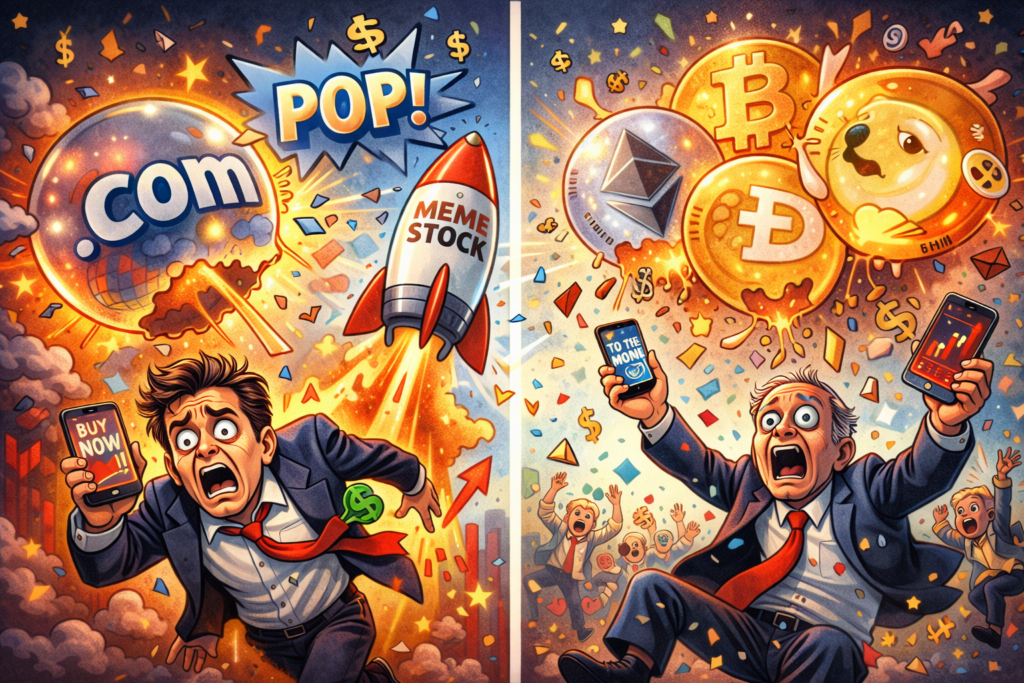
In the late 1990s, hope conquered all sense on Wall Street. A revolutionary thing called the Internet had investors convinced that old-school fundamentals no longer mattered. Startup companies with no profits (sometimes not even any revenue) were selling for insane prices just because they had “.com” in their name. It was a speculative mania of epic proportions. The Nasdaq index skyrocketed fivefold between 1995 and 2000, and people poured money into any startup promising to become “the next Amazon” (never mind that Amazon itself wasn’t making a profit yet). This frenzy relied on the promise of future growth rather than actual earnings, leading investors to overlook traditional fundamentals.
Of course, all those rosy hopes met cold hard reality in March 2000. Turns out, you can’t retire on “eyeballs” and website traffic if there are no profits. The dot-com bubble burst spectacularly. The Nasdaq plummeted by nearly 77%, collapsing from a peak of ~5,048 to ~1,139 over two brutal years. Trillions of dollars of paper wealth evaporated. Many dot-com darlings went bust (Pets.com famously raised millions in an IPO and imploded within nine months). Even established tech companies like Cisco and Intel saw their stock prices shrink 80%+. It took 15 years for the Nasdaq to regain its pre-crash peak. So much for “this time is different.”