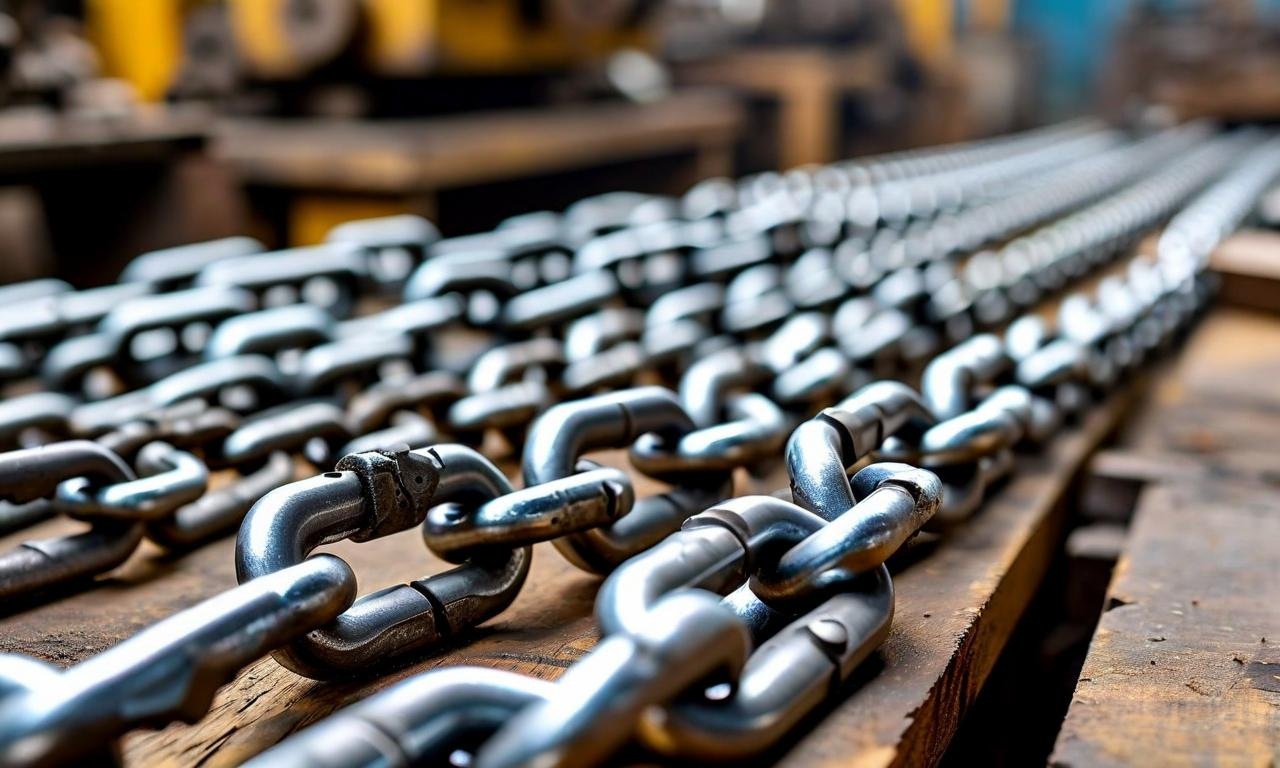
Indian Link Chain Manufacturers Ltd Q2 FY26 – ₹0 Revenue, ₹500 Cr Market Cap, 7,138x P/E: The Case of a Company That Trades More Announcements Than Goods
1. At a Glance – When Silence Is the Loudest Financial Statement
Indian Link Chain Manufacturers Ltd is the kind of company that makes you rub your eyes, clean your glasses, and then check if Screener has gone mad. Incorporated in 1958, this corporate fossil currently commands a market capitalisation of about ₹500 crore while reporting zero sales, negative operating profit, and a quarterly profit that fluctuates like a government job transfer order. The current price hovers around ₹1,868, up about 149% in six months and a jaw-dropping 740% over one year. ROCE sits at a modest 4.58%, ROE at 3.36%, debt is zero (because lending money to this business would be an extreme sport), and promoter holding has crashed to 8.66%, leaving the public holding a dominant 91.33%. The stock trades at roughly 20.7 times book value and an eye-watering P/E of over 7,000, which is not a typo, it’s a philosophical question. The latest quarterly results show sales of ₹0 crore, PAT of -₹0.03 crore, and EPS of -₹0.11. And yet, the stock price behaves like it just discovered AI, EVs, and defence exports in one board meeting. Curious? You should be. Confused? Even more so. Let’s dig.
2. Introduction – Welcome to the Museum of Indian Microcaps
Indian Link Chain Manufacturers Ltd is not a business story; it’s a sociology experiment. Founded when India was still figuring out Five-Year Plans, the company started as a manufacturer of chains. Real chains. Heavy, industrial, metal ones. Then it dabbled in trading steel chains and chemicals. Then labour problems happened. Then uneconomical operations happened. Then closure happened. And now, decades later, the company is “trying to develop trading business,” which is corporate language for “we are still figuring out what to do with the shell.”
Financially, this company has been loss-making for years, surviving largely on other income, primarily interest income on fixed deposits. Operational revenue has been effectively zero in recent years. Despite that, the stock price has delivered returns that would make venture capitalists blush. This disconnect between business fundamentals and market behaviour is not new in Indian markets, but Indian Link Chain is a particularly pure specimen.
The recent years have been less about chains and chemicals and more about open offers, preferential allotments, resignations, appointments, term sheets, proposed name changes, and auditor musical chairs. If corporate announcements were billable hours, this company would be a unicorn. So the question isn’t “what does the company do?” anymore. The real question is: what does the market think it might do next?
3. Business Model – WTF Do They Even Do?
Let’s be brutally honest. As of the latest filings, Indian Link Chain Manufacturers Ltd does not have an operating business that generates sales. Historically, it was into manufacturing and trading of chains and chemicals. Both those operations were shut down due to labour issues and uneconomical working. Since then, the company has been in a prolonged identity crisis.
Currently, the company’s P&L shows zero sales and recurring expenses, leading to operating losses. Whatever profit or loss appears at the bottom line is largely driven by other income, mainly interest earned on fixed deposits. This is not a trading business. This is not a manufacturing business. This is closer to a listed treasury account with compliance costs.
However, where things get interesting is the corporate activity. Over the last couple of years, the company has seen changes in promoters, management resignations, open offers, preferential allotments of equity shares and warrants, incorporation of a wholly owned subsidiary (RRP Technologies Limited), and announcements around acquisition of RRP Electronics with a proposed name change to RRP Electronics India. So while the current business model is “earn interest and burn cash slowly,” the story being sold is one of transformation.
Whether this transformation materialises into actual revenue-generating operations remains to be seen. For now, the business model is best described as “optional future plans with present inactivity.”
4. Financials Overview – Numbers That Whisper, Stock That Shouts
Result Type Locked: Quarterly Results Annualised EPS Rule: Latest quarterly EPS × 4
Quarterly Comparison Table (₹ Crore)
Source table
Metric
Latest Qtr (Sep 2025)
YoY Qtr (Sep 2024)
Prev Qtr (Jun 2025)
YoY %
QoQ %
Revenue
0.00
0.00
0.00
0%
0%
EBITDA
-0.10
-0.03
-0.03
NA
-233%
PAT
-0.03
0.04
0.03
-175%
-200%
EPS (₹)
-0.11
0.80
0.60
-113.8%
-118.3%
Annualised EPS based on latest quarter comes to approximately -₹0.44. Yes, negative. And yes, the stock still trades at a four-digit P/E if you cherry-pick trailing numbers from better quarters.
Witty commentary? Sure. This is less a financial performance and more a heartbeat monitor of a patient who occasionally wakes up, moves a finger, and goes back to sleep.
5. Valuation Discussion – When Maths Starts Questioning Life Choices
Let’s try valuing this company purely as an academic exercise.
P/E Method
With annualised EPS at -₹0.44, the P/E method technically collapses. A negative EPS cannot support a meaningful P/E valuation. Even if one uses trailing twelve-month EPS of ₹1.89, the