Perfectpac Ltd Q2 FY26: The Corrugated Comeback – When Boxes Make More Profit Than Your Mutual Fund SIP
1. At a Glance
Perfectpac Ltd — the 52-year-old packaging veteran from Faridabad — is quietly doing what most flashy startups only dream of: printing profits without raising a single rupee of venture debt. The share price sits at ₹86.9 (as of Dec 11, 2025), down 31% over the last year, but this humble box-maker still packs a punch. With a market cap of ₹57.8 crore, P/E ratio of 15.3, and book value of ₹59, the company looks like an old-school industrial tortoise outlasting a thousand cardboard hares.
In Q2 FY26 (September 2025), Perfectpac reported sales of ₹29.36 crore and a net profit of ₹1.20 crore, showing YoY growth of 6.34% in revenue and 17.6% in PAT — not bad for something as unsexy as corrugated boxes. The ROCE of 11.9% and ROE of 8.68% signal a decently efficient business that doesn’t need to over-leverage. With debt-to-equity at 0.02, this is as close to “debt-free” as a manufacturing firm gets. And yes, it’s still paying a healthy dividend yield of 1.15%, because apparently, cardboard cash flow is real.
Perfectpac may not trend on Twitter, but in the world of consistent manufacturers who quietly outlive their customers’ marketing budgets, this company is one thick corrugated wall of reliability.
2. Introduction
In a world obsessed with flashy packaging — from Apple boxes to influencer unboxing videos — someone has to actually make those boxes. Enter Perfectpac Ltd, the OG of cardboard craft since 1973. Long before “eco-friendly packaging” became a startup pitch, Perfectpac was turning paper into profit.
If Amazon is the mall of the internet, Perfectpac is the invisible scaffolding that keeps that mall running. The irony? The company doesn’t need hype. It sells carton boxes, folded cartons, printed cartons, and expanded polystyrene packaging — products so mundane yet so indispensable that even your expensive OLED TV owes its safe delivery to a Perfectpac cousin.
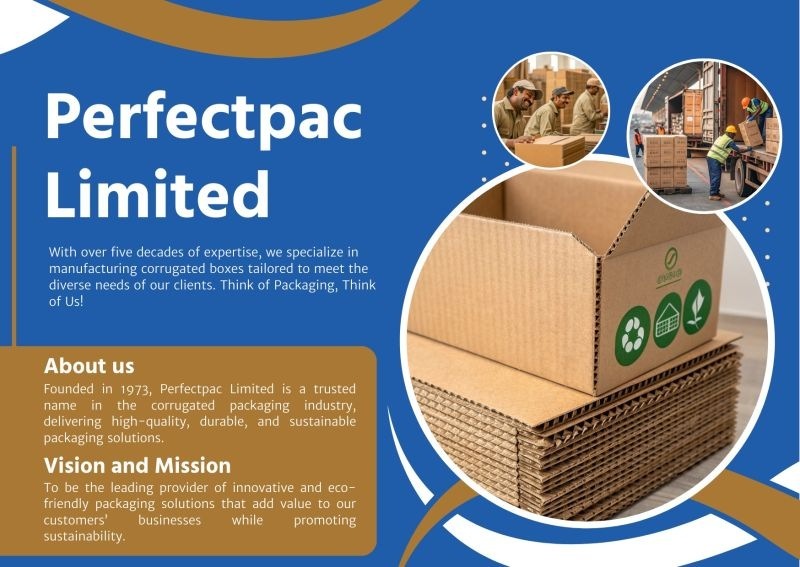
The firm’s two main manufacturing facilities — Faridabad (9,000 MTPA) and Greater Noida (9,000 MTPA) — along with an automatic board-making and printing plant (15,000 TPA), ensure it can handle demand from both FMCG giants and electronics mammoths. The clientele list reads like a who’s who of consumer capitalism: LG, Nestle, Samsung, Whirlpool, Panasonic, Videocon, and even Hamdard Laboratories (yes, your Rooh Afza rides inside Perfectpac too).
While the packaging industry faces global headwinds of rising raw material costs and ESG-driven changes, Perfectpac keeps it simple: make quality boxes, keep margins steady, and let the compounding do the heavy lifting.
3. Business Model – WTF Do They Even Do?
Perfectpac’s business model can be summed up in one line — “They make boxes so others can make money.” But let’s unwrap that a bit.
The company manufactures corrugated boards, cartons, and EPS products for industries like electronics, FMCG, consumer durables, and pharmaceuticals. The idea is simple: if it needs to be shipped, it needs to be boxed. Perfectpac provides those boxes, in all shapes, sizes, and printing requirements.
What makes them different from the dozens of other box-makers? Vertical integration and consistency. The firm produces its own boards, ensuring control over raw materials and costs. The Faridabad and Noida plants handle design, printing, and finishing — a “box-to-delivery” model, if you will.
Their customers rely on reliability — missing a packaging delivery can stall entire production lines at LG or Nestle. So while flashy digital startups burn cash acquiring customers, Perfectpac keeps earning steady repeat orders from multinationals who just can’t afford a packaging failure.
If box-making were a crime, Perfectpac would be guilty of precision and punctuality.
4. Financials Overview
Let’s look at what’s inside the financial box of Perfectpac’s Q2 FY26 results:
Metric
Latest Qtr (Sep’25)
YoY Qtr (Sep’24)
Prev Qtr (Jun’25)
YoY %
QoQ %
Revenue (₹ Cr)
29.36
27.61
29.68
6.34%
-1.08%
EBITDA (₹ Cr)
2.21
1.89
2.20
16.9%
0.45%
PAT (₹ Cr)
1.20
1.02
1.21
17.6%
-0.8%
EPS (₹)
1.80
1.53
1.82
17.6%
-1.1%
The quarter’s numbers show steady volume growth and flat sequential performance, suggesting raw material costs are stabilizing and demand is holding firm. Annualizing EPS gives ~₹7.2 per share, translating to a P/E of ~12.1x — cheaper than the industry median P/E of 16.8x.
In short, Perfectpac is compounding slowly, box by box, profit by profit.
5. Valuation Discussion – Fair Value Range Only
Let’s unpack the valuation three ways — because no one likes a one-size-fits-all box.
(a) P/E Method Current EPS = ₹5.66 Industry Average P/E = 16.8 → Fair Value Range = ₹5.66 × (12 to 18) = ₹68 to ₹102
(b) EV/EBITDA Method EV/EBITDA = 7.63 Assuming industry range 7x–10x → Fair Value Range = ₹80–₹110
(c) Simplified DCF Assuming free cash flow of ₹3.5 crore, 8% growth, and 12% discount rate: → Fair Value Range = ₹85–₹105
🎯 Combined Fair Value Range: ₹75 – ₹105 per share.
Disclaimer: This fair value range is for educational purposes only and is not investment advice. Boxes may be recycled, but valuations shouldn’t.
6. What’s Cooking – News, Triggers, Drama
Perfectpac’s life isn’t full of scandals — it’s full of steady paperwork and measured manufacturing. But a few things are happening:
Board reappointed Managing Director Sanjay Rajgarhia in July 2023 —