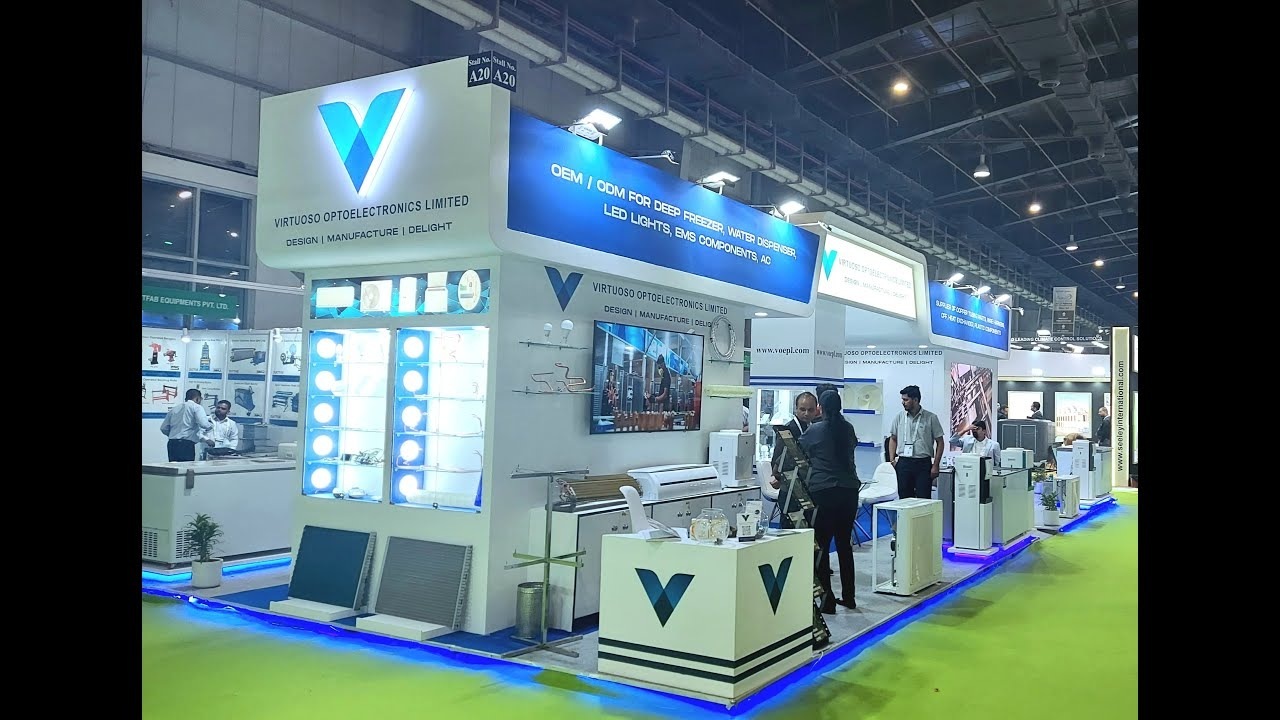
Virtuoso Optoelectronics Ltd H1 FY26: Revenue Hits ₹689 Cr, EPS at ₹2.70, ROE Crawls at 5.73% – Can the Bharti-backed OEM Break Free from Voltas Reliance?
1. At a Glance
Virtuoso Optoelectronics Ltd (VOEPL), the Bharti family’s pride in white goods and EMS, is like that overachieving cousin who still leans on the family name. At a current market cap of ₹1,300 Cr and trading at ₹420, the stock has slid nearly 20% over the past three months—so much for festive cheer. The company’s Q3FY25 numbers tell a story of high revenue growth shadowed by bleeding profits: ₹301 Cr in quarterly sales, but a net profit of just ₹2.54 Cr, down a shocking 66% QoQ. ROE limps at 5.73%, ROCE sits at a modest 12.7%, and the P/E is nosebleed territory at 162x. Meanwhile, promoter holding is down slightly to 52.13%, and the company has yet to reward shareholders with dividends. With Voltas accounting for 70–75% of revenue, VOEPL’s fate still hangs by a single client thread, though management vows to dilute this dependency to below 30% in the coming years.
If you thought this was just a white goods story, think again—VOEPL is building capacities for ACs, water dispensers, commercial refrigeration, and compressors like a kid hoarding toys before Diwali. The question is, can they convert capacity into consistent profitability?
2. Introduction
Let’s set the scene. Imagine an OEM/ODM that can make your air conditioner, your water dispenser, and even your cross-flow fan controllers—all under someone else’s brand. That’s Virtuoso Optoelectronics. Since 2015, the Bharti-promoted firm has been quietly stitching together a manufacturing empire spanning eight plants, but the charm is in the details: 60 million lamp-equivalents in lighting, 800,000 indoor AC units, and even a new compressor facility in the works.
But like all family businesses, there’s drama. The company’s quarterly profit has fallen off a cliff, P/E ratios are stratospheric, and dependency on a single client (Voltas) is akin to balancing on a tightrope while juggling hot potatoes. At the same time, VOEPL is chasing backward integration, government PLI incentives of ₹50.5 Cr, and a Rs. 800 Cr investment in Nashik for electronics and motor components.
In short, it’s a high-stakes play: growth ambitions meet operational growing pains. Will these shiny capacities translate into market glory, or are we looking at an over-leveraged, low-margin circus?
3. Business Model – WTF Do They Even Do?
VOEPL wears three hats, none of which is boring:
OEM Hat: They manufacture indoor and outdoor AC units, heat exchangers, and copper tubing designed by clients, then slap the client’s brand on it. Essentially, “We make it, you take the glory.”
ODM Hat: Here, VOEPL gets to be creative, designing electronics, home appliances, and lighting solutions, which are again sold under client brands. Think of it as ghostwriting—but for gadgets.
EMS / Components: Beyond finished goods, VOEPL churns out controller boards, sheet metal parts, wire harnesses, cross-flow fans, plastic injection molds, and even reciprocatory compressors. They’re like the Swiss Army knife of electronics manufacturing.
Revenue-wise, it’s roughly 60% EMS solutions, 40% AC manufacturing, but new categories like water dispensers and commercial refrigeration are gaining traction. And yes, they are ambitiously expanding: water dispensers from 150k to 200k units annually, commercial refrigeration from 150k to 400k units, and compressors targeting 2.8 million units by FY26.
So, to sum up: if your house needs an AC, water dispenser, or lamp, VOEPL probably touched it at some point. But here’s the kicker—most of their orders are booked by Voltas. How’s that for a concentration risk?
4. Financials Overview
We lock onto the Half Yearly Results H1 FY26 as the guiding light for calculations.
Metric
Latest H1
H1 Last Year (YoY)
Previous H1 (QoQ)
YoY %
QoQ %
Revenue (₹ Cr)
689
597
695
15.3%
-0.87%
EBITDA (₹ Cr)
61
56
60
8.9%
1.7%
PAT (₹ Cr)
8.05
14
11.9
-42.5%
-32.4%
EPS (₹)
2.70
4.78
4.06
-43.5%
-33.5%
Commentary: Revenue growth is decent at 15.3% YoY, but PAT collapse of 42.5% is the financial equivalent of a double fault in tennis. Margins are under pressure, P/E is astronomical, and profitability is clearly struggling to catch up with scale.
5. Valuation Discussion – Fair Value Range
For educational purposes:
P/E Method: Using EPS of 2.70 and a conservative sector multiple of 50x (industry P/E), fair value ≈ ₹135.
EV/EBITDA Method: Enterprise Value ₹1,506 Cr, EBITDA ₹61 Cr → EV/EBITDA = 24.7x. Sector average 15–18x → fair value range: ₹320–₹420.
DCF (Simplified): Assuming 10% growth, 8% discount → range ₹280–₹380.
Disclaimer: This fair value range is for educational purposes only