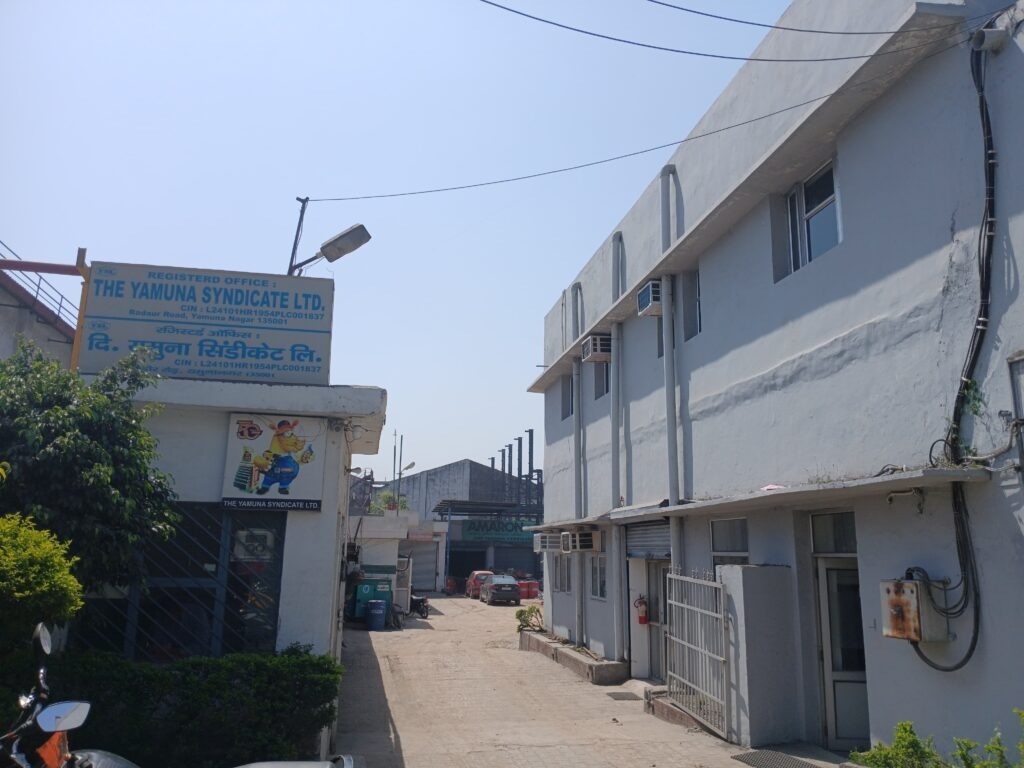
Yamuna Syndicate Ltd Q2 FY26 – ₹87 Cr PAT Clubbed With ₹5,100 Cr Stake, Nil Debt & 0 Drama.
1. At a Glance
When you’re holding a ₹5,100 crore stake in a heavy engineering behemoth while running a modest ₹64 crore trading business on the side, you’ve basically hacked capitalism. Yamuna Syndicate Ltd (YSL) is that rare Indian company that looks like a small shopkeeper on paper but secretly controls a machinery empire through its 45% stake in ISGEC Heavy Engineering Ltd. At a market cap of just ₹1,016 crore and zero debt, it’s trading at a ridiculous 0.79x book value — basically the valuation equivalent of buying a penthouse and getting the parking lot free.
The share trades at ₹33,064, down about -33% YoY (because the market still hasn’t learned math), with a P/E of 11.6 and EPS of ₹2,840. It even throws a modest 1.5% dividend yield, funded largely by the huge dividend inflow from ISGEC. The Q2FY26 quarter was quieter — PAT slipped to ₹20.4 crore (down -51.8% QoQ) as the “Other Income Gods” took a short vacation. But the balance sheet remains debt-free, and the company continues to enjoy a 9.3% ROE without breaking a sweat.
So yes, this is basically a sleepy Ambala retailer that also happens to own half a listed engineering giant. Irony doesn’t get more profitable than this.
2. Introduction
Imagine if your local HP petrol pump dealer secretly owned half of ISGEC Heavy Engineering. That’s Yamuna Syndicate for you. Incorporated in 1955, this grand old trader started by selling lubricants, agrochemicals, and car batteries — and somehow ended up with a 45% stake in an engineering company that builds sugar mills, boilers, and EPC plants across continents.
It’s the sort of portfolio you’d find in a confused NRI uncle’s demat account — “Some Havells AC dealership, some Amaron batteries, and one small ₹5,000 crore investment for the kids.”
Over seven decades, YSL has stayed old-school: it trades HPCL fuels, Amaron batteries, pesticides, and now, even Lloyd air conditioners (because who doesn’t want margin-free summer headaches?). But the real kicker? The dividends. Every year, ISGEC quietly wires crores to YSL, which then passes some of that to its shareholders — creating a passive income loop that would make even fintech influencers blush.
This is not a “growth stock.” This is “the rich uncle stock” — steady, quiet, dividend-paying, and completely allergic to debt.
3. Business Model – WTF Do They Even Do?
Let’s decode the chaos:
YSL has two parallel businesses. (1) Trading – a glorified dealership empire selling HP fuels, lubricants, Amaron batteries, agricultural inputs, and electricals across Haryana. It’s the Ambala version of a Reliance Smart store — minus the Jio ads.
(2) Investments – it holds a 45% stake in ISGEC Heavy Engineering Ltd (IHEL), one of India’s major EPC and machinery manufacturing players. ISGEC contributes to YSL’s profits through dividends and valuation gains. The market value of that single holding is ~₹5,100 crore, i.e., 5 times YSL’s entire market cap.
In FY24, YSL also sold a Kurukshetra property for ₹15.11 crore. And unlike your cousin’s “real estate investment,” it actually got paid.
In short: they sell everything your car or tractor might need, plus they own a multi-billion engineering giant. A small-town shopkeeper with a billionaire heart.
4. Financials Overview
Let’s talk numbers — the only language that matters. Figures in ₹ Crores (Consolidated)
Metric
Latest Qtr (Sep’25)
Same Qtr Last Yr (Sep’24)
Previous Qtr (Jun’25)
YoY %
QoQ %
Revenue
15.0
15.0
19.0
0%
-21.0%
EBITDA
0.2
0.3
0.3
-33%
-33%
PAT
20.4
42.0
24.0
-51.4%
-15%
EPS (₹)
664
1,377
791
-51.7%
-16%
Commentary: When “Other Income” sneezes, YSL’s PAT catches pneumonia. The operating business barely breaks even at a 1–2% margin, while dividends from ISGEC and property gains make up the fireworks. Q2FY26’s PAT drop was simply a function of lower dividend inflows. Yet the full-year EPS still sits in the ₹2,800–₹3,000 range — enough to justify the P/E of ~11x.
This is not an operating earnings story — it’s a portfolio yield story wearing a trading company’s mask.
5. Valuation Discussion – Fair Value Range (Educational Only)
Let’s play number detective.
Method 1: P/E Approach EPS (TTM) = ₹2,840 Industry Avg P/E = ~31.9 YSL P/E = 11.6 If we assign even a conservative 15–18x P/E (for its debt-free, dividend-yielding nature): Fair Value = ₹42,600 – ₹51,000