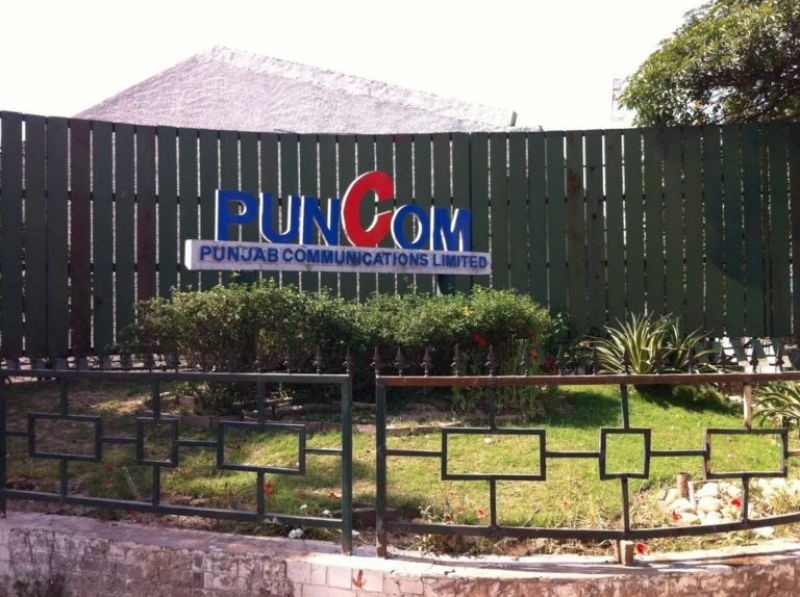
Punjab Communications Ltd Q2 FY26 – From Near Extinction to Profit Resurrection, Puncom’s Comeback Story Has More Plot Twists Than a Daily Soap!
1. At a Glance
Punjab Communications Ltd (Puncom), once a sleepy PSU from the Doordarshan era, just decided to wake up and shout, “Surprise!” to Dalal Street. With a market cap of ₹79 crore, the company’s stock has shot up 32% in 3 months, currently trading at ₹65.7 per share. The once-red balance sheet now glows faintly green — Q2 FY26 (Sep 2025) showed sales of ₹8.17 crore and a PAT of ₹3.23 crore, a 423% jump QoQ, thanks to a rare alignment of stars, auditors, and perhaps government orders actually being delivered.
The P/E sits at 16.2, which is way below the telecom equipment industry median of 48x — signaling that either Puncom is seriously undervalued or investors are still traumatised by its last decade of losses. The EPS stands at ₹4.61, while ROCE (-2.82%) and ROE (-3.62%) still wave red flags like an Indian referee in the World Cup. Debt? None. Contingent liabilities? A thumping ₹53.7 crore — the ghost of PSU pasts.
In short: a once-forgotten telecom relic from Punjab is now trying to dial a comeback number. Whether it connects or not — that’s what we’re about to decode.
2. Introduction
Imagine being a 1980s tech company created by the Punjab government to “revolutionize communications.” Fast forward 40 years, and your main competition is not Cisco or Huawei — it’s irrelevance.
That’s the bittersweet story of Punjab Communications Ltd, affectionately called Puncom. Born in 1981, listed in 1994, and buried under bureaucratic weight for decades, Puncom somehow survived privatization waves, disinvestment talks, and missed tender opportunities.
And yet, 2025 has seen this telecom fossil suddenly trending again. The company’s quarterly profit of ₹3.23 crore is its biggest flex in years. After decades of negative operating margins, a positive OPM of 4.77% feels like a Punjabi wedding where the groom actually showed up.
But what caused this sudden turn? A mix of one-time income, cost discipline, and a few large power and railway orders that finally materialized. The boardroom’s musical chairs (three CFOs in two years, IAS officers playing pass-the-chairman) seem to have finally found a rhythm.
Still, the question remains — is this a short circuit or a signal of real revival?
3. Business Model – WTF Do They Even Do?
Puncom’s business model is like an old landline: functional, complex, but somehow still ringing.
The company manufactures telecommunication and IT equipment — things like VMUX, SDH, Power Line Carrier Communication (PLCC) systems, SMPS power plants, and control communication gear for power and railway networks. Think of it as the nerdy cousin who connects substations and train control offices while private telcos chase 5G dreams.
Puncom’s key verticals are:
Transmission Products: V-MUX, PDH, PLCC, SDH – the backbone of voice and data transmission for railways and power utilities.
SMPS Power Systems: Switch-mode power plants and integrated telecom power systems — basically the UPS of telecom gear.
Turnkey Projects: They install, commission, and maintain full-scale telecom projects for Railways, PGCIL, BSNL, and State Electricity Boards.
Contract Manufacturing: They rent out their factory and SMT lines for other companies’ IT and telecom production.
In other words, Puncom is the engineering uncle who doesn’t tweet about AI but quietly ensures the lights and calls stay on in your city.
And yes — it’s still owned by the Punjab Government, which means every major decision takes longer than a highway toll queue during Diwali.
4. Financials Overview
Let’s decode the recent quarterly performance, where Puncom suddenly went from a PSU meme to a profit meme.
Metric
Latest Qtr (Sep 2025)
YoY Qtr (Sep 2024)
Prev Qtr (Jun 2025)
YoY %
QoQ %
Revenue (₹ Cr)
8.17
5.54
6.67
47.5%
22.5%
EBITDA (₹ Cr)
0.39
-2.95
-2.29
—
—
PAT (₹ Cr)
3.23
-1.00
0.35
423%
823%
EPS (₹)
2.69
-0.83
0.29
—
—
Commentary: Finally, a PSU that discovered profitability without a “one-time gain from land sale.” The operating margin turned positive for the first time in