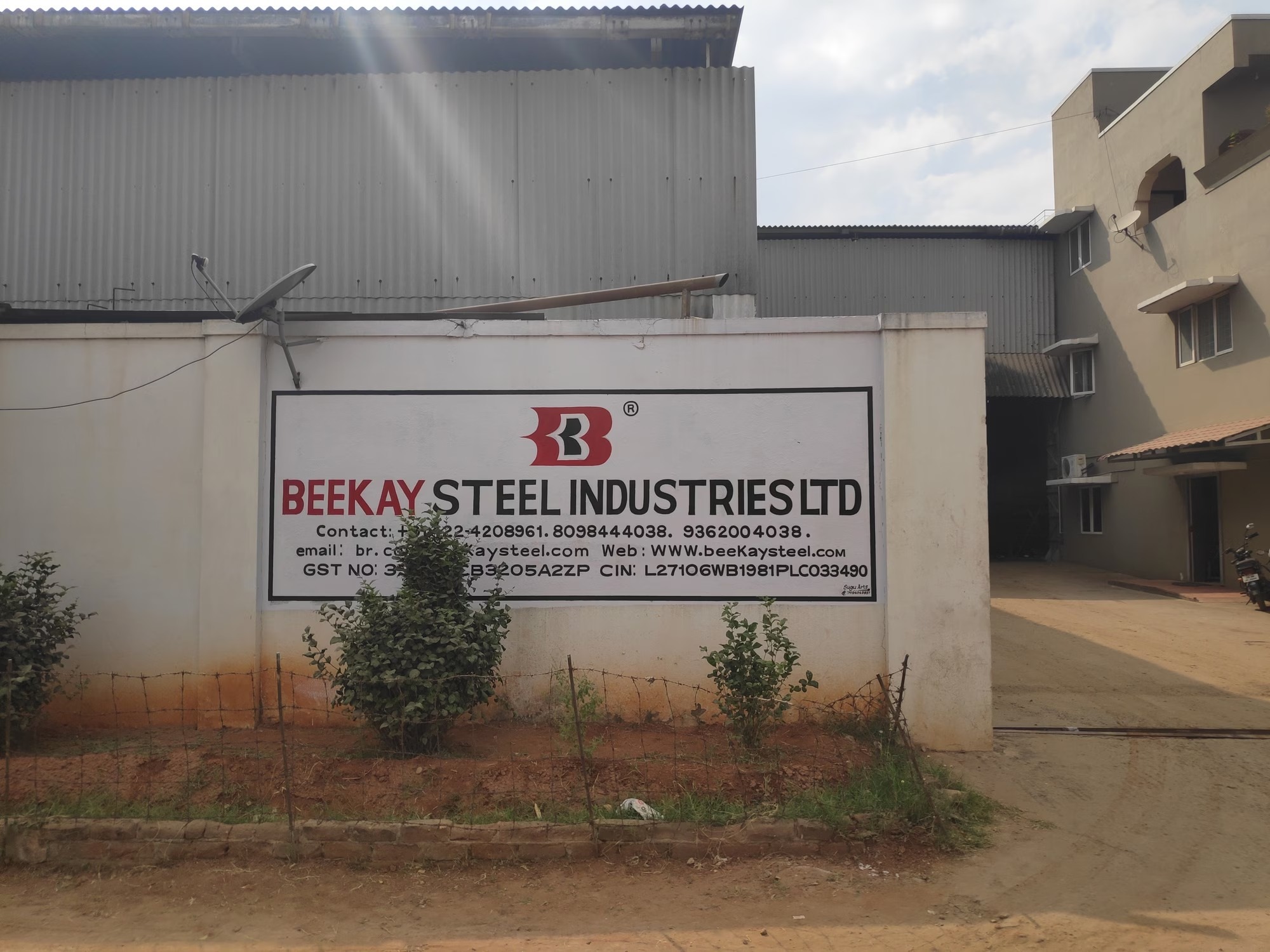
Beekay Steel Industries Ltd H1 FY26 – The Steel Barons of the South Swing the Hammer, but the Profit Curve Has Gone Limp
1. At a Glance
Beekay Steel Industries Ltd (BSE: 539018) — the 1981-born steel-maker from Kolkata that once strutted like a lion in the TMT jungle — is having a mild identity crisis in H1 FY26. At ₹431 per share, with a market cap of ₹822 crore and a P/E ratio of 12.0, the company looks cheaper than a steel rod in a clearance sale, yet investors aren’t biting. The stock is down 31% over the past year, and nearly 16% in the last six months — the kind of decline that makes even patient shareholders start googling “Why my steel stock doesn’t rise.”
With Q2 FY26 PAT at ₹11.6 crore, down 64.5% YoY, Beekay’s earnings curve has more dips than a packet of Lays. Revenue held steady at ₹266 crore (up 16% YoY), proving the top line is fighting while the bottom line is catching its breath. A low ROE of 6.33% and ROCE of 7.52% confirm what we all suspect — steel margins are currently allergic to inflation and power bills.
Still, with a Book Value of ₹552, the stock trades at just 0.79x P/B, so the market seems to think Beekay is a sale item in a steel bazaar — sturdy stuff but not glamorous enough to flaunt.
2. Introduction
If Indian steel had a family WhatsApp group, Beekay Steel would be that middle sibling quietly doing solid work but never getting the spotlight. While JSW and Tata Steel flex in front of investors with billion-dollar expansions, Beekay sticks to its roots — TMT bars, bright bars, structurals, and machined sections.
And yet, behind this “quiet achiever” image hides a company that’s been on an aggressive expansion spree, particularly in Odisha, where it’s reviving an old Cuttack plant and planning a ₹725 crore Phase 2 capex. That’s not the move of a timid player — that’s more like a silent chess player suddenly deciding to go for checkmate.
But let’s not sugarcoat it — FY25 wasn’t Beekay’s best year. The profit after tax slid to ₹68.8 crore from ₹130 crore last year, and even though sales nudged up to ₹1,150 crore, the operational muscle weakened. Steel prices, energy costs, and the classic working capital crunch seem to have tag-teamed Beekay into the ropes.
Yet, with 71.8% promoter holding, a sprawling seven-plant footprint, and a strong client list featuring Tata Steel, L&T, Vedanta, and Hindalco, Beekay is far from a has-been. It’s more like that tough old welder who’s seen it all — sparks, heat, and still shows up for the next shift.
3. Business Model – WTF Do They Even Do?
Beekay Steel’s business is simple — take iron, beat it senseless, and sell it as strength. The company manufactures and sells various forms of steel — TMT bars, bright bars, structurals, and machined products.
It runs on two fuel lines:
Proprietary business (77%) — retail sales of TMT bars and automotive/engineering steel.
Non-proprietary business (23%) — job work and institutional orders.
This mix gives Beekay the advantage of both B2C and B2B exposure — it sells directly to dealers and retail customers, while also doing serious engineering-grade manufacturing for industrial clients.
The structural steel segment — beams, channels, angles — forms 23% of revenue, catering to construction and infrastructure sectors. The rest is largely TMT bars, which have found demand in southern India, accounting for over 60% of Beekay’s total sales.
Geographically, Beekay is an Andhra–Tamil Nadu–Odisha powerhouse. It has seven manufacturing facilities spread across Jharkhand, West Bengal, Tamil Nadu, and Odisha. Total capacity includes 5.46 lakh MTPA TMT bars, 96,092 MTPA rolled bars, and 4,654 MTPA bright bars. Basically, if it bends, cuts, or strengthens, Beekay probably makes it.
The company also makes crane rails, and exports to UAE, Saudi Arabia, Australia, Netherlands, and Bahrain, although foreign trade is only 2% of revenue. Think of exports as more like bragging rights than revenue goldmines.
4. Financials Overview
Quarterly Results Lock: Half Yearly (H1 FY26)
Metric
Latest Qtr (Sep’25)
YoY Qtr (Sep’24)
Prev Qtr (Jun’25)
YoY %
QoQ %
Revenue
₹266 Cr
₹229 Cr
₹283 Cr
16.1%
-6.0%
EBITDA
₹21 Cr
₹27 Cr
₹18 Cr
-22.2%
16.7%
PAT
₹11.6 Cr
₹33 Cr
₹31 Cr
-64.5%
-62.6%
EPS (₹)
₹6.10
₹17.18
₹16.34
-64.5%
-62.6%
Commentary: If this table were a meme, it would be the “expectation vs reality” template. Revenue grew respectably, but profits melted faster than steel in a blast furnace. Margins compressed as energy costs and lower realizations pinched. Even though Other Income provided occasional oxygen in previous quarters, it wasn’t enough to save H1 FY26. The operating profit margin slipped to 8%, reminding us that steelmaking is glamorous only in textbooks.
5. Valuation Discussion – Fair Value Range Only
Let’s approach this with cold, hard math — and a bit of sarcasm.
P/E Approach: Current EPS = ₹36 (TTM) Industry average P/E = ~21.4 Beekay’s P/E = 12.0
If we apply industry P/E, fair price = ₹36 × 21.4 = ₹770. If we assume a discount for smallcap illiquidity and low ROE (say 30%), fair value ≈ ₹540–₹600 range.
EV/EBITDA Method: EV = ₹1,115 Cr EBITDA (TTM) = ₹141 Cr (approx from 8.89% OPM on ₹1,150 Cr