B&B Triplewall Containers Ltd H1 FY2026 – From Cardboard Boxes to Boxing the Competition
(Revenue ₹294.4 Cr, PAT ₹7.86 Cr, OPM 11%, ROE -4.8%)
1. At a Glance
B&B Triplewall Containers Ltd — the company that quite literally boxes India’s FMCG dreams — just dropped its H1 FY2026 results, and it’s folding up no small surprises. With revenue of ₹294.4 crore and a PAT of ₹7.86 crore, the company’s corrugated crusade continues, packaging everything from your Amazon orders to your masala bottles. The stock sits at ₹204, giving it a market cap of ₹426 crore, and a P/E that’s doing a disappearing act (since FY25 PAT was negative).
Promoters, however, seem bullish, upping their stake to 73.8% — clearly confident that their boxes still have a few surprises inside. Debt stands heavy at ₹221 crore (a 1.87x debt-to-equity ratio), while ROCE is a paper-thin 2.98%. Yet, the market’s still giving this one a premium 3.55x book value, probably betting on capacity expansion, the Kraft paper unit, and new client orders.
So yes, it’s a story of growth wrapped in corrugation — sturdy, scalable, and a little rough around the financial edges.
2. Introduction
If packaging were Bollywood, B&B Triplewall Containers would be that dependable character actor — not flashy, not headline material, but always in the frame, holding the story together. Founded in 2011, this Bengaluru-based corrugated crusader has become a silent enabler of India’s retail revolution. From Amazon boxes that carry our impulsive buys to the cartons that protect Asian Paints’ fancy shades — these guys package dreams, dents, and delivery delays alike.
Their current setup spans Bangalore, Tamil Nadu, and Hyderabad, with a combined production capacity of 9,300 tons per month for boxes and 7,500 tons for paper. That’s a lot of pulp power! Yet, despite all this cardboard muscle, profitability has been… well, let’s say “delicately packed.” FY25 saw a net loss of ₹3 crore, but the latest half-year numbers show a comeback in progress with PAT swinging back into the black at ₹7.86 crore.
And while the company loves automation (BHS corrugator, BOBST FFG — the Ferraris of box-making), the challenge now is less about machines and more about margins. Can it keep profit margins strong in a paper-thin business, or will inflation and energy costs crumple the packaging party?
3. Business Model – WTF Do They Even Do?
At its core, B&B Triplewall makes corrugated boards, boxes, and sheets — the unsung heroes of logistics and retail. You can’t ship your soap, sneakers, or samosas without them. The company’s products come in varieties like 3-ply, 5-ply, and 7-ply boards, designed to suit everything from fragile electronics to bulky FMCG consignments.
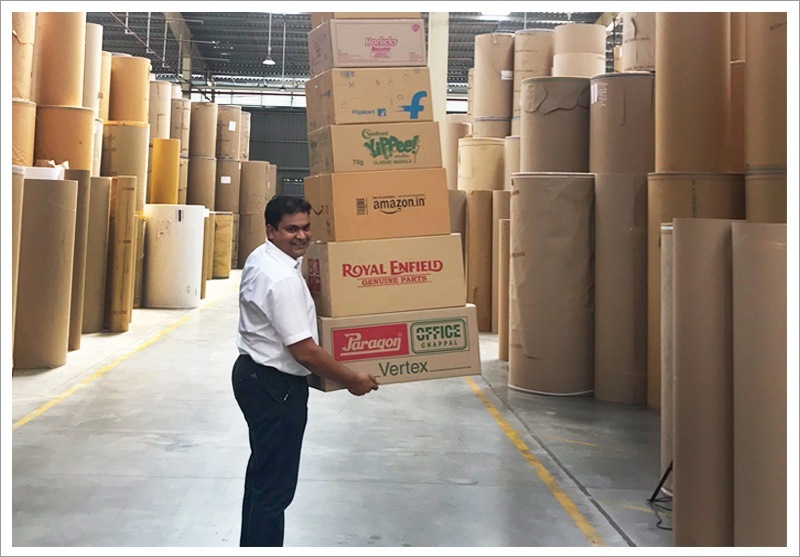
Its B2B model serves marquee clients like Reliance, Adani Wilmar, Flipkart, ITC, Asian Paints, Amazon, and Britannia — basically, every brand that needs sturdy packaging for mass movement. B&B doesn’t play small — its largest unit in Karnataka is one of India’s most automated corrugated plants.
Revenue streams flow mainly from two verticals:
Corrugated Packaging (Boxes, Boards, Fitments)
Paper Manufacturing (Kraft Paper Unit under expansion)
This dual model ensures a backward integration advantage — less reliance on external paper suppliers and better control on raw material costs. Smart, right? Except debt has crept up faster than profits, making the balance sheet look like a box under too much load.
So yes, the business model is strong — but like any cardboard product, the real test is when it gets wet (read: market downcycle).