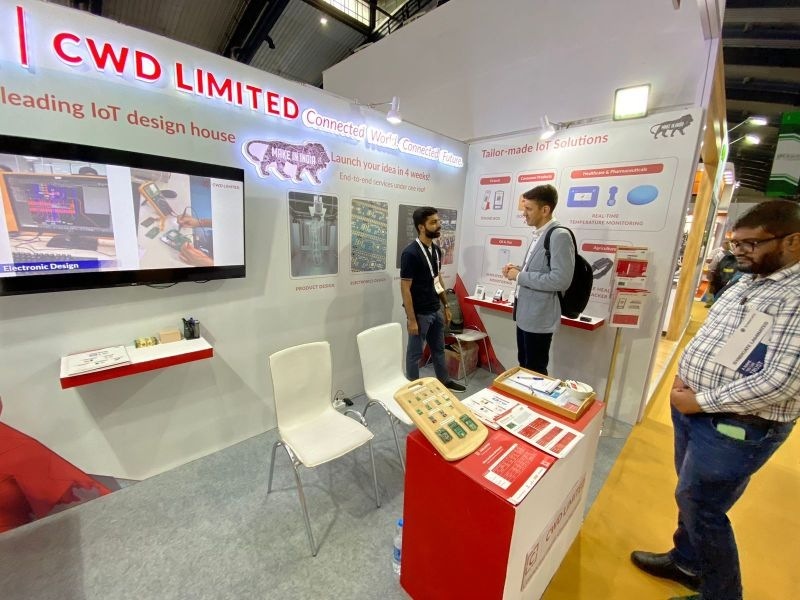
CWD Ltd Q2FY26: 490% Sales Surge, 329% Profit Boom, and 4:1 Bonus Bonanza – Is This IoT Startup India’s Next Tech Fairy Tale or Just a Fancy Bluetooth Speaker?
1. At a Glance
CWD Ltd, the not-so-silent wireless innovator from Mumbai, has made more noise than a Bluetooth speaker on max volume this quarter. With sales jumping 490% YoY to ₹41.15 crore and PAT up 329% to ₹4.19 crore, the company has suddenly become the darling of the smallcap tech universe. Its stock price has shot up 196% in a year, and the current market cap stands at ₹802 crore — not bad for a company born in 2016 that calls itself “Connected Wireless Devices.”
At ₹1,824 per share, CWD trades at a P/E of 94x, Price to Book of 10.6x, and ROE of just 5.78%. But who cares about sober valuation when there’s a 4:1 bonus issue, ₹6,076.9 lakh preferential allotment, and BSE main board migration all lined up like a Diwali dhamaka sale? The story here isn’t just growth — it’s about how a company went from hobby electronics to handling ₹129 crore+ worth of orders for UPI sound boxes, NIC cards, and smart meters.
So the million-rupee question: is CWD India’s answer to Dixon Tech or just a tech start-up high on Bluetooth fumes?
2. Introduction
In the world of Indian tech manufacturing, where every other company dreams of becoming the next Apple supplier, CWD Ltd is that overconfident engineering student who actually submitted the working project instead of just the report.
Founded in 2016, this baby-faced firm decided to take on giants by building wireless IoT products — a risky move in a market that barely understood IoT back then. Fast forward to FY25–26, and the company is now shipping smart medical electronics, smart lighting chips, vaccine tracking modules, and farm cattle trackers (yes, even the cows are connected now).
The company’s exports form 38% of its revenue, proving that it’s not just about Make in India — it’s more like Make in India, Sell Everywhere. With a Hong Kong subsidiary (CWD Innovations HK Ltd), the company has gone global faster than your neighborhood influencer trying to pronounce “IoT ecosystem.”
But here’s the real kicker — this small tech player’s quarterly profit jump of 329% isn’t from a one-off fluke. It’s riding a wave of massive orders worth ₹137 crore combined for UPI sound boxes, smart weather sensors, and smart meter systems.
Still, with high inventory days (566) and debtors at 190 days, the “wireless” dream sometimes feels more like a “waiting for payments” reality.
3. Business Model – WTF Do They Even Do?
So what exactly does CWD Ltd do apart from sounding fancy? In simple terms — they make the invisible visible and the dumb smart.
CWD’s business model revolves around Information and Communication Technology (ICT) products, where they blend hardware and software like chai and sugar — you don’t see the difference, but you feel the buzz.
Their operations can be divided into two main segments:
Consumer Electronics: Think Bluetooth-enabled smart devices, smart lighting electronics, and connected home products.
Design & Development Solutions: Custom-built IoT tech for enterprises — from vaccine tracking devices to cattle monitoring solutions.
Some of their flagship products include:
Smart Power Meter Modules (turning boring electricity meters into chatty smart meters)
Smart Lighting Systems (lights that save energy and judge your mood)
Farm Cattle Trackers (so even cows can have Fitbit moments)
The company isn’t just assembling gadgets. It’s a fully integrated OEM with global sourcing, manufacturing, quality testing, packaging, and logistics — all under one roof.
CWD’s recognition under DIPP’s StartUp India program adds a nice startup sparkle. But don’t forget — in this sector, innovation burns cash faster than a 5G speed test.
Commentary: That 490% sales growth is louder than any IoT buzzer. But the QoQ dip in EPS hints that growth might be running faster than efficiency. Margins have improved, but let’s be real — when you start from ₹7 crore sales last year, any increase looks like an IPL run chase.
5. Valuation Discussion – Fair Value Range (Educational Only)