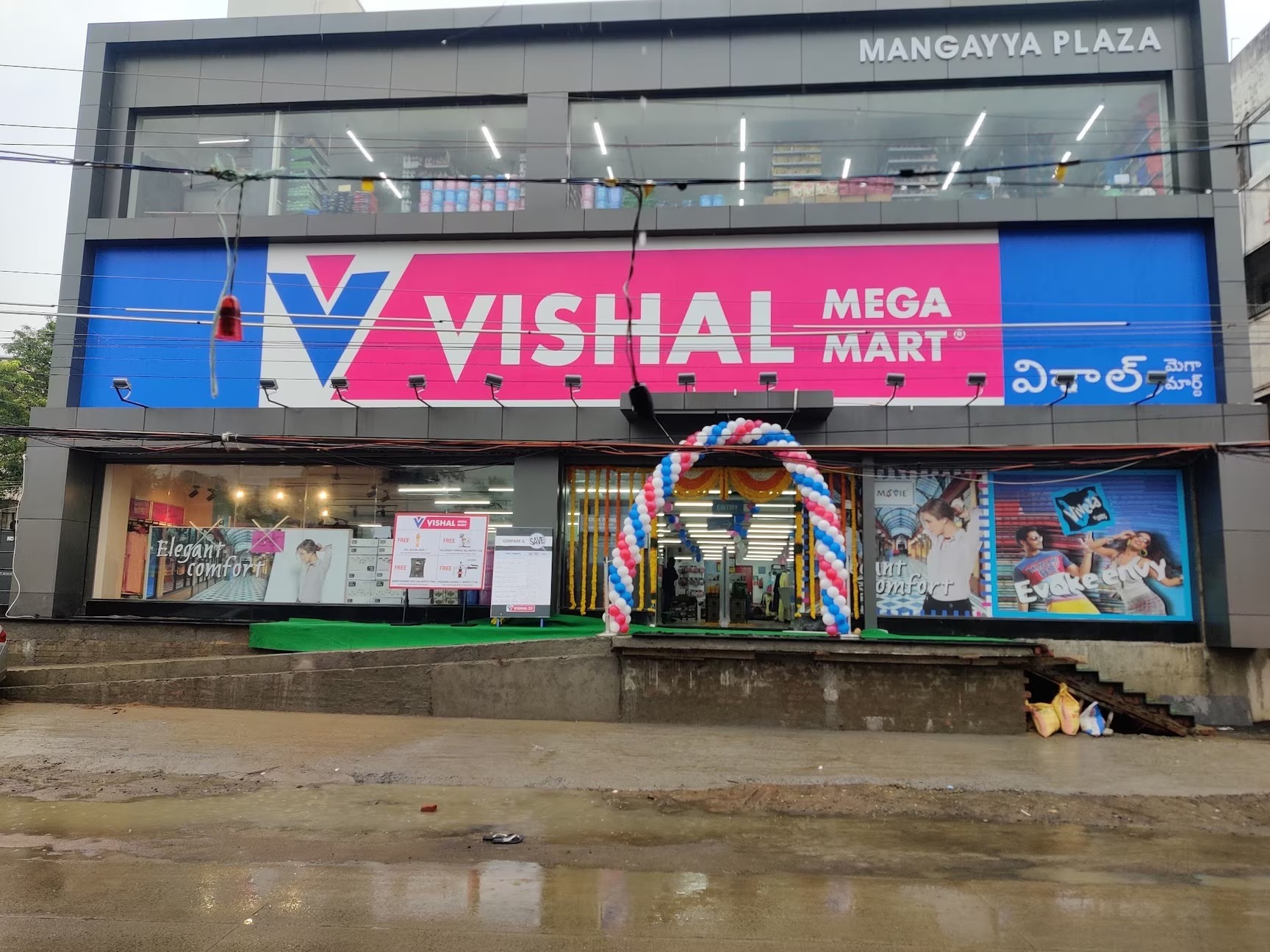
1. At a Glance
If Walmart and a Sarojini Nagar shop had a child raised by Ambani’s marketing team, it would be Vishal Mega Mart Ltd. Incorporated in 2001, this hypermarket behemoth now runs 645 stores across 414 cities, turning the great Indian middle-class bargain hunt into a ₹63,000 crore stock market carnival.
With a Q2FY26 profit of ₹152 crore and revenue of ₹2,981 crore, the company posted YoY growth of 46.5% in PAT and 22.4% in sales—not bad for a brand that still calls ₹499 “premium pricing.”
The stock trades at ₹135 with a P/E of 86x—a valuation so rich it makes even luxury brands blush. ROE stands at 10.1%, ROCE at 13.1%, and the debt-to-equity ratio at a “manageable” 0.27.
Yet, like the Bhagavad Gita reminds us: “Karmanye vadhikaraste, ma phaleshou kadachana.” — Do your duty, not for the rewards. Vishal Mega Mart is clearly doing just that—duty towards expansion, even if the reward (dividends) never arrives.
2. Introduction
Remember when “Mega Mart” meant one warehouse with flickering tube lights and a “Buy 2 Get 3” offer? Fast-forward to FY26, and Vishal Mega Mart (VMM) is a ₹11,800 crore sales powerhouse that’s trying to dress India’s lower-middle-class aspirations in polyester and pride.
Once mocked as the “budget cousin” of D-Mart, VMM today stands second only to Avenue Supermarts in the Indian retail league tables. Its secret sauce? Cheap, accessible, and fast-moving products—from noodles to nighties—sold with ruthless supply-chain efficiency.
The hub-and-spoke model has replaced chaos with control. Warehouses hum with the precision of a military operation. The 839 vendors who supply its shelves now operate like soldiers on an assembly line of affordability.
And yet, while the company sells detergent to the masses, its P/E multiple of 86x seems designed for the classes. Investors are essentially paying premium pricing for a discount retailer. Irony much?
But that’s the charm of Indian retail. A business that caters to the ₹300 shopper can still mint market caps that make sense only in rupees followed by nine zeros.
3. Business Model – WTF Do They Even Do?
In simple terms, Vishal Mega Mart is India’s homegrown discount retail empire for the middle and lower-middle-income segment. Think of it as the place where the Great Indian Savings Instinct meets modern retail therapy.
The business revolves around three broad categories:
- Apparel (43.78% of FY24 revenue) – From synthetic sarees to school uniforms, everything that covers a human body (at affordable rates).
- FMCG (27.46%) – Fast-moving staples like biscuits, spices, oils, and all the soap you need after watching their prices rise.
- General Merchandise (28.54%) – Toys, homeware, travel bags, and that one non-stick pan you never knew you needed.
Stores are spread across Tier-1 and Tier-2 cities—194 in metros and 451 in smaller towns—each averaging 18,000 sq. ft. of retail therapy space.
Their hub-and-spoke distribution model is the logistical heart of the empire. One central warehouse and 17 regional centers keep 645 stores stocked just-in-time, ensuring that from Delhi to Dibrugarh, everyone can find a ₹99 bedsheet.
Most of the merchandise is produced via third-party manufacturing, guided by VMM’s own design and quality team. Out of 839 contract manufacturers, 19 brands have crossed ₹100 crore in sales, and six brands now exceed ₹500 crore individually.
In essence, Vishal sells “value fashion and essentials,” but their investors seem to be buying the dream of