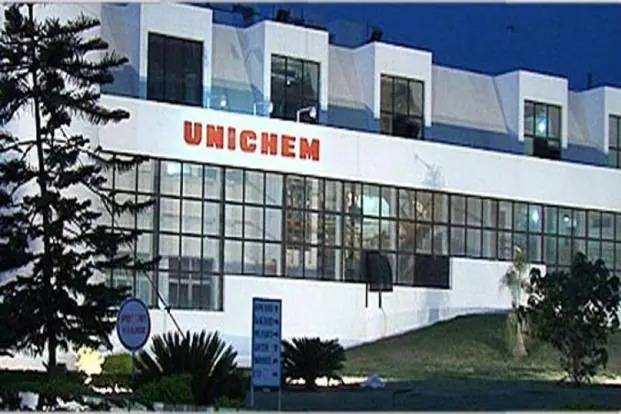
1. At a Glance
When your latest headline reads “Paid €16.75 million fine to European Commission” and your quarterly profits are up 84% YoY, you know life at Unichem Laboratories Ltd (NSE: UNICHEMLAB) isn’t dull. The ₹3,296 crore market-cap pharma player, trading at ₹470 per share, is that classic smallcap story — bouncing between USFDA inspections, EU fines, and a few rays of financial sunshine.
The September 2025 quarter tells a story of contradictions: sales up 14.1% YoY to ₹579 crore, and PAT at ₹45.3 crore, compared to just ₹24.6 crore a year ago. EPS stood at ₹12.6 on a TTM basis, giving the company a P/E of 22.6, comfortably below the industry average of 31.6 — like a student who didn’t top the class but still got a “good effort” sticker.
But investors haven’t been feeling generous — the stock is down 46% YoY, trading perilously close to its 52-week low of ₹438. With a debt-to-equity of 0.21, ROE at 5.6%, and ROCE at 6.2%, Unichem’s balance sheet looks as balanced as a newly licensed juggler.
So yes — the company’s quarter was better, the year was worse, and the shareholders? Possibly somewhere between confused and caffeinated.
2. Introduction
Unichem Laboratories is like that long-running TV serial — full of twists, medical jargon, and occasional courtroom drama. Founded decades ago as a humble formulation maker, the company has since grown into a global generics and API manufacturer, exporting to over 50 countries. But the last few years have felt less like Grey’s Anatomy and more like Suits.
In 2025 alone, the company made headlines not for blockbuster drugs but for European antitrust fines, NPPA notices for overpricing, and a US product recall that must have sent a few compliance officers hunting for antacids.
Yet, in the middle of this chaos, the Q2FY26 numbers whispered something unusual — profit. The same company that posted a loss of ₹10 crore in June 2025 swung back to a profit of ₹45 crore in September 2025, powered by double-digit revenue growth and surprisingly disciplined costs.
For a company with a history of negative ROEs (yes, minus), this comeback, however temporary, feels like finding an old ₹500 note in your winter jacket. Sure, it doesn’t change your net worth, but it makes you smile for a moment.
So the question isn’t “Is Unichem back?” It’s “For how long before another regulator slides into their inbox?”
3. Business Model – WTF Do They Even Do?
Unichem’s business model is the pharmaceutical equivalent of a thali: a bit of everything — APIs, generics, and contract manufacturing (CMO). They manufacture and market APIs and formulations that cover cardiology, gastro, diabetology, psychiatry, neurology, and anti-infectives. In simpler terms: if it’s a tablet and you’ve popped it, Unichem might have made it — unless it was from Sun Pharma, Cipla, Dr. Reddy’s, or Zydus… which means probably not.
Their API segment feeds not just internal use but also third-party clients, creating a steady (if unspectacular) revenue stream. The formulations business — both branded and unbranded generics — drives the bulk of sales, especially in domestic and semi-regulated markets.
And then there’s the Contract Manufacturing (CMO) arm — the unsung hero that quietly fills capsules for other pharma biggies while Unichem battles in courtrooms.
But here’s where things get interesting — in FY24, IPCA Laboratories acquired 52.67% stake, turning Unichem into its pharmaceutical stepchild. The Mody family, led by Dr. Prakash Amrut