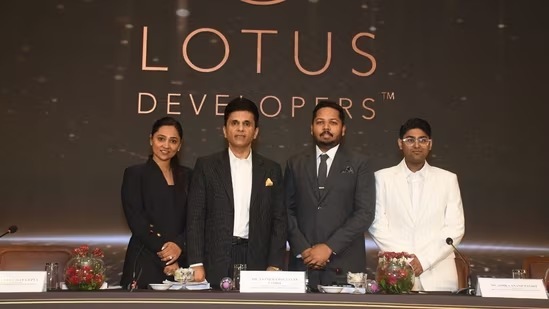
Sri Lotus Developers & Realty Ltd Q2 FY26 – The ₹792-Crore IPO Baby Turning Mumbai Redevelopment Into a Goldmine (With 37% ROCE and 41% ROE, They’re Basically the Ambanis of Andheri)
Date of Publishing -
Spotted a factual error — a wrong number, date, or fact? Tell us and we will check the source.
1. At a Glance
Welcome to Sri Lotus Developers & Realty Ltd, where Mumbai’s skyline meets Gujarati optimism and Bollywood budgets. Fresh off its ₹792 crore IPO, the company has strutted into the listed realty arena like a celebrity at a Juhu brunch — diamond-studded, heavily networked, and slightly overvalued at a P/E of 37.4.
As of 13 November 2025, the stock lounges at ₹171, about 9% down over 3 months, yet flaunting a market cap of ₹8,336 crore. Its ROE of 41.3% and ROCE of 37.1% scream “money factory,” even if the working capital days have ballooned to 392 (aka: money stuck in marble, tiles, and paperwork).
With Q2 FY26 revenue at ₹176 crore (up 43.5% YoY) and PAT of ₹46 crore (down 8.4% QoQ), the company is managing the balancing act between rapid topline growth and margin sanity. Their operating profit margin stands at a jaw-dropping 52.8%, proof that in Mumbai, even cement dust can be profitable if branded well enough.
2. Introduction
Every bull market needs its poster child of aspiration, and Sri Lotus Developers fits the part — swanky Andheri offices, redevelopment projects in Bandra, and brochures shinier than most people’s CVs.
Founded in 2015, the company was quietly flipping residential and commercial dreams before bursting into fame with its August 2025 IPO, raising ₹792 crore faster than a Bandra bungalow booking. Since then, it’s been all over investor chatter — “asset-light,” “high-margin,” “pure-play Mumbai developer.”
Its brand ‘Lotus Developers’ reportedly commands a 22% pricing premium in the Juhu micro-market, which is basically Mumbai’s Beverly Hills. Why? Because when your brand’s synonymous with redevelopment in one of India’s most land-starved metros, you don’t sell homes — you sell lifestyle bragging rights.
And unlike land-hoarding developers of yesteryear, Sri Lotus doesn’t buy land — it partners, redevelops, and flips faster than a political alliance in Maharashtra.
So yes, the company’s asset-light strategy is smart — think of it as running an OnlyFans for real estate: you don’t own the platform, but you still make all the money.
3. Business Model – WTF Do They Even Do?
Let’s decode this “asset-light” mystery.
Sri Lotus operates mainly through development and joint development agreements (JDAs) — meaning it doesn’t own land; it convinces owners to let them rebuild their properties into luxury marvels. The benefit? Low capital risk, high brand leverage, and faster turnover. The drawback? You need the kind of negotiating skills only found in Bandra Realtors and wedding planners.
Their projects span:
Ultra-Luxury Residential (₹7 crore and above): Think penthouses with sea views and kitchens bigger than your apartment.
Luxury Residential (₹3–₹7 crore): For those who want to tell people they live “near Juhu beach.”
Commercial Offices: Because even accountants want ocean-facing cabins now.
FY25 revenue mix screams where the money really is:
Commercial: 80.7%
Ultra-luxury residential: 7.3%
Luxury residential: 6.4%
Others: 5.6%
Basically, this company is less about “Ghar ka sapna” and more about “Corporate lobby ka aroma diffuser.”