1. At a Glance
Precision Camshafts Ltd (PCL) just dropped its Q2 FY26 results, and let’s say it’s less “precision engineering” and more “precision damage control.” The Solapur-based camshaft giant—once the darling of the auto ancillaries pack—saw its consolidated revenue slide to ₹198 crore, down 12% QoQ and 24% YoY. PAT for the quarter stood at ₹6.36 crore, marking a sharp 24.3% sequential dip and a crash landing from the golden days when engines still loved cams.
Market cap? ₹1,672 crore. Stock price? ₹176 (down 42% YoY). Book value: ₹85.8. ROE? 3.9%, which means shareholders might get better torque returns from their scooters. But wait—there’s drama! The German subsidiary MFT has entered insolvency, dragging along an impairment of ₹49.75 crore. Management tried to sugarcoat it with a ₹9.35 crore “deconsolidation gain.” Nice accounting gymnastics, but investors are still nursing whiplash.
Debt is low at ₹65 crore (D/E = 0.08), and interest coverage at 6.97x means no panic there. OPM has compressed to 7.9%, and EV/EBITDA stands at a somewhat spicy 15.1x. Promoters hold a confident 65.4%, and the dividend yield of 0.57% is like a tip left by a polite customer. In short: a strong machine, but the engine is misfiring.
2. Introduction
Remember when camshafts were the backbone of internal combustion engines, the heart of every car’s rhythmic hum? Well, Precision Camshafts has spent three decades crafting those beautiful metal hearts—only to now watch EVs laugh in silent irony. Founded in 1992, PCL once supplied camshafts to giants like Maruti Suzuki, Toyota, BMW, and Tata. Today, it’s in the middle of what we can only describe as a “camshaft existential crisis.”
The company’s flagship Camshaft & Assemblies division (87% of revenue) still keeps the wheels turning—literally—but the European market slowdown has squeezed its EMOSS subsidiary, which used to convert diesel trucks into electric beasts. Unfortunately, that electric dream just ran out of charge, with MFT Germany now officially insolvent.
The irony? PCL was one of the few traditional auto ancillaries to see EV disruption as an opportunity rather than a threat. They jumped in early with EMOSS Netherlands, hoping to surf the e-mobility wave. But instead of riding a Tesla, they’re paddling a Maruti 800.
Meanwhile, back home, the company’s core camshaft business is running at 91% casting utilization and 72% machining utilization—a mechanical miracle in this macro mess. But with ROCE at 6.19%, PCL’s returns are flatter than a dead battery. Still, let’s be honest: in the land of loss-making EV startups, being debt-free and profitable is no small feat.
3. Business Model – WTF Do They Even Do?
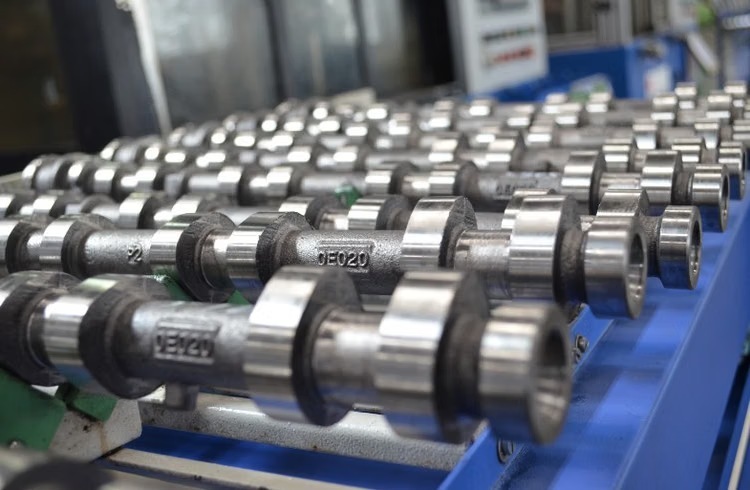
Precision Camshafts makes camshafts, the unsung heroes inside engines that control the timing of valves—basically the thing that decides when your car breathes. Their core business—Camshafts & Assemblies—contributes 87% of revenue and dominates India with a 70% market share, holding a 9% share globally. That’s serious machine shop muscle.
They supply 150+ varieties across passenger vehicles, tractors, light commercial vehicles, and locomotives. Subsidiary MFT (now the Germany problem child) produced Balancer Shafts and Prismatic Components, while MEMCO Engineering in Nashik made fuel injection components. The trio used to look like a neat ecosystem of automotive precision. Now, it’s more like a dysfunctional family dinner.
PCL also owns EMOSS, a Dutch electric drivetrain manufacturer. It used to sound futuristic—powertrains with payloads up to 50 tons, 350 km range, scalable to 500+. But as