1. At a Glance
If Warren Buffett ever wanted to test his patience, Bhagiradha Chemicals & Industries Ltd (BCIL) would be the perfect experiment. The stock trades at a P/E of 275 — yes, not a typo — for a company with just ₹12.2 crore PAT on ₹489 crore sales. That’s like paying Taj Hotel rates for an Andhra mess lunch.
As of November 2025, BCIL’s market cap stands at ₹3,352 crore, price at ₹258, down -13% in 3 months and -27% in 1 year. Despite this slide, the company’s debt has shot up to ₹189 crore, while ROE is crawling at 2.53%. The agrochemical space has been ruthless, but Bhagiradha seems to have decided that margin compression is a lifestyle choice, not a business cycle.
Still, it’s hard to ignore the ongoing ₹800 crore capex explosion through its subsidiary, Bheema Fine Chemicals Pvt. Ltd., promising backward integration, tax perks, and perhaps redemption for long-suffering investors. The Kadechur facility is now operational, the preferential warrants are fully utilized, and the financial statements look like a chemistry practical — full of volatile reactions but waiting for one big synthesis breakthrough.
2. Introduction – The Slow-Cooked Chemical Curry
Bhagiradha Chemicals isn’t your typical pesticide stock; it’s the agrochemical equivalent of a scientist who insists on wearing a lab coat to dinner. Founded in 1993 by the late Sri S. Koteswara Rao, an ex-IICT scientist, the company has spent three decades perfecting the art of turning complicated molecules into moderate profits.
While India’s agrochemical scene is buzzing with global ambitions, Bhagiradha decided to take the “slow and steady” route — like an autorickshaw competing in a Formula 1 race. Yet, you can’t call it lazy. The company has built serious R&D muscle, with 8 synthesis labs, 60+ chemists, and collaborations with global partners from Japan, the USA, and Israel.
But here’s the irony — despite all the intellectual horsepower, exports form just 3% of total sales. 97% of revenue still comes from the domestic market. It’s like being fluent in five languages but only using Telugu at home.
The big plot twist? A new 9,002 MT per annum facility is rising in Karnataka under its subsidiary, Bheema Fine Chemicals, armed with tax benefits, solar integration, and a ₹800 crore investment cocktail funded by equity, convertible warrants, debt, and internal accruals. It’s Bhagiradha’s moonshot moment — either they’ll become a big player in specialty agrochemicals or just another chapter in “CAPEX Gone Wild.”
3. Business Model – WTF Do They Even Do?
So, what exactly does Bhagiradha cook in its chemical kitchen?
The company manufactures insecticides, herbicides, fungicides, and specialty intermediates — fancy words for “stuff that kills pests and makes plants happy.” Its product mix of 32 active ingredients includes big agro names like Chlorpyrifos, Diafenthiuron, Fipronil, Buprofezin, Azoxystrobin, and Imazethapyr.
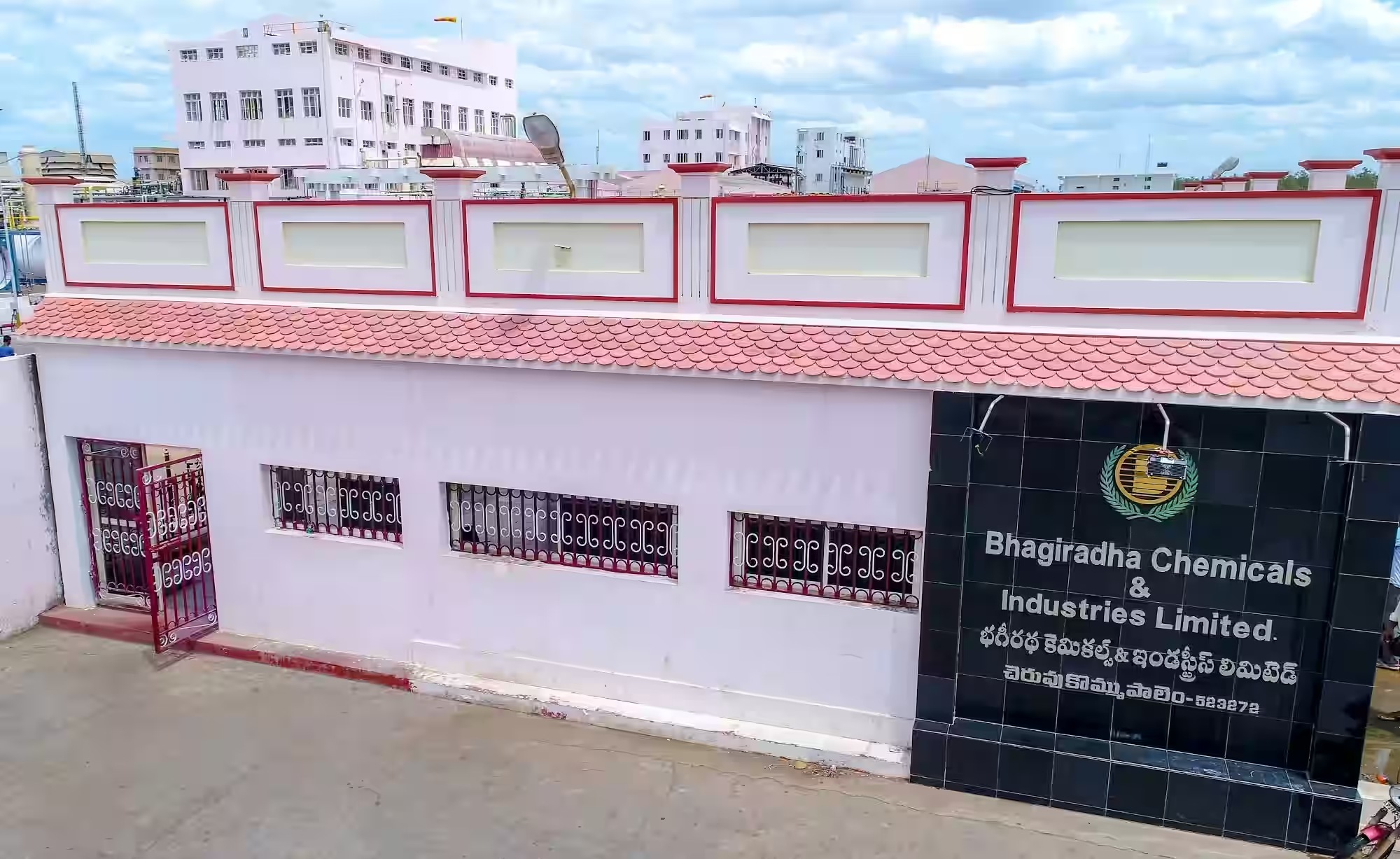
Production happens at their Cheruvukommupalem (Andhra Pradesh) facility with an installed capacity of 3,250 MT per annum, currently 80% utilized. Every year, Bhagiradha focuses on 7–10 molecules, keeping flexibility in production lines — like a DJ switching tracks when the crowd gets bored.
Their new Kadechur (Karnataka) plant will add another 9,002 MT capacity, increasing total potential output to nearly 12,000 MT. The goal? To shift towards complex, high-margin molecules and backward integration to reduce import dependency.
But business model aside, the company’s USP lies in its deep process chemistry expertise, thanks to decades of R&D and custom synthesis partnerships. Yet, investors can’t help but ask: with such R&D