1. At a Glance
Welcome to the electric circus called SJVN Ltd, where waterfalls meet spreadsheets and every megawatt has a mood swing. The stock’s sitting at ₹83.1 — which, let’s be honest, feels like the stock price of a PSU trying to convince investors that it’s a “green energy pioneer” while still collecting hydro rent. With a market cap of ₹32,657 crore, P/E of 58.6, and ROE of 5.81%, it’s basically that overachieving cousin who talks about sustainability but still borrows your car.
In Q2FY26, sales clocked in at ₹1,032 crore, barely budging QoQ (+0.6%), but profit took a hydropower dive — down 30.2% to ₹308 crore. The operating profit margin (OPM) remains an impressive ~83%, showing that water still pays. But here’s the twist: Debt has ballooned to ₹27,025 crore (that’s up nearly 4x since FY22). It’s raining loans, hallelujah.
Despite the leverage, SJVN just got its Navratna badge in August 2024, and they’re celebrating by announcing a ₹1,000 crore securitisation, a CFO appointment, and of course, a project dispute — because what’s a PSU without a good boardroom cliffhanger?
So buckle up. Between hydro, solar, wind, thermal, and transmission, this company’s portfolio looks like a buffet at an energy conference — everything’s on the table, but the dessert (profit growth) still hasn’t arrived.
2. Introduction – The Hydro King Who Wants to Be the Solar Sultan
If there’s one PSU that’s trying to rebrand itself faster than a startup after a bad Series A, it’s SJVN. Born as Satluj Jal Vidyut Nigam, the company made its name with roaring Himalayan rivers and a monopoly over gravity. But with India now chanting “renewable, renewable” like it’s the new Hanuman Chalisa, SJVN has been forced to swap its life jacket for solar panels.
Once content with hydro royalties, the company now wants to be everywhere — hydro dams in Himachal, thermal plants in Bihar, solar farms in Rajasthan, and even power trading across states. It’s like watching an old-school government officer start a YouTube channel: admirable, confusing, and occasionally electrifying.
The highlight? Their 1,972 MW of hydropower capacity still forms the backbone, while 494 MW of renewable capacity and 1,320 MW under thermal setup show diversification. But diversification comes at a price — debt, delays, and disputes.
SJVN’s debt-to-equity ratio of 1.91 is now officially a “Hydro Loan.” Yet, despite the fiscal weightlifting, the company maintains 98% of capacity under long-term PPAs, giving it a stable cash flow backbone that most renewable startups would sell their CFOs for.
But here’s the irony — the stock is down -22.8% YoY, despite India’s power demand soaring. Why? Because investors seem to suspect that SJVN’s balance sheet expansion might be powered more by loans than electrons.
3. Business Model – WTF Do They Even Do?
Let’s decode the hydra that is SJVN’s business model.
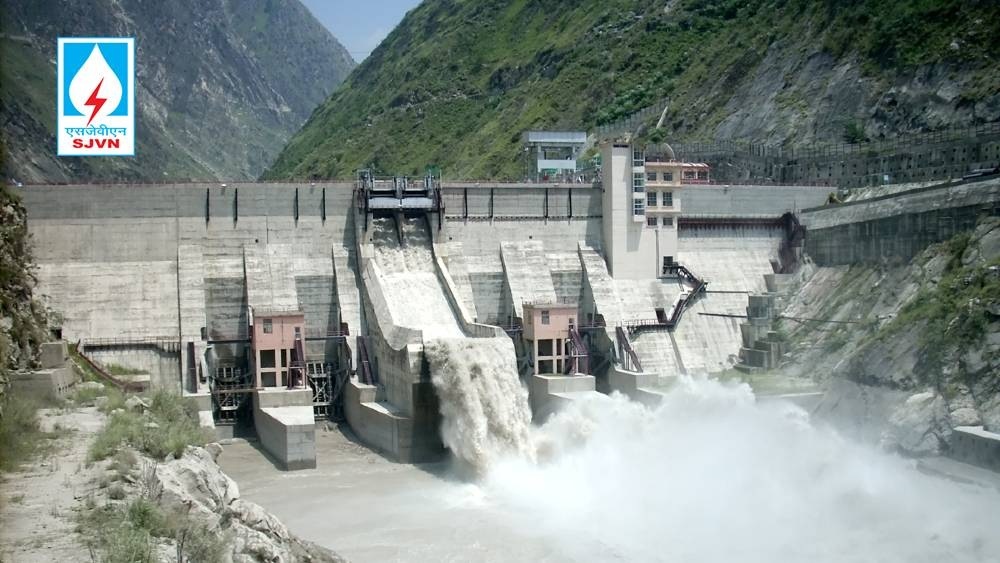
a) Hydro Power (Core) – The OG cash cow. With three operating projects (Nathpa Jhakri, Rampur, and Naitwar Mori) totaling 1,972 MW, this segment still generates the bulk of SJVN’s revenue. However, it’s slow-growing — like your uncle’s scooter on a slope. Currently, four new hydro projects (1,558 MW) are under construction.
b) Renewable Energy (Ambitious Side Hustle) – Solar and wind together contribute 494 MW, but another 2,058 MW worth of solar projects are under development. Through its subsidiary SJVN Green Energy Ltd (SGEL), it’s building solar plants faster than PSU paperwork can travel between ministries.
c) Thermal Power (The Risky Cousin) – Because why not mix fossils with renewables? The 1,320 MW Buxar Thermal Power Project has completed its first 660 MW trial run in November 2025. If all goes well, this project might generate more