1. At a Glance
Welcome to the circus called Prism Johnson Limited, where cement, tiles, and RMC dance together under one balance sheet, each pretending to be the star. The ₹7,146 crore market cap behemoth closed Q2 FY26 at ₹142 per share, trading at an eyebrow-raising 95.3x P/E — which is basically the market saying, “We believe in miracles.” Over the last 3 months, the stock slid -2.9%, making shareholders question whether “building materials” includes rebuilding their confidence.
Despite a 13.1% YoY rise in quarterly sales to ₹1,855 crore, PAT barely touched ₹2.81 crore — a profit that could sponsor a decent office renovation, not much else. The OPM improved to 10.04%, a rare bright spot, while ROCE limped at 2.22% and ROE stayed in the red at -4%. No dividends, no fireworks, just pure “let’s survive till next quarter” energy.
2. Introduction – A Multi-Material Multi-Drama Company
If you thought diversification reduces risk, Prism Johnson is here to prove it multiplies confusion. Cement, tiles, RMC, sanitaryware, insurance stakes — the company’s portfolio looks like a hardware store married an insurance broker.
Founded in 1992, Prism has become one of India’s largest integrated building materials players. But “integrated” seems to mean “everything but profits integrated.” Its operations span across cement (44% of FY23 revenue), H&R Johnson tiles (35%), and ready-mix concrete (21%). Each segment brings something unique — cement brings bulk, tiles bring style, and RMC brings dust.
The company’s latest achievements include a ₹50 crore rights issue investment in Raheja QBE General Insurance, multiple limestone lease wins, and a few dramatic exits — including terminating a 24 MW captive wind project after disagreements with ReNew. Who needs renewable energy when you have renewable excuses?
Meanwhile, Prism’s promoters — the Raheja family — continue holding a steady 74.87% stake, watching from their tiled bathrooms as the company oscillates between hope and hopelessness.
3. Business Model – WTF Do They Even Do?
Prism Johnson’s business model can be summarized as: Make everything a construction site needs, except profits.
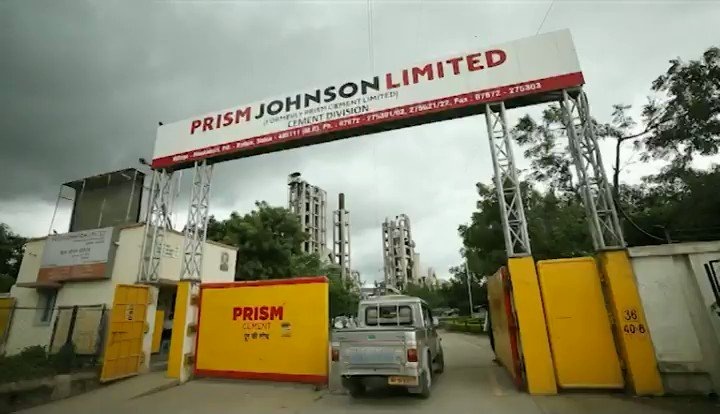
A) Prism Cement (44%) – The heart of the company. It operates with a 7.8 MTPA capacity in Satna, MP, supplemented by 0.82 MTPA from grinding units in UP and Bihar. With brands like Champion, Champion Plus, and Duratech, Prism cement promises strength — and given their ROE, investors sure need it.
B) H&R Johnson (35%) – The company’s tile and sanitaryware arm. With 10 tile plants (61 mn m²) and two faucet factories (3.6 mn pieces/year), this division adds glamour to Prism’s portfolio. The company recently completed a 1.2 mn m² Morbi expansion, and another 5.5 mn m² greenfield project in West Bengal is on the cards. Clearly, capacity expansion is easier than expanding margins.
C) RMC (21%) – Among India’s top three in ready-mix concrete, operating 91 plants across 44 cities. That’s impressive scale — pity it’s not reflected in the share price.
Together, these businesses are supposed to form a synergistic empire of concrete, tiles, and trust.