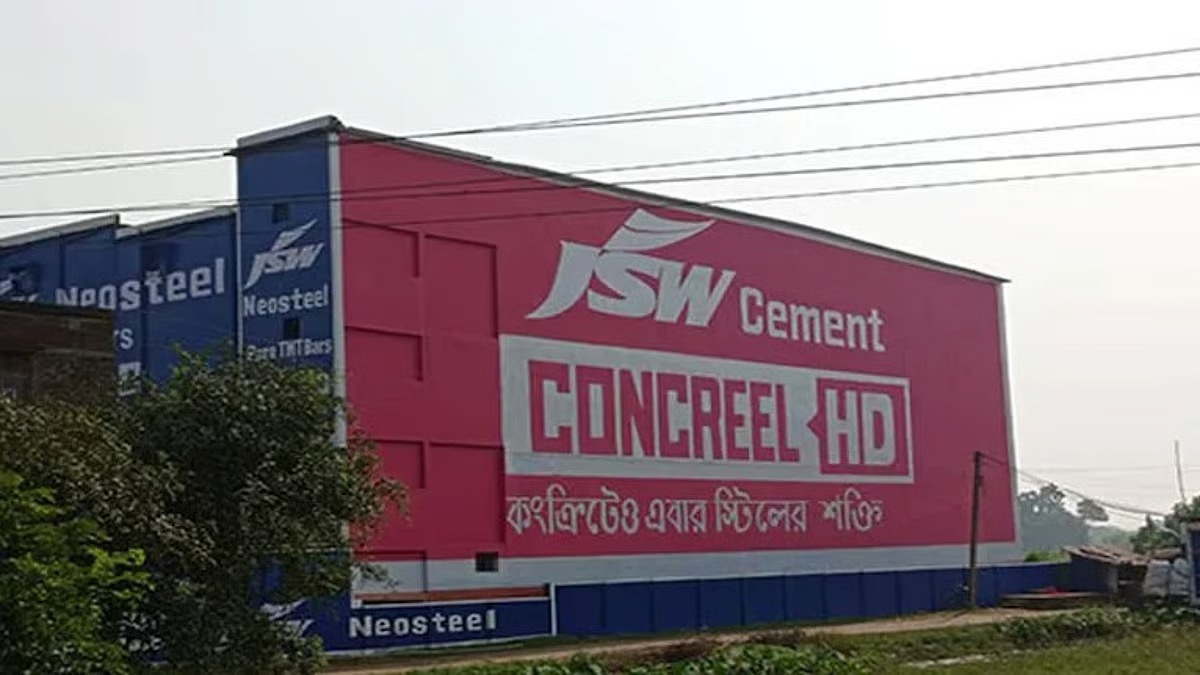
JSW Cement Ltd Q2 FY26 – ₹1,436 Cr Revenue, ₹75 Cr PAT & a ₹1,466 Cr Fair-Value Bombshell. Welcome to India’s Greenest (and Most Dramatic) Cement Story.
Date of Publishing -
Spotted a factual error — a wrong number, date, or fact? Tell us and we will check the source.
1. At a Glance
In a world where cement companies brag about capacity, JSW Cement brags about carbon. India’s “greenest” cement manufacturer posted a Q2 FY26 consolidated revenue of ₹1,436 crore and a net profit of ₹75.4 crore — but with a twist: an exceptional fair-value charge of ₹1,466 crore that nearly cemented everyone’s jaws to the floor.
At a market cap of ₹17,406 crore and a stock price of ₹128 (Nov 7 close), this newly listed JSW Group baby comes with a P/E ratio of 496 – yes, the kind of P/E that could make a startup blush. The company recently listed on August 14, 2025, after a ₹3,600 crore IPO. Book value? ₹44.4. ROCE? A polite 4.64%. ROE? An apologetic -4.81%. Debt? ₹4,560 crore, because why settle for less.
And yet, the stock market doesn’t care — because it’s JSW. Because it’s green. Because apparently, carbon is the new gold.
2. Introduction
Once upon a kiln, in the land of limestone and loans, Sajjan Jindal’s empire decided to make cement cool. Thus was born JSW Cement — the self-proclaimed green knight in an industry known for dust, debt, and dullness.
After years of quietly expanding its footprint, JSW Cement made its grand stock market debut in August 2025, raising ₹3,600 crore. Half of that went to reduce borrowings, the rest to build more plants — and possibly, to fund the caffeine supply of every civil engineer in India.
But the company didn’t stop there. With 20.6 million tonnes per annum grinding capacity and 6.44 MTPA of clinker, it’s now expanding like your neighbor’s illegal balcony — aiming to double both capacities in a few years.
In a cement world dominated by UltraTech, Shree Cement, and Ambuja, JSW Cement wants to be the eco-friendly disruptor. Think of it as the “Tesla of cement,” except instead of Elon Musk tweets, you get a ₹1,466 crore fair-value adjustment surprise.
The company boasts the lowest CO₂ emission intensity in the industry — 258 kg per tonne, 52% lower than Indian peers. That’s impressive, though investors might wish they emitted fewer losses too.
3. Business Model – WTF Do They Even Do?
JSW Cement doesn’t just make cement — it recycles India’s guilt. The company takes industrial by-products like blast furnace slag and turns them into green cement. Basically, it’s the Swachh Bharat of construction materials.
Their portfolio includes:
Cement: Blended and Ordinary Portland Cement for all those highways, metros, and marriages that need a foundation stronger than family ties.
GGBS (Ground Granulated Blast Furnace Slag): A by-product from steelmaking that gives your concrete superpowers (and gives JSW bragging rights as India’s largest GGBS producer with 84% market share).
Clinker: The hot and heavy intermediary product, burned at high temperature like every investor’s hopes after an exceptional loss.
Allied Products: Ready-mix concrete, screened slag, and construction chemicals — because JSW Cement doesn’t just build homes, it builds ecosystems.
Its sustainability narrative is real. 21.48% of its total power in FY25 came from green sources. The company also operates 7 plants across India and 1 clinker unit in the UAE, with mines in Andhra Pradesh, Odisha, and Madhya Pradesh (and more waiting for approvals like half the country’s startups).
So yes, they literally dig, burn, grind, and then call it “green.” The irony is delightful, but the margins — not so much.