1. At a Glance
Move over, the “wire” is no longer just a crime thriller—it’s V-Marc India Ltd’s business plan. The ₹1,525 crore market-cap SME star just pulled off a jaw-dropping performance in H1 FY26 with revenues of ₹6,915 million (+100% YoY), EBITDA ₹783 million (+128%), and PAT ₹364 million (+221%). Yes, triple-digit growth figures—something usually reserved for crypto charts or RBI’s inflation nightmares.
The stock trades at ₹624 (07 Nov 2025), having more than tripled from ₹200 levels within a year—up 43.5% in 3 months and 97.8% in 6 months. With a P/E of 24.9, ROE of 24.3%, and ROCE of 26.4%, the wires seem well-connected between earnings and returns.
But it’s not all electric sunshine—43.2% of promoter holdings are pledged, meaning even the owners are “wired” to their lenders. Still, with sales growth of 70% YoY and profit growth of 87%, the numbers are glowing brighter than Diwali lights.
2. Introduction – A Shockingly Charged Story
Once upon a time in 2014, a small company from Haridwar decided that electricity cables didn’t have to be boring. Thus was born V-Marc India Ltd, now one of India’s most energetic stories from the SME board.
From a modest ₹5 crore revenue in 2014 to ₹1,251 crore in FY25—this company’s journey has been less of a straight line and more like a high-voltage waveform. It doesn’t just make PVC-insulated wires and cables—it manufactures ambition, insulation, and a fair bit of investor excitement.
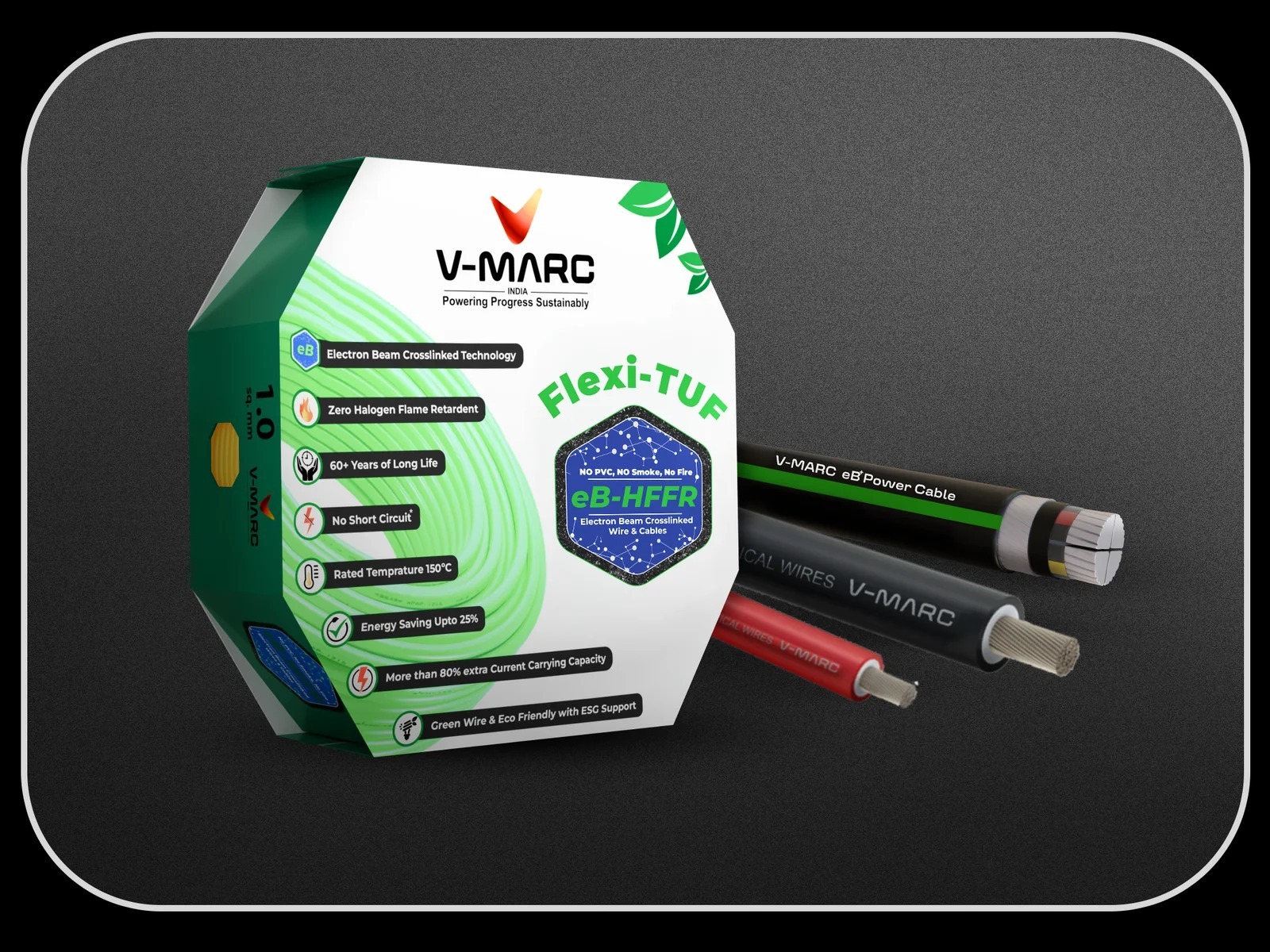
If you think cable manufacturing sounds dull, think again. V-Marc’s products are found in places like PowerGrid, NTPC, ONGC, Indian Oil, and BSNL—basically every entity that either runs your electricity or your Wi-Fi. Its cables span everything from FR, HRFR, FRLS, HFFR to XLPE, which in cable-speak means “the good stuff that doesn’t catch fire easily.”
And while most SMEs struggle to keep up with changing tech, V-Marc just upgraded to Dry Curing CCV Line, a tech leap that allows production up to 66 kV cables. Basically, the company just moved from making household wires to powering substations—and that’s no small spark.
So the next time you flip a switch in Uttar Pradesh, Uttarakhand, or Madhya Pradesh—there’s a good chance you’re connected (literally) through a V-Marc product.
3. Business Model – WTF Do They Even Do?
In simplest terms: they make cables, and lots of them.
But here’s the breakdown for the lazy investor who’d rather watch Shark Tank than read balance sheets:
- LT Cables – For low-tension electrical networks. Includes LT PVC Power & Control, XLPE, and Aerial Bunched Cables.
- HT Cables – For high-voltage applications, up to 33 kV currently, expanding to 66 kV soon.
- Communication Cables – CCTV, LAN, Co-axial, Telephone cables—so that your data, like their revenue, moves fast.
- Light Duty Cables – Fire-resistant multistrand and flat cables that your local electrician calls “mast maal.”
The customer list reads like a PSU fan club—PowerGrid, NTPC, GAIL, SAIL, Indian Oil, ONGC, PWDs, and state discoms.
Their dealer network spans 19 states with 600+ dealers and 5 depots, ensuring that whether it’s an industrial project or a small house rewiring job, there’s a V-Marc wire nearby waiting to conduct business.
Revenue-wise, the company’s mix is smart: 70% retail,