1. At a Glance
If auto components were a Bollywood movie, Alicon Castalloy Ltd would be that dependable character actor — not the hero, but always present, sweating under the foundry furnace. The company’s Q2FY26 numbers are a mixed alloy — shiny operationally, dull on the bottom line. At a market cap of ₹1,525 crore and a stock price of ₹936 (down 3.15% on 6th Nov), Alicon is not exactly melting hearts at Dalal Street. Revenue for Q2FY26 stood at ₹428 crore, down 7.7% YoY, while PAT dipped 17.4% to ₹13.9 crore. Operating margin, though, remained a respectable 13%.
The company boasts a stock P/E of 43.5, a book value of ₹377, and a ROE of 8.02%, which is like running a marathon in crocs — painful but somehow finishing. Still, with ROCE at 11.6% and debt-to-equity of 0.57, it’s financially fitter than many small-cap uncles trying to lift “Make in India” slogans. Over six months, the stock is up 42%, showing that investors are cautiously optimistic — or just high on aluminum fumes.
2. Introduction
Alicon Castalloy — the unsung casting artist of India’s automotive dreams — has been pouring molten metal since before EV hype became the neighborhood gossip. The Pune-based foundry giant is the quintessential supplier’s supplier: you’ll never see its logo on your car, but chances are, it’s holding your engine together.
Once upon a time known as Enkei Castalloy, this Indo-Japanese love child between Pegasus Castalloy and Japan’s Enkei Corporation evolved into today’s Alicon Castalloy — part of the Alicon Group, with a presence in 18 countries. From humble castings to high-tech components like e-axles and inverter housings, the company’s story mirrors the industry’s slow crawl toward electric mobility.
In the auto ecosystem, Alicon’s aluminum castings are like the bones under a Bollywood hero’s six-pack — invisible but essential. Yet, as global OEMs cry about chip shortages and EV transitions, Alicon finds itself at a strategic crossroads: keep serving combustion dinosaurs or chase the electric unicorn.
And while most auto suppliers in India pretend to be “green” by putting a solar panel in their parking lot, Alicon has actually invested in Clean Max Uno (26% stake) and Radiance MH Sunrise (10.4%) — both solar power projects. A rare smallcap that’s literally putting sunlight into its balance sheet!
3. Business Model – WTF Do They Even Do?
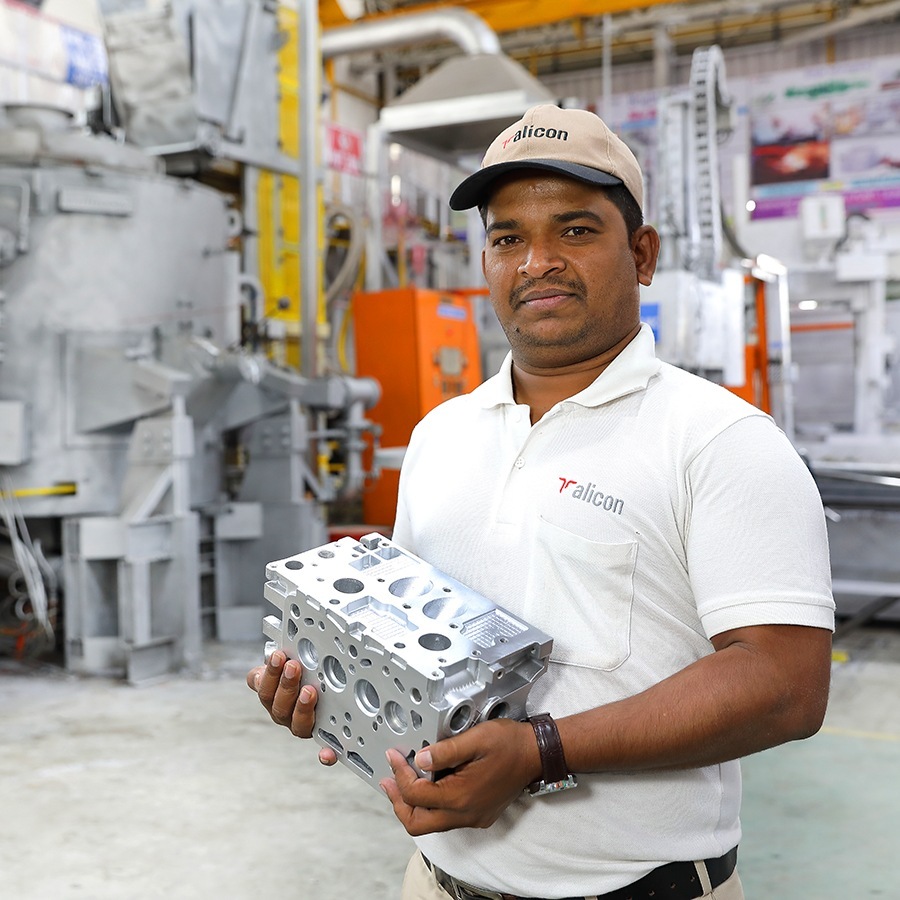
In short: Alicon melts aluminum, shapes it, machines it, and sells it. In long form: it manufactures precision aluminum castings like cylinder heads, intake manifolds, engine brackets, motor housings, inverter casings, battery trays, and — for the cool EV crowd — e-axles and battery enclosures.
The auto segment (94% of revenue) is its bread, butter, and brake pads. Customers include Audi, Tata, Toyota, Hero, Honda, Suzuki, and basically anyone who has ever made a vehicle in India. Non-auto business (6%) caters to heavyweights like Siemens, Bosch, Samsung, and Philips — the kind of names that make investors feel safe until they check margins.
Alicon operates four manufacturing facilities — three in India and one in Slovakia. Together, they run at around 76–77% utilization, which means they still have enough spare furnace capacity to roast competitors if needed.
Its process mix of Low-Pressure Die Casting (LPDC) and Gravity Die Casting (GDC) gives it flexibility — or in desi terms, the ability to switch between “mass order” and “premium prototype” mode. With 866 live parts and 97 customers, no single client contributes over 15% of turnover — a diversification most smallcaps can only dream of.
In FY24, Alicon spent ₹114 crore on capex, with another ₹150 crore lined up for FY25. The goal? Strengthen production for EVs, hybrids, hydrogen, and fuel-cell parts. In FY24 alone, it launched 50 new products — proof that the company’s R&D team doesn’t sleep, only