1. At a Glance
Suzlon Energy Ltd, the reformed wind energy warhorse, just turned Q2 FY26 into a standing ovation moment. Revenue stormed up to ₹3,871 crore, a year-on-year growth of 84%, while net profit erupted 539% YoY to ₹1,279 crore — powered partly by a Deferred Tax Asset (DTA) boost of ₹717 crore. The market, however, still values this once-bankrupt phoenix at a handsome ₹81,597 crore.
Trading around ₹60 a share, Suzlon has given -9% return in the last 3 months, a mild wind chill after its roaring recovery spree that saw the stock soar over 93.9% in 3 years. With an ROE of 41.4% and a ROCE of 32.5%, Suzlon’s balance sheet now flexes harder than its turbine blades. The debt? Barely ₹397 crore — practically pocket change for a company that once owed more than some small nations.
But before you clap too loudly, remember: the book value is ₹5.78, and the stock trades at 10x book, making even Ambani’s eyebrows rise. Still, for a company that once crashed harder than Lehman Brothers, today’s Suzlon feels like the Rocky Balboa of renewables — bloodied, broke, but back swinging.
2. Introduction
Once upon a meltdown, Suzlon Energy was the poster child of Indian over-ambition. In the mid-2000s, it bought European companies, borrowed billions, and thought the wind would blow forever. Spoiler: it didn’t. By 2012, the debt load was so heavy that even its turbines couldn’t lift it.
Fast-forward to FY26 — Suzlon is no longer a cautionary tale, but a redemption arc. It’s almost debt-free, operationally muscular, and back to making the kind of profits its lenders once dreamt of while crying into their balance sheets.
But what’s most fascinating is how it pulled this off. Through debt restructuring, a few rights issues, some divine DTA blessings, and management that finally decided to behave like accountants instead of adventurers, Suzlon re-engineered not just its turbines but its destiny.
At ₹60 a share, the company is now a reformed wind giant with a desi swagger. The founder Tulsi Tanti, who sadly passed away in 2022, might be gone — but his dream of making India wind-sufficient is very much alive, blowing through every new S144 turbine across the Deccan plateau.
3. Business Model – WTF Do They Even Do?
Suzlon is basically the “wind power mechanic of India,” but on steroids. They design, manufacture, install, and maintain Wind Turbine Generators (WTGs). The company doesn’t just sell a machine; it sells the entire ecosystem around it — site selection, tower erection, power evacuation, and even baby-sitting the turbines for 20 years under its O&M (operations & maintenance) contracts.
Think of it as a shaadi planner for wind energy: Suzlon finds the location (wind resource assessment), builds the mandap (infrastructure), handles the guests (clients like Tata Power, Adani, and NTPC), and cleans up afterward (O&M).
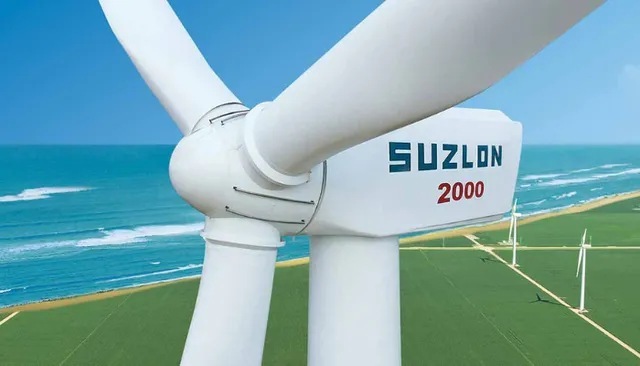
Their latest toys, the S144, S133, and S120 turbines, range between 2.1 MW and 3.x MW capacities — perfect for India’s “low-wind” sites. The S144 stands 160 meters tall — taller than any politician’s promises.
About 73% of Suzlon’s FY22 revenue came from the sale of wind turbines and components, while 27% came from O&M services — the stable annuity stream that keeps the cash coming when new projects slow down.
With an order