The Great Market Tamasha: From Euphoria to Despair and Back
Namaste, fellow FOMO investors! Buckle up, because today we’re taking a wild ride through the market cycle – that ridiculous, repetitive saga of booms and busts that makes us feel like kings one minute and fools the next. Think of it as an Indian masala movie plot: there’s drama, comedy, romance (with your stocks), heartbreak, and eventually a hopeful ending… until the sequel. The stock market, much like a big fat Indian wedding, has phases where everyone’s dancing in joy, followed by times when the food is cold, the DJ has fled, and we’re left holding stale gulab jamuns wondering “What just happened?” In market-speak, these phases have fancy names: euphoria, denial, panic, depression, and recovery. But fear not – we’ll spice them up with Bollywood flair, cricket analogies, and enough sarcasm to make even a stand-up comic in Mumbai proud.
First, let’s clarify one thing: markets always move in cycles. Up, down, and back around. It’s like seasons or your neighborhood kitty party gossip – what was hot news last year will cool off, only to heat up again. A market cycle is basically a repeating pattern of rising, peaking, falling, and bottoming prices driven by human emotion, economic trends, and “liquidity” (money sloshing around). In other words, greed and fear play kabaddi with our portfolios. And guess what? Most of us (yes, us, including that know-it-all brother-in-law quoting Warren Buffett at every dinner) end up doing the exact opposite of sensible investing: we buy high in excitement and sell low in fear. Why? Because emotional investing leads to mistakes – our greed and fear often cause us to buy at tops and sell at bottoms. If you don’t believe me, look at your own investing history: Ever jumped into a stock because everyone said “boss, this one is going to the moon!”? And later sold it in a panic when it tanked? Don’t worry, you’re not alone – this script has been running in Dalal Street and Wall Street for decades, starring millions of everyday investors as the comedic sidekicks.
Now, before diving into each stage of this financial circus, let’s set the stage with some perspective: market downturns are normal. They happen frequently – historically, about one bear market every three years on average. So downturns are as Indian as monsoons: expected regularly, sometimes arriving late, but never skipping their date entirely. We’ve seen it all before: the 2008 crash (when the Sensex and global markets plunged ~50% in value, wiping out wealth faster than you can say “Lehman bhai gone”), the 2020 pandemic crash (a 34% collapse in the S&P 500 in just over a month – like the market caught COVID fever and fainted), the 2021 meme-stock and crypto euphoria (stocks and coins flying high like Diwali rockets), followed by the 2022 crash (as inflation and war fears kicked everyone in the gut). Even the dot-com bubble of 2000 saw the S&P 500 index lose about 49% by its bottom. So, cycles happen, folks. What goes up will come down – and then go up again. Knowing this is half the battle; the other half is not losing your sanity (or shirt) in the process.
Okay, enough foreplay. Lights, camera, action! Let’s journey through the classic market cycle in all its glory, with each phase explained in a language we desi investors understand: Bollywood melodrama, cricket commentary, and that unmistakable Indian knack for jugad (making do) even when things go wrong.
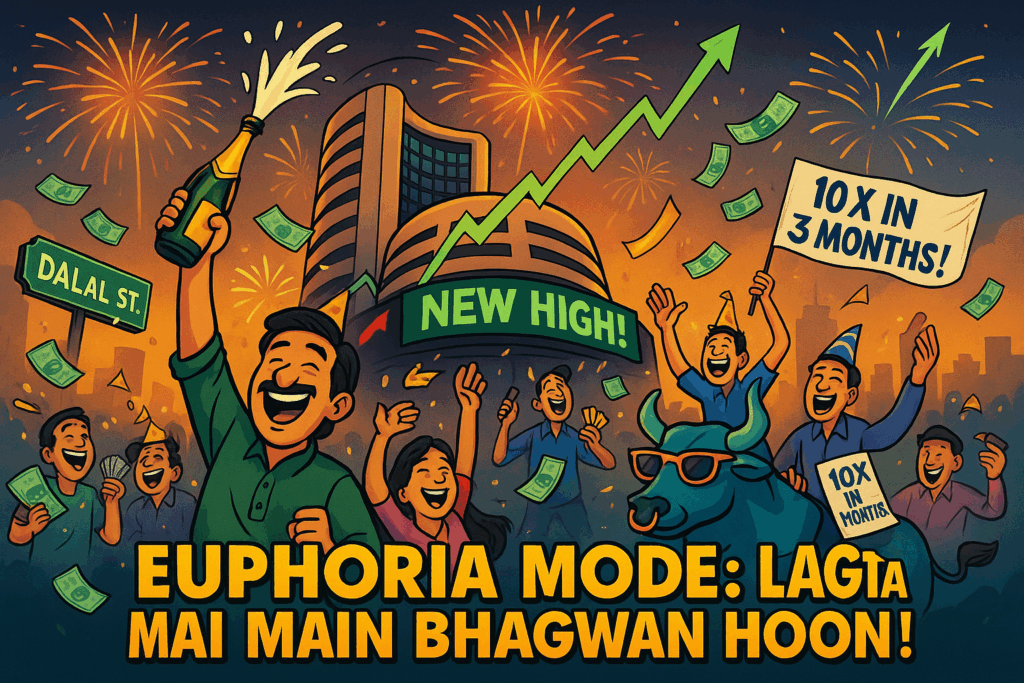
Scene 1: Euphoria – “Lagaan of Luxury” Welcome to the bull market ki baarat – the roaring party where stocks are the groom, investors are dancing relatives, and everyone’s high on optimism (and maybe a little something in their lassi). Euphoria is that peak phase where prices are at all-time highs, everyone believes they’re a genius, and greed is in full flow. Picture the energy of an Indian wedding Sangeet night: Uncle ji, who once thought “stock market is gambling,” is now boasting about his multi-bagger stocks; Aunties are trading tips on WhatsApp instead of recipes; your college roommate who couldn’t tell an income statement from a grocery bill is now a crypto guru on Twitter. Sentiment is through the roof. This is the “sab moh maya hai… but let’s get rich first” phase. Every dip is seen as a buying opportunity – “Buy the dip, bro, market can only go up!” – and any cautionary voice is dismissed as “jealous or jaded.” Fundamentals? Hah! Even junk companies find their stock prices doubling because, in a bull mania, investors start ignoring risk entirely. It’s that classic “this time it’s different” delusion. You feel invincible – like Virat Kohli hitting centuries on flat pitches, you think you can’t go wrong. The media is cheering, analysts are raising target prices, and IPO hai toh bas party hai (every IPO lists at a premium, making day-one buyers quick bucks). Money is so easy it feels like Munna Bhai MBBS – even if you flunked Finance 101, the market gives you full marks.
During euphoria, even stocks with great fundamentals keep rising beyond rational levels, but crucially, even utterly garbage stocks climb too. It’s not that fundamentals don’t exist; it’s that nobody cares! Liquidity (easy money) is abundant – like free alcohol at an open-bar wedding – so everyone’s drinking and dancing. If interest rates are low and central banks are printing money, markets get flooded with cash, and all that money has to go somewhere – usually into stocks, real estate, crypto, whatever’s trendy. In 2021, for example, central banks worldwide had pumped liquidity and cut rates, leading investors to take on more and more risk. It was like the central bank DJs kept the music going all night. The result? A frenzy. In India, the number of new stock investors exploded – demat accounts more than tripled from 2021 to 2025, fueled by the post-pandemic boom and buoyant IPOs. Think about that: millions of newbies who had never touched stocks jumped in, seeing their friends make quick profits. During the 2020-2021 bull run, it felt like everyone and their chaiwala had a stock tip. Your gym trainer is discussing Dogecoin, your Uber driver asks if he should buy Tesla, your mom’s friend claims her son made a fortune on Zomato shares. This “sabko paisa ban raha hai” (everyone’s making money) vibe creates a nationwide FOMO. Greed becomes a bonding experience.
Sarcasm aside, euphoria is dangerous precisely because it feels so good. It’s like a Bollywood dance number – all upbeat, choreographed optimism – and you’re convinced the movie will have a happy ending right there. At the peak of euphoria, people say insane things with straight faces: “Stocks only go up.”“I’m in it for the long run” (when they mean the last 3 months of gains). “This new startup with zero profits is the next Amazon, I swear – apna time aayega!” Valuations reach nosebleed levels. I recall in early 2008 and again in late 2021, price-to-earnings ratios and market caps made no sense, but who cared? If you voiced concern, you’d hear: “Bhai, tumne life me kuch nahi dekha. Abhi market dekhte jao, 100k Sensex pakka!” (Bro, you haven’t seen anything yet; watch, Sensex 100k for sure!). We laugh, but it’s true – in euphoria, bullish predictions become absurdly bold.
It’s also when investor mistakes abound. Common Mistakes in Euphoria: Overconfidence and overleveraging. People start believing they have the Midas touch. Your friend who made 50% in two months starts trading on margin, effectively taking loans to buy more stock – like putting double masala hoping for double taste, not realizing it could burn. New investors chase fads – be it dot-com in 1999, real estate stocks in 2007, or crypto in 2021 – without understanding the business. They throw money at anything that’s moving, a bit like buying cricket World Cup tickets from a tout at triple price because India won a league match and you assume they’ll win it all (and then they crash out in semis – oops). Smart investors? They’re at this very same party, but they quietly start edging towards the exit. Remember Warren Buffett’s golden rule: “Be fearful when others are greedy…” – well, the “Oracle of Omaha” actually trimmed positions during exuberant times and kept cash ready to deploy later. In our shaadi analogy, the smart folks drink less and note where the fire exit is, while others are doing naagin dance obliviously. Smart investors in euphoria take some profits, rebalance portfolios, or at least refrain from joining the late-stage bidding wars. They don’t announce it (so don’t expect an uncle at a party to say he’s selling – he’ll just hum “all is well” and quietly offload some shares). But trust me, the veterans know that “peak happiness = peak risk”, as counterintuitive as that sounds. In fact, a classic chart of investor emotions shows **euphoria as the point of maximum financial risk – exactly when you feel invincible. Like a batsman on 99 who plays a rash shot thinking he’s invulnerable – that’s when he’s most likely to get out.
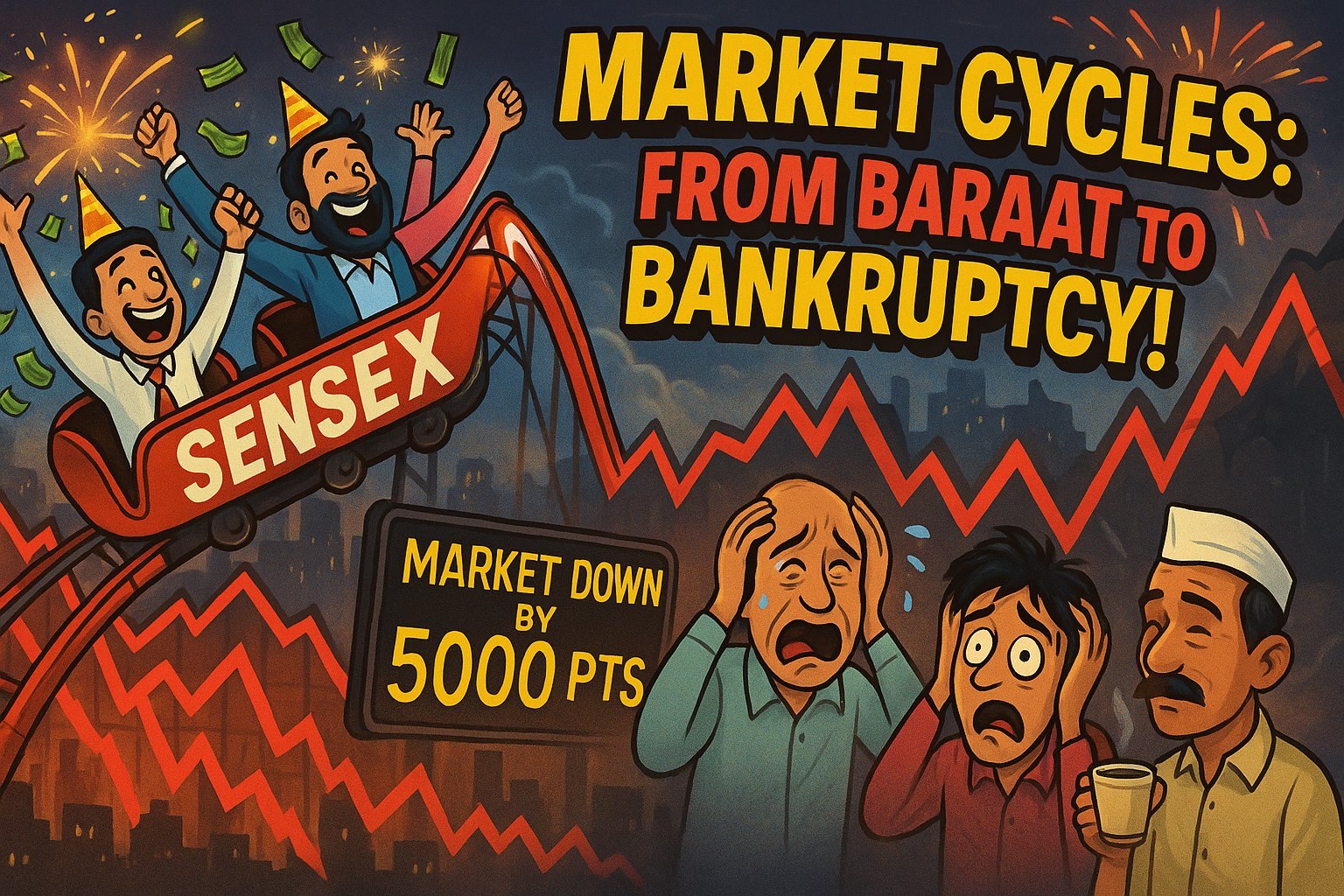
Above: The classic “market cycle of emotions” cheat-sheet humorously illustrates how investors swing from optimism to euphoria, then crash into panic and despair before recovering. At Euphoria, we’re all saying “Mogambo khush hua!” (Mogambo is pleased) thinking we’re stock market geniuses, and at Depression, we’re like forlorn Bollywood heroes in the rain, convinced we’ll never love (invest) again. This chart is basically the stock market’s “Kabhi Khushi Kabhie Gham” – starting with joy, ending in tears, and eventually hope sneaks back in.
Scene 2: Denial – “Yeh Shaadi Cancel Nahin Ho Sakti!” Every blockbuster has a twist. In our market movie, that comes when the graph stops obediently going up. After the euphoria peak, prices start to fall – maybe just a little at first. This is where Denial kicks in. Imagine the wedding where someone whispers that the catering might be running out of food. Does anyone panic? Nah, we confidently say, “Arre, shaadi hai, sab manage ho jayega” (It’s a wedding, everything will be managed). Similarly, when the market begins to slide off its highs, investors go: “This is just a temporary setback. I’m a long-term investor.” (Sound familiar? It’s straight from the handbook of investor self-delusion.) In the denial stage, we refuse to accept that the party might be ending. The mindset is: “Market thoda down kya hua, you guys act like it’s a crash. Chill yaar, it will bounce back next week.”
Denial is basically optimism on autopilot – an echo of euphoria’s sentiment, but now in the face of contrary evidence. Key hallmark: People cling to “fundamentals” and “long-term” rhetoric to justify not acting. Ironically, this is when those who ignored fundamentals at the top suddenly become fundamental investors overnight: “The stocks I hold are quality companies; they’ll be fine. This dip is a chance to add more.” There’s actually some logic: if you truly bought great companies, a dip is fine. But in denial, even those holding junk will tell themselves stories. It’s like in Bollywood when the heroine catches the hero flirting and he says, “It’s not what it looks like!” – we create narratives to avoid pain.
A classic emotional snapshot at this stage, as noted by market psychologists: “Anxiety, then denial” – you feel nervous watching prices drop, but then you tell yourself and others, “It’s just a correction… I’ll hold through it”. Maybe you even double down, buying a bit more on dips to prove your conviction. If euphoria was partying hard, denial is the hungover morning where you insist you’re fine and take another sip of beer to cure it (the “hair of the dog” strategy).
This phase can last a while or be brief, depending on how fast the downturn accelerates. Investor mistake in denial: refusing to re-evaluate. Some level of denial is natural – nobody likes admitting they were wrong at the peak. But stubbornly holding losers without a plan is dangerous. For example, in early 2008 as markets started slipping from their Jan highs, many investors in India said “It’s a temporary dip. India’s growth story is intact.” That was partly true – India’s long-term growth was intact, but that didn’t stop Sensex from falling further off a cliff when the global financial crisis unfolded. Similarly, in late 2021 when tech stocks started wobbling, a lot of us said “Tech is the future, this weakness is transitory.” Next thing we knew, 2022 gave a reality check.
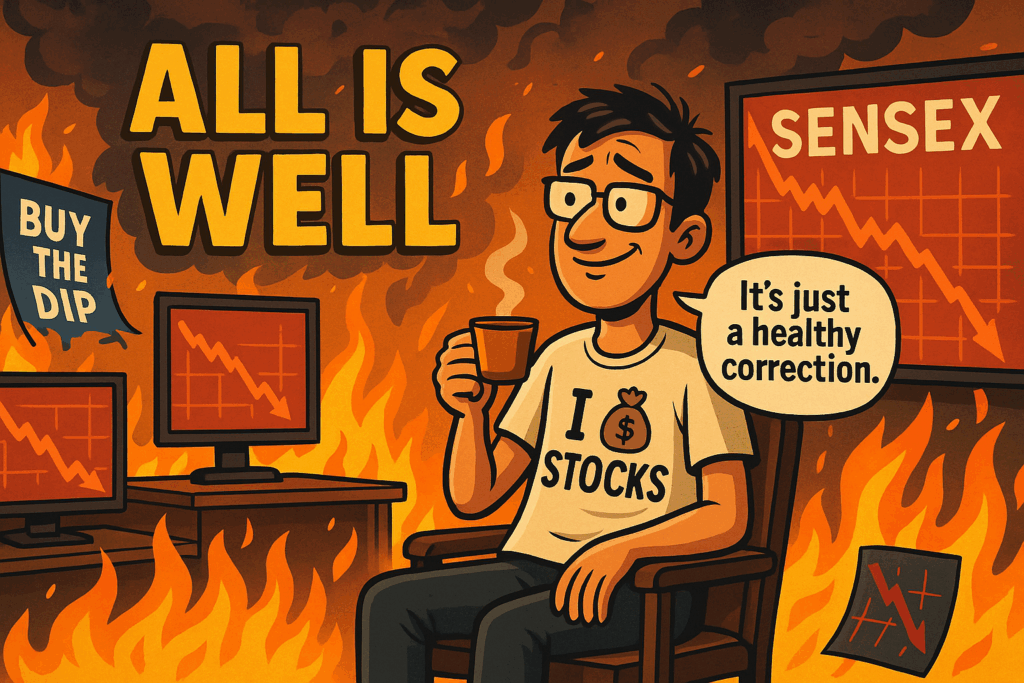
During denial, media and analysts also contribute. You’ll see headlines like “Market dips 5%, experts call it healthy correction.” Bulls on TV will reassure: “Buy on dips, nothing fundamentally changed.” And sometimes they’re right – occasionally a dip is just a dip. But in a true cycle turn,

2 Responses
very well written descriptive article
Nice way to explain market psychology! Thanks.