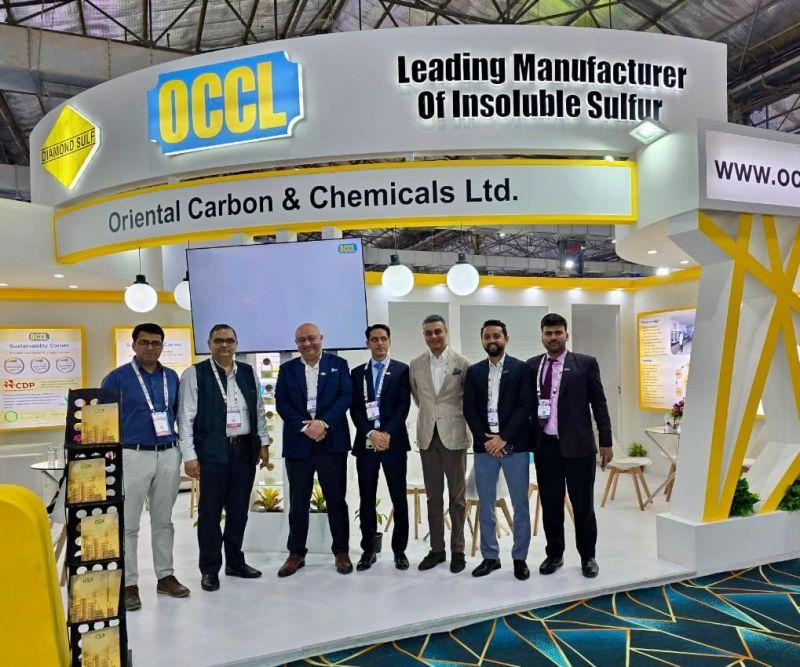
OCCL Ltd Q2 FY26 – The New Sulphur King: From Demerger Dust to Chemical Royalty
1. At a Glance
In the world of chemical smallcaps, OCCL Ltd (Organically Cool Chemical Legend?) just pulled off something that sounds like a chemistry experiment but behaves like a stock market stunt. Born in 2024 from the demerger of Oriental Carbon & Chemicals Ltd, OCCL has gone from zero to ₹561 crore market cap faster than your lab assistant can spell “vulcanization.”
With Q2 FY26 revenue at ₹120 crore (up 16% YoY) and PAT of ₹8.7 crore (up 15.7% YoY), this baby is already profitable. Its full-year TTM revenue now stands at ₹446 crore, and PAT at ₹35.8 crore, with EPS ₹7.16. At ₹112 per share, it trades at a modest 15.7x earnings, a far cry from chemical peers with P/Es in the 20s and 30s.
Margins are healthy — OPM 17.9%, ROCE 14.9%, ROE 10.8%, and Debt-to-Equity only 0.18x. Even better, the Government’s anti-dumping duty on Chinese and Japanese imports of insoluble sulphur (June 2025) practically declared independence day for OCCL’s profitability.
And the stock? It’s volatile like sulphur itself — +40% in six months, -26% in three months, currently in the “wait-and-react” zone. The company declared a ₹1 interim dividend on Q2 results, showing it can share profits without acting like a startup hoarder.
Basically, OCCL is a brand-new old business — an industrial phoenix with the same chemical DNA, just cleaner, meaner, and more profitable.
2. Introduction
Imagine if you could take your profitable division, remove the investment baggage, and give it a fresh ticker symbol — that’s exactly what OCCL Ltd did in FY24. The chemicals business split off from AG Ventures Ltd (formerly Oriental Carbon & Chemicals Ltd), leaving the legacy investments behind and bringing the money-making sulphur arm front and center.
But don’t mistake it for a newbie. OCCL inherited decades of know-how in Insoluble Sulphur — a critical compound used in tyre manufacturing to improve performance, durability, and prevent bloom (that white, powdery thing on rubber).
Today, OCCL commands 55–60% domestic market share and ~10% global market share, serving tyre giants like Bridgestone, Continental, Goodyear, and Michelin.
With three plants — two in Dharuhera (Haryana) and one in Mundra SEZ (Gujarat) — OCCL has the manufacturing muscle to deliver 39,500 MTPA of Insoluble Sulphur and 88,000 MTPA of Sulphuric Acid & Oleum.
Oh, and it exports to 21 countries — so while you were waiting for monsoon to fix your car’s grip, OCCL was quietly supplying the rubber industry across five continents.
Question: How often do you find a 1-year-old company that already exports to 21 countries?
3. Business Model – WTF Do They Even Do?
Let’s simplify: OCCL makes one product that’s essential for one industry that’s never going away — tyres.
Their primary hero, Insoluble Sulphur (86% of revenue), is sold under the brand DIAMOND SULF — a vulcanizing agent used in tyre manufacturing. Think of it as the salt in your sambar — invisible but essential. Without it, tyre treads would bloom and crack faster than smallcap investor patience in a bear market.
The other 14% of sales come from Sulphuric Acid & Oleum, which are industrial workhorses used in detergents, fertilizers, and chemical processes.
But OCCL isn’t just making commodity chemicals — it’s making highly specialized grades used by global tyre OEMs. That’s why they can command premium pricing and consistent exports.
With 55-60% of revenue from exports, the company is dollar-friendly by nature. The US alone contributes 10–15% of total revenue, making OCCL a quiet beneficiary of rupee depreciation.
In short: one product, one purpose, one planet — that’s the OCCL formula.
4. Financials Overview
Metric
Latest Qtr (Q2 FY26)
YoY Qtr (Q2 FY25)
Prev Qtr (Q1 FY26)
YoY %
QoQ %
Revenue
₹120 Cr
₹103 Cr
₹123 Cr
+16.1%
-2.0%
EBITDA
₹19.2 Cr
₹18.5 Cr
₹26.3 Cr
+3.7%
-27.0%
PAT
₹8.69 Cr
₹7.51 Cr
₹13.14 Cr
+15.7%
-33.8%
EPS (₹)
1.74
1.50
2.63
+16.0%
-33.8%
Annualised EPS = ₹6.96 → P/E ≈ 16x, still below peers like SRF and GNFC.
Commentary: Q2 was solid — revenue growth healthy, margins stable around 17%, and earnings resilient despite a mild QoQ drop (seasonal). The new anti-dumping duty adds a strong tailwind for FY26–27 profitability.