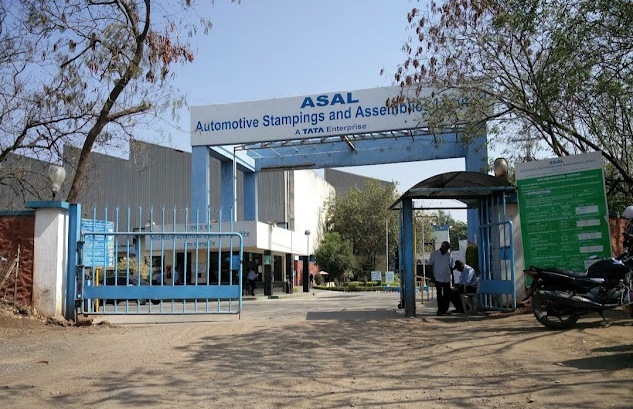
Automotive Stampings & Assemblies Ltd Q2FY26 | From Scrap to Swagger: The Tata Metal Minion’s High-Tensile Comeback (But with 103× Book Value Madness)
1. At a Glance
If resilience had a factory address, it would be stamped somewhere between Tata Motors’ Sanand plant and ASAL’s welding line. Automotive Stampings & Assemblies Ltd (ASAL) — Tata Group’s forgotten metal-bender — has clawed its way back from losses, negative net worth, and near-debt default into the green lane.
At ₹564 a share and a market cap of ₹895 crore, ASAL trades at a jaw-dropping P/B of 103× — because apparently, markets think steel panels can be spiritual assets. P/E is 58.4×, which is basically “hope premium + Tata surname surcharge.”
Q2FY26 revenue came in at ₹212 crore (+7.4% YoY), with a modest ₹4.39 crore profit (+2.6% QoQ). OPM stood at ~6%, a huge recovery from the sub-zero margins of its dark years (FY18-FY21). Debt is ₹149 crore, mostly friendly fire from Tata AutoComp Systems (TACO), its 75% parent.
So yes — the company that once welded losses has now welded its balance sheet too. But is this real financial fitness or just a temporary shine before the next dent?
2. Introduction
There’s a special place in the stock market for companies that almost died but then refused to stay buried — ASAL is that zombie-turned-fitness influencer.
Born in 1990 and adopted by Tata AutoComp Systems Ltd, ASAL builds the sheet-metal stampings and welded assemblies that give shape to Tata Motors’ vehicles. Basically, it supplies the skeleton before TML adds muscles, wheels, and the “Tata Punch” branding.
But rewind to FY19–FY21 — the company was in intensive care. Net worth negative, operating margins thinner than papad, interest coverage flatter than the Indian middle class’s savings account. Then came a hard reset — Tata’s financial infusion, debt trimming, and manufacturing discipline turned things around.
Fast-forward to FY25–FY26 — ASAL’s now running five plants, two new ones (Sanand, Jamshedpur), and even producing battery trays and aluminum cooling tubes for the EV wave. From welding truck cabins to fabricating EV skeletons — talk about reincarnation!
The irony? Despite surviving its own corporate crash test, ASAL now faces an investor valuation crash test. Because at 103× book value, this looks less like recovery and more like “faith-based metallurgy.”
3. Business Model – WTF Do They Even Do?
Let’s demystify the beast.
Automotive Stampings & Assemblies Ltd is a Tier-1 auto-component supplier specializing in:
Sheet Metal Stampings — Think of the metallic doors, roofs, and frames that go into Tata’s vehicles.
Welded Assemblies — Joined metal components for chassis, under-bodies, and crash structures.
Battery Trays & Cooling Tubes — The newest EV-flavored delicacy.
Fabricated Heavy Parts — For commercial vehicles, construction equipment, and off-roaders.
In simple terms, ASAL is the industrial tailor that cuts and stitches steel for Tata Motors, Fiat India, Ashok Leyland, Piaggio, JCB, and Tata Hitachi.
Manufacturing Network (FY24–FY25):
Chakan (Pune) – The flagship hub.
Pantnagar (Uttarakhand) – Serves Tata’s CV plant.
Sanand (Gujarat) – The EV module hotspot (commenced Nov’23).
Jamshedpur (Jharkhand) – The heavy fabrication playground (started Mar’24).
Two Auxiliary Plants – Dedicated for tool & die operations.
Its top 4 customers contribute ~79% of revenue, meaning if Tata Motors sneezes, ASAL catches pneumonia.
And yet, the story is shifting — with rising EV volumes, ASAL’s new identity as “Battery Tray Baba” could make it a crucial cog in Tata Passenger Electric Mobility’s expansion.
4. Financials Overview
Quarterly Snapshot (₹ Crores)
Metric
Q2 FY26
Q2 FY25
Q1 FY26
YoY %
QoQ %
Revenue
212
197
173
+7.4%
+22.5%
EBITDA
12.6
11.4
10.8
+10.5%
+16.7%
PAT
4.39
4.28
2.54
+2.6%
+72.8%
EPS (₹)
2.77
2.70
1.60
+2.6%
+73.1%
Annualised EPS = ₹11.08 → P/E ≈ 50.9×
Commentary: Margins are recovering slowly. Revenue growth looks pedestrian, but profitability is holding up. If you remember FY18’s –8% OPM, today’s 6% feels like a Michelin-star performance.
5. Valuation Discussion – Fair Value Range Only
Method 1: P/E Approach
Industry Median P/E = 33× EPS (TTM) = ₹9.73 → Fair Value = ₹320 – ₹360 per share
Method 2: EV/EBITDA
EV = ₹1,039 Cr | EBITDA = ₹50 Cr (FY25) EV/EBITDA = 20.8× vs peers at 14–18× → Fair Value Range ≈ ₹380 – ₹450
Method 3: Simplified DCF
Assume FCF recovery to ₹20 Cr/year, 10% growth for 5 years, WACC 11%, terminal 5% → Fair Value ≈ ₹350 – ₹420
🎯 Fair Value Range (Educational Only): ₹320 – ₹450/share
Disclaimer: This range is purely educational and not investment advice.
6. What’s Cooking – News, Triggers, Drama
Let’s recap the corporate masala of 2024–2025:
Sanand Plant (Gujarat) — Went live in Nov’23 to serve Tata’s EV assembly lines. Now producing lightweight aluminum cooling tubes and battery tray assemblies. Translation: “We now weld batteries instead of bumpers.”
Jamshedpur Plant (Jharkhand) — Commissioned Mar’24 for heavy fabrication parts used in commercial vehicles and construction equipment.
Working Capital Drama: Q2FY26 filings mention current liabilities exceeding current assets by ₹48.8 crore — the corporate version of “salary delayed, but rent due.”
Leadership Shuffle: CEO Jitendraa Dikkshit out, Suhas Dode in (since May 2023).
SEBI Warning (2024): Got an “administrative warning” for a compliance miss. Think of it as a yellow card, not a red.
CRISIL Rating Upgrade (Mar’25): Rating revised upward post debt reduction and sustained operating profitability.
And yet — the Tata halo remains its best credit rating. Who needs Moody’s when your parent is literally “Moody’s Motor Company”?
7. Balance Sheet (₹ Crores)
Particulars
FY23
FY24
FY25
Total Assets
226
285
294
Net Worth (Equity + Reserves)
-27
-7
9
Borrowings
83
105
149
Other Liabilities
170
188
137
Total Liabilities
226
285
294
Funny Auditor Notes:
Net worth turned positive after a decade — finally, assets > liabilities. Champagne-grade accounting!
Borrowings are mostly intragroup (Tata AutoComp), so debt stress = family argument.
Fixed assets steady at ₹118 Cr — new plants added without blowing the bank (courtesy of TACO funding).
8. Cash Flow – Sab Number Game Hai
Year
Operating CF
Investing CF
Financing CF
FY23
₹25 Cr
-₹14 Cr
-₹12 Cr
FY24
₹31 Cr
-₹12 Cr
-₹20 Cr
FY25
-₹7 Cr
-₹16 Cr
₹25 Cr
Interpretation: FY25’s negative operating cash screams working capital stress. Financing inflow saved the day — probably Tata AutoComp’s benevolent wallet.
They’ve spent ₹70–80 crore in FY24–FY25 on new EV component lines — fair enough, but let’s hope it’s not “Capex Today, Cash-Flow Someday.”